Gregg Popovich Biography: The Spy Who Became a Coaching Great
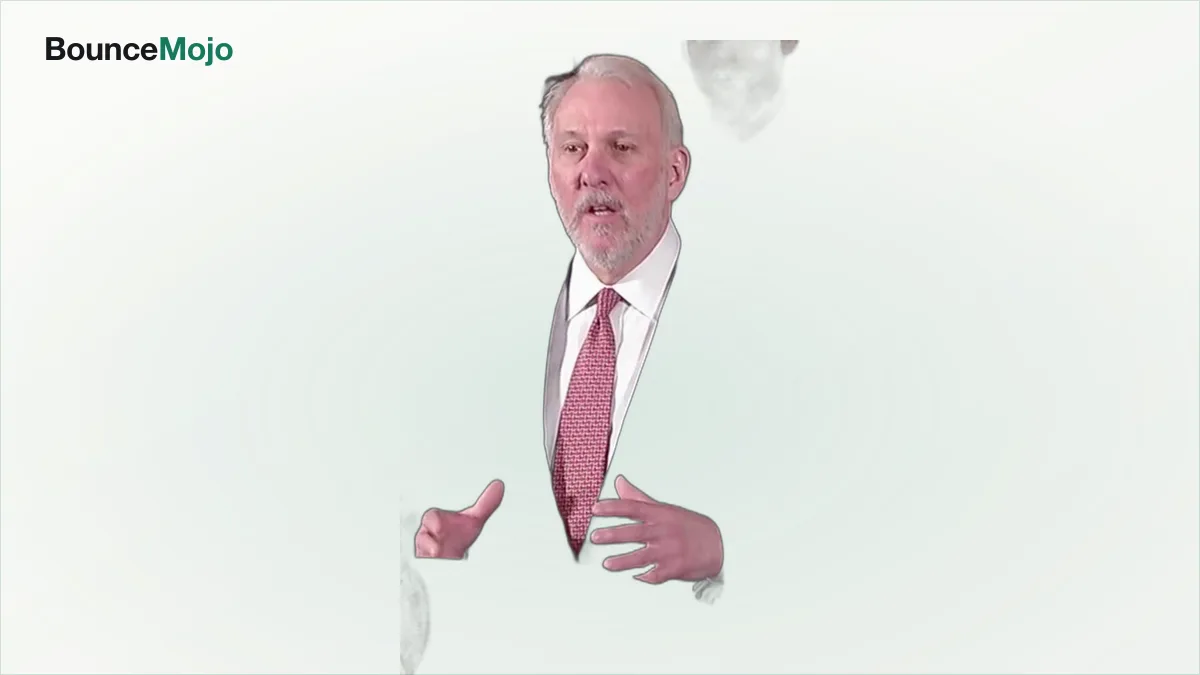
Everybody remembers the five championship banners in San Antonio. Almost nobody remembers that the man who hung them once trained as a military intelligence officer and nearly joined the CIA.
Here’s what most people miss: the discipline that made Gregg Popovich the winningest coach in NBA history wasn’t born in a gym. It was forged in the Air Force, years before he ever drew up a single play.
The Myth vs. The Reality
The myth is the scowl. Gregg Popovich, the gruff, unsmiling genius who terrifies sideline reporters and treats losing like a personal insult, engineered from birth to command a locker room. Five titles. The most wins in league history. A stare that could freeze a referee mid-whistle.
That version is real. It’s also wildly incomplete.
Here’s the truth: the “born coach” story erases the most interesting part. Popovich didn’t spend his twenties dreaming of the NBA. He spent them in an Air Force uniform, studying Soviet intelligence, touring Eastern Europe, and seriously weighing a career in espionage. Basketball was almost the road not taken.
Think about it. We love a story of a man built for one thing, because it makes his greatness feel inevitable. But that’s not what happened. Popovich was a soldier and a scholar first, a man who backed into coaching and then applied a military mind to it, and that unlikely path is exactly why his teams played with the precision of a trained unit.
Now, that path didn’t start in a gym or a war room. It started in a steel town on the shore of Lake Michigan. Which raises the question: what world produces a coach this rigid, this loyal, and this quietly brilliant?
The World That Made Gregg Popovich
To understand Popovich, you have to understand the working-class Midwest he came up in, and the immigrant grit that shaped him.
He was born on January 28, 1949, in East Chicago, Indiana, a gritty industrial city built on steel. His father was a Serbian immigrant, his mother of Croatian descent, and the household carried the values of people who had crossed an ocean and worked hard for everything. This was blue-collar America, where discipline and effort weren’t inspirational slogans. They were survival.
But the era mattered too. Popovich came of age in Cold War America, when service and self-sacrifice were expected of young men and a path through the military was a path to respect. A talented, disciplined kid could earn a place at a service academy, and that combination of brains and basketball is exactly what opened the door.
Here’s the deal: Popovich was a genuinely gifted player, good enough to captain his college team and lead it in scoring. But he was never destined for NBA stardom as an athlete. His gift was something quieter, a mind that saw structure and systems where others saw chaos.
But before any of the coaching came the uniform. And that’s where the real story of his method begins.
The Crucible: Early Life and the Climb
The environment that shaped him
Two things defined the young Gregg Popovich: a service academy and a Soviet obsession.
He earned a place at the United States Air Force Academy, where he played basketball and, in his senior year, captained the team and led it in scoring. But the court was almost secondary. He graduated in 1970 with a degree in Soviet studies, an unusual specialty that spoke to a serious, analytical mind. He learned Russian. He studied a rival superpower up close.
Then came the service. Popovich completed Air Force intelligence training, toured Eastern Europe and the Soviet Union with the U.S. Armed Forces basketball team, and briefly considered a career with the CIA. Picture it: a young officer, fluent in the language of America’s great adversary, standing at a fork between the intelligence world and a life in sport.
You might be wondering: how does a would-be spy end up drawing up basketball plays? The answer is that the two disciplines were never as far apart as they seem. Intelligence work is about preparation, patience, reading an opponent, and controlling information. Popovich would spend the next four decades applying exactly those instincts to a basketball court. He didn’t abandon his training. He redeployed it.
He chose basketball. And the choice would rewrite the sport.
The catalyst
The catalyst had a name too: Larry Brown.
After his service, Popovich took an obscure job coaching Division III basketball at Pomona-Pitzer in California, a program so small it was invisible to the basketball world. He spent years there, learning his craft in near-total anonymity, even sabbaticing for a season to work as a volunteer assistant under Larry Brown at Kansas so he could study a master up close.
Here’s the kicker: that apprenticeship paid off. When Brown took over the San Antonio Spurs, he brought Popovich with him as an assistant in 1988. It was Popovich’s entry into the NBA at last, in his late thirties, after a decade in the college wilderness. He had arrived by the slow road, and he had missed nothing along the way.
By 1994 he was the Spurs’ general manager, running the front office. Two years later, in December 1996, he made the boldest move of his career: he fired the head coach and installed himself. The critics howled. The unknown former spy had just handed himself the job.
The gamble was about to make history. But it would demand everything he had.
The Key Players
No career this long is a solo act, and Popovich was surrounded by people who shaped his path.
Start with Larry Brown, the mentor who saw something in a Division III coach and pulled him into the NBA. Brown taught Popovich the professional game and gave him the platform that everything else was built on. Their relationship was the hinge on which his whole career turned.
Then there’s David Robinson, the Hall of Fame center already in San Antonio when Popovich took over. Robinson gave the young coach a foundation to build on and the credibility to survive his rocky first season, when the team stumbled and the doubters circled.
And there’s Tim Duncan, arguably the most important player of Popovich’s life. Drafted first overall in 1997, the quiet, fundamentally perfect big man became the cornerstone of everything, five championships across nearly two decades. Popovich and Duncan formed one of the great coach-player partnerships in sports history, built on mutual respect and a shared hatred of the spotlight.
There was also R.C. Buford, the general manager who worked alongside Popovich for decades, unearthing overlooked talent like Tony Parker and Manu Ginóbili and turning the Spurs into the best-run franchise in the league.
Now: surround yourself with the right foundation and the right partners, and you can build something that lasts a generation. Popovich was about to do exactly that.
The Turning Point
The pinnacle
The pinnacle wasn’t a single night. It was a dynasty that refused to end.
The first title came in 1999, when Popovich guided the “Twin Towers” of Robinson and Duncan to the franchise’s first NBA championship. It proved the gamble had worked. But what came next is what made him a legend. He won again in 2003, then 2005, then 2007, then, most improbably of all, in 2014, when an aging Spurs team dismantled a superteam with a display of ball movement so beautiful it looked choreographed.
Five championships across three different eras of the sport. Along the way he became the winningest coach in NBA regular-season history, passing every legend who came before him, with roughly 1,390 victories. He was named Coach of the Year three times and, in a fitting capstone, coached Team USA to Olympic gold at the Tokyo Games.
Here’s the truth: he became the most accomplished coach the league had ever seen, and he did it while barely cracking a smile.
The price
Because the same relentless standard that won the titles took a toll too.
Popovich’s intensity was total. He demanded excellence every single day, in every drill, from every player, and that unyielding pressure is not easy to live inside. He carried the weight of a franchise for nearly 30 years, through injuries, roster turnover, and the constant grind of an 82-game grind that never truly stops.
The heaviest blow was personal. In 2018, his wife Erin, his partner of more than four decades, passed away, a loss that shook the famously private coach to his core. He returned to the bench, because the work was the one place he knew how to be. But the man behind the scowl had paid a real human price for the life he’d built.
He had given basketball everything for decades. The game had made him a legend. It had also asked for nearly all of him in return.
The Unvarnished Truth
Popovich is not a simple figure, and flattening him into a lovable curmudgeon does his story a disservice.
He could be brutally hard on players and openly hostile to the media, treating routine interviews with a disdain that became almost a running joke. His standards bruised egos, and not every player thrived under a coach who withheld praise as a matter of principle. The gruffness was real, and it wasn’t always endearing.
There’s also the loneliness of his kind of greatness. Being the best on earth at something as consuming as running an NBA franchise for three decades leaves little room for anything else. Popovich poured himself into the team so completely that the work became inseparable from the man.
Here’s what’s easy to miss: his greatest strength and his hardest edge were the same trait. The uncompromising demand for excellence that built a dynasty was also what made him so difficult to please. The discipline was the gift and the burden at once.
None of that dims the banners. But it does explain why the players who lasted under him revere him with something close to devotion.
Controversies and Criticisms
Popovich’s career carried real friction, and it’s worth being honest about it.
His notorious hostility toward in-game media, especially the courtside interviews he clearly detested, drew criticism as dismissive and unprofessional, even if fans found it entertaining. He treated the obligation with barely concealed contempt for decades.
More substantively, his practice of “load management,” resting healthy star players to keep them fresh for the playoffs, was genuinely controversial. In one famous case the league fined the Spurs after Popovich sent stars home before a nationally televised game. Critics argued it cheated paying fans; Popovich argued he was protecting his players. The debate reshaped how the entire league thinks about rest.
Popovich was also unusually outspoken on politics for a coach, using his platform to speak on social issues in ways that drew both admiration and anger. He never hid from the reaction. He considered speaking his mind a duty, not a risk.
So what does a life like this actually teach the rest of us? More than the win total suggests.
What We Can Learn From Gregg Popovich
Navigating hard times
Popovich’s real lesson isn’t about winning. It’s about preparation meeting patience.
He didn’t get his NBA break until his late thirties, after a decade coaching a tiny college nobody had heard of. Most people would have quit or chased shortcuts. He kept learning, kept refining, and trusted that the work would eventually find its stage. When the chance finally came, he was ready in a way that a faster rise could never have made him.
In other words: the slow road wasn’t a detour. It was the whole education.
The success blueprint
The blueprint here is about building systems that outlast talent.
Popovich never relied on any single superstar to define his teams. He built a culture, a way of playing and behaving, so durable that players fit into it rather than the other way around. Stars came and went, but the system stayed, and it kept producing winners across three completely different eras.
Want the fuller picture of how that translated into wealth? The full net worth breakdown shows how five titles and rare franchise equity built a nine-figure fortune. And to see how he ranks among the sport’s biggest coaching fortunes, the richest coaches list puts it in context.
The deeper takeaway is about loyalty. In an era of coaches hopping from job to job, Popovich proved that staying, fully committing to one place, one culture, one standard, can build something no amount of restless ambition ever could.
Which brings us to the final reckoning on the man.
Final Verdict
Gregg Popovich is going to be remembered for the wrong reason.
Most people will file him under “winningest coach in NBA history,” the scowl, the five rings, the record that may never fall. A smaller, smarter group will remember something more unlikely: a Serbian steelworker’s son who trained to fight the Cold War, backed into coaching by the slow road, and then built one of the great dynasties in sports on discipline, loyalty and a refusal to chase easy praise.
Here’s the bottom line: the titles made him famous. The way he won them, and the culture he built to do it, made him a model that coaches in every sport now study. He turned a military mind into a basketball philosophy and stayed loyal to one city for nearly 30 years.
He is the winningest coach the league has ever seen. He is also proof that the least likely path, taken with total discipline, can lead somewhere no shortcut ever will. And in the long run, that patient, unglamorous version of greatness is the one worth remembering.
Shop Gregg Popovich on Amazon
Books, audiobooks, merch and more, handpicked for fans.
As an Amazon Associate we earn from qualifying purchases.
Frequently Asked Questions
Where did Gregg Popovich grow up?+
Popovich grew up in East Chicago, Indiana, the son of immigrant parents, a Serbian father and a Croatian mother. He starred in basketball at Merrillville High School before earning a place at the United States Air Force Academy.
Did Gregg Popovich serve in the military?+
Yes. Popovich graduated from the Air Force Academy in 1970 with a degree in Soviet studies, completed intelligence training, and served five years of active duty, touring Eastern Europe and the Soviet Union with the U.S. Armed Forces basketball team.
How did Gregg Popovich get into NBA coaching?+
After coaching Division III Pomona-Pitzer for years and a season studying under Larry Brown at Kansas, Popovich joined the San Antonio Spurs as Brown's assistant in 1988, later becoming general manager and then head coach in 1996.
How many championships did Gregg Popovich win?+
Popovich won five NBA championships as Spurs head coach (1999, 2003, 2005, 2007 and 2014) and later coached Team USA to an Olympic gold medal at the Tokyo Games.
Why did Gregg Popovich stop coaching?+
Popovich suffered a stroke in November 2024 and, after a period away from the bench, stepped down as head coach in May 2025. He remains the Spurs' president of basketball operations.
Want the money side of the story?
Read Gregg Popovich's Full Net Worth Breakdown →Shop Gregg Popovich on Amazon
Books, audiobooks, merch and more, handpicked for fans.
As an Amazon Associate we earn from qualifying purchases.