Sting Biography: The Silent Icon Who Never Sold Out
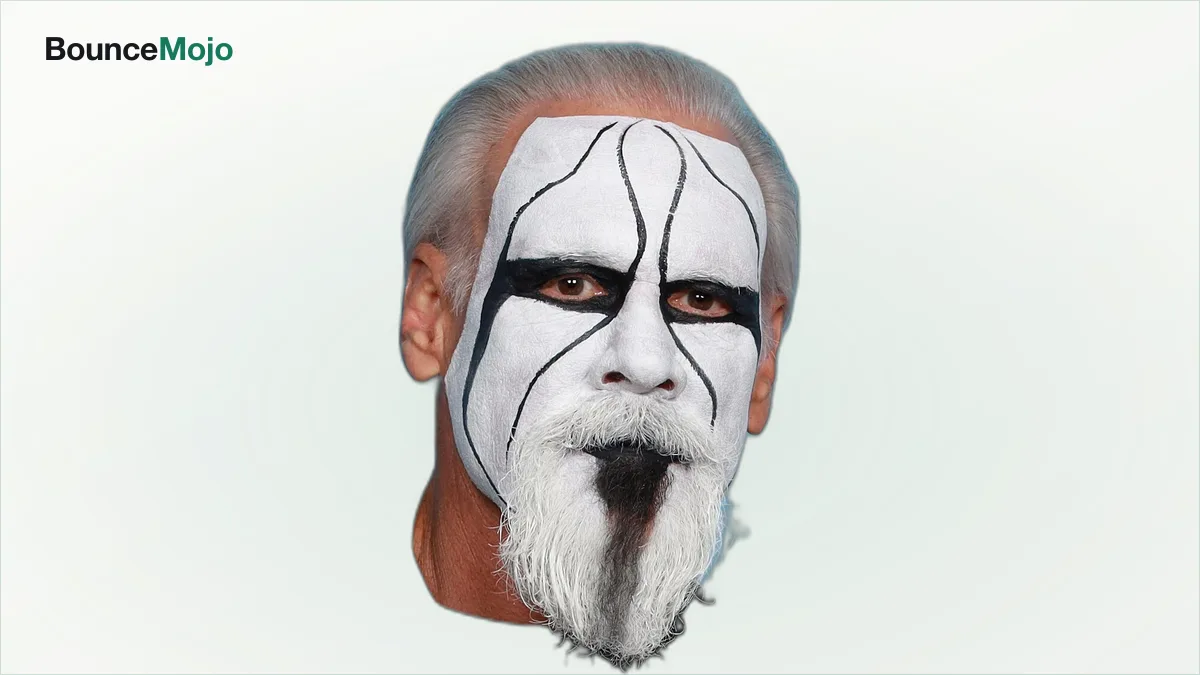
Everybody remembers the man in the rafters. Almost nobody remembers he started as a musclebound beach kid in neon.
Here’s what most people miss: the most valuable thing Sting ever did was refuse the biggest offer in the business.
The Myth vs. The Reality
The myth is a lone figure in black and white, descending from the rafters with a baseball bat, saying nothing. Cool, mysterious, untouchable. The “Crow” Sting is one of the most iconic images wrestling ever produced.
That version is real. It is also the second half of the story.
Here’s the truth: before the silence, Sting was the loudest, most colorful babyface in the sport. A blond, face-painted ball of energy in fluorescent tights, high-fiving kids and howling to the crowd. The brooding icon everyone remembers was a total reinvention of a man who had already been a superstar for a decade.
You might be wondering: why does that matter? Because it tells you who Steve Borden actually is. Not a natural loner. A performer smart enough to blow up his own successful character and rebuild it when the business changed. Most stars cling to what worked. He torched it.
But to understand why he had the nerve to reinvent himself, you have to understand where he came from, and it wasn’t a wrestling family.
The World That Made Sting
Sting arrived on March 20, 1959, in Omaha, Nebraska, and grew up in Southern California in an era before wrestling was a national television juggernaut.
This matters. The 1980s wrestling boom, the Hulk Hogan explosion, hadn’t happened yet when young Steve Borden was coming up. His world was Southern California gym culture, the golden age of bodybuilding, muscle beaches and iron temples. Borden went all in on that world, training seriously and eventually co-owning a Gold’s Gym health club. Wrestling wasn’t even on his radar.
Think about it: the man who became one of the most loyal figures in wrestling history didn’t grow up dreaming about it. He fell into it sideways, as a jacked gym owner looking for what came next.
Now: that outsider path shaped everything. Because he came to wrestling as a grown man with a life already built, he never treated it as his only option. And that quiet independence would define the biggest decisions of his career.
Which brings us to the night that started it all.
The Crucible: Early Life and the Climb
The environment that shaped him
Steve Borden was an athlete before he was a wrestler. He played football and basketball in high school, then poured himself into bodybuilding as a young adult.
The turning point was almost accidental. A friend took Borden to a live WWF event in Los Angeles, a card stacked with Hulk Hogan, the Iron Sheik, André the Giant, and the British Bulldogs. He had no television access to wrestling in his community and no real interest going in. He walked out electrified. The spectacle, the size, the reaction of the crowd, it hit him like a revelation.
Here’s the deal: that single night rewired a man who already had a career. He decided to become a wrestler in his mid-20s, older than most who break in.
He started in 1985 as “Flash,” part of a muscle-heavy tag unit. Soon he paired with another gym rat named Jim Hellwig. The two of them, raw and enormous, formed the Blade Runners. Borden became “Sting.” Hellwig would later explode into fame as the Ultimate Warrior.
The catalyst
The catalyst for Sting’s rise came in the National Wrestling Alliance and the Jim Crockett Promotions territory that became WCW.
He was young, athletic, charismatic, and impossibly likable. And in 1988, he got the opportunity that made him: a marathon 45-minute draw against the great Ric Flair for the world title at the first Clash of the Champions. He went the distance with the best in the business and announced himself as a franchise player.
You might be wondering: what separates a good hand from a franchise? In Sting’s case, it was that Flair match. It made him a made man, and WCW built its house around him for the next decade.
But the higher he climbed, the more one relationship curdled, and the more the wider business tried to pull him away.
The Key Players
No wrestling life is a solo act, and Sting’s is stacked with defining figures.
Start with Ric Flair. If Sting had one dance partner across his entire career, it was the Nature Boy. Their rivalry ran for years and produced many of WCW’s biggest moments. Flair was the villain who made Sting a hero, and the standard against which he measured himself.
Then there’s the Ultimate Warrior, his original tag partner. The two broke in together as the Blade Runners, but their paths and personalities diverged violently once Warrior became a WWF megastar. Their relationship famously soured into estrangement, a reminder that the people who start alongside you don’t always finish there.
There was Hulk Hogan, too, who arrived in WCW in 1994 and reshaped the company. Hogan’s presence, and later his heel turn as the leader of the nWo, set up the storyline that produced Sting’s greatest reinvention.
And later in life came Darby Allin, the young, fearless AEW star who became Sting’s tag partner and protégé in his final run. Allin gave the aging icon a perfect foil for a dignified last chapter.
Now: with the nWo taking over WCW, Sting faced a choice. Stay the same colorful hero and get swept aside, or become something entirely new. What he did next is the reason anyone remembers him at all.
The Turning Point
The pinnacle
In 1996, Sting disappeared into the rafters.
As the nWo tore WCW apart, Sting stopped talking. He traded the bright colors for a black trench coat and stark black-and-white face paint, borrowing the look of the film “The Crow.” He hovered above the arena, silent, watching, refusing to pick a side. For more than a year, WCW milked the mystery.
It was a masterstroke. The payoff came at Starrcade 1997 against Hogan in the most anticipated match in company history. The “Crow” Sting became the emotional center of WCW’s hottest period, the fan favorite who represented everyone the nWo had wronged.
Here’s the truth: he was already a legend before 1996. The reinvention made him immortal.
The price
But there was a cost hidden inside all that loyalty.
Sting stayed with WCW its entire life, refusing the WWF’s overtures even when the money and the spotlight were bigger up north. When WCW collapsed in 2001, the industry’s marquee holdout suddenly had no marquee to hold out for. While former rivals had spent years building WWF brand equity, Sting had bet everything on a company that no longer existed.
He spent the 2000s as the biggest star in TNA, a strong second-tier promotion, rather than the global juggernaut. And he didn’t set foot in a WWE ring until 2014, deep into his 50s, long past his physical prime. The loyalty that made him a WCW god also cost him the one stage that could have made him a mainstream household name.
It gets more human than that, though. Because behind the icon was a man who nearly lost himself.
The Unvarnished Truth
Sting is not a plaster saint, and he has never pretended to be.
By his own account, the pressures of stardom pushed him into a period of heavy drinking and drug use during the peak WCW years. He has spoken openly about a marriage strained to breaking and a lifestyle spinning out of control at the exact moment he looked most invincible on television.
Here’s what’s easy to miss: the “Crow” character, silent and isolated, mirrored a real isolation he was living through. The rafters weren’t just a gimmick. They matched a man who felt genuinely lost.
The turnaround came in August 1998, when Borden became a born-again Christian. He got sober, repaired his family life, and refocused around faith. From then on, he was famously one of the more grounded, drama-free figures in a chaotic business.
That faith also created its own quiet tension. Sting sometimes turned down angles or content that conflicted with his beliefs, occasionally limiting what promoters could do with him. It didn’t derail his career, but it made him a different kind of star, one who put personal conviction ahead of maximum exposure.
None of that stopped the questions from following him, and some of them stuck for years.
Controversies and Criticisms
For a man with remarkably little scandal, Sting still drew his share of debate.
The loudest criticism is the road not taken. For decades, fans and pundits argued about how big Sting could have been if he’d jumped to the WWF at his peak. Some framed his loyalty as noble. Others called it a career-limiting mistake that kept the sport’s best-kept secret from becoming a true global icon. He remains the biggest star of his era who spent almost none of his prime in the industry’s dominant company.
There’s the estrangement from the Ultimate Warrior, too, a falling out between the two Blade Runners that never fully healed and became part of wrestling lore.
And late in his career, some questioned whether a man past 60 belonged in the ring at all, especially after a scary neck injury during his brief 2015 WWE run against Seth Rollins. Sting answered that himself with a healthy, celebrated AEW farewell, but the “how long is too long” debate trailed him to the end.
So what does a career this stubborn and this principled actually teach the rest of us? Quite a lot.
What We Can Learn From Sting
Navigating hard times
Sting’s story is a blueprint for reinvention under pressure.
When the business changed and the nWo threatened to make him irrelevant, he didn’t dig in and defend his old character. He blew it up. He accepted that the version of him that worked in 1990 wouldn’t work in 1997, and he built something new. Reinvention is scary precisely because the old thing is still working. Sting did it anyway, and it saved him.
In other words: the moment your winning formula starts to age, the brave move is to change it before it fails, not after.
The success blueprint
The financial lesson is quieter but just as valuable. Sting never had the crossover fame of the richest wrestlers, yet he built and, crucially, kept an eight-figure fortune.
He did it by living below his means, avoiding the ruinous excess that wrecked so many peers, and treating each promotion as an addition rather than a bet-the-house gamble. The full net worth breakdown shows how loyalty and discipline compounded into lasting wealth, and the richest wrestlers list shows exactly where that puts him.
The deeper takeaway is about identity over exposure. Sting turned down the biggest stage to stay true to a company and, later, to a faith. He chose meaning over maximum fame. Most people spend their lives doing the opposite.
Which brings us to the final word on the man in the rafters.
Final Verdict
Sting is going to be remembered as the loyal one, and that’s exactly right.
He was the franchise player who wouldn’t leave, the colorful hero who reinvented himself into a silent icon, the sober family man in a business that chewed people up. He never became the global crossover star some thought he could be. He became something rarer instead: a legend who did it his own way and walked away whole, healthy, and at peace, wrestling a dignified final run into his 60s.
Here’s the bottom line: the paint, the bat, the rafters, all of it was theater. The real story is a gym owner who stumbled into wrestling in his mid-20s, gave one company his entire prime, nearly lost himself to the lifestyle, found his footing, and built a fortune and a family that outlasted the spotlight.
He never sold out. And in a business built on selling, that turned out to be the most valuable thing he owned.
Shop Sting on Amazon
Books, audiobooks, merch and more, handpicked for fans.
As an Amazon Associate we earn from qualifying purchases.
Frequently Asked Questions
What is Sting's real name?+
Sting's real name is Steve Borden, born March 20, 1959, in Omaha, Nebraska, and raised in Southern California.
How did Sting get into wrestling?+
A bodybuilder who co-owned a Gold's Gym, Borden had no interest in wrestling until a friend took him to a live WWF card in Los Angeles. Watching Hulk Hogan and André the Giant convinced him to try the business himself.
Why did Sting change his look in 1996?+
Sting swapped his colorful 'Surfer' persona for the silent, brooding 'Crow' character who watched from the rafters. The reinvention revived his career and became one of wrestling's most iconic images.
Did Sting ever wrestle for WWE?+
Yes. After being the face of WCW for years, Sting held out from the WWF for his entire prime and only signed with WWE in 2014, later entering the Hall of Fame in 2016.
When did Sting retire?+
Sting retired from in-ring competition in 2024 after a final run in AEW, tagging with Darby Allin and going out victorious in his mid-60s.
Want the money side of the story?
Read Sting's Full Net Worth Breakdown →Shop Sting on Amazon
Books, audiobooks, merch and more, handpicked for fans.
As an Amazon Associate we earn from qualifying purchases.