Samuel Eto'o Biography: The Cameroon Kid Who Conquered Europe
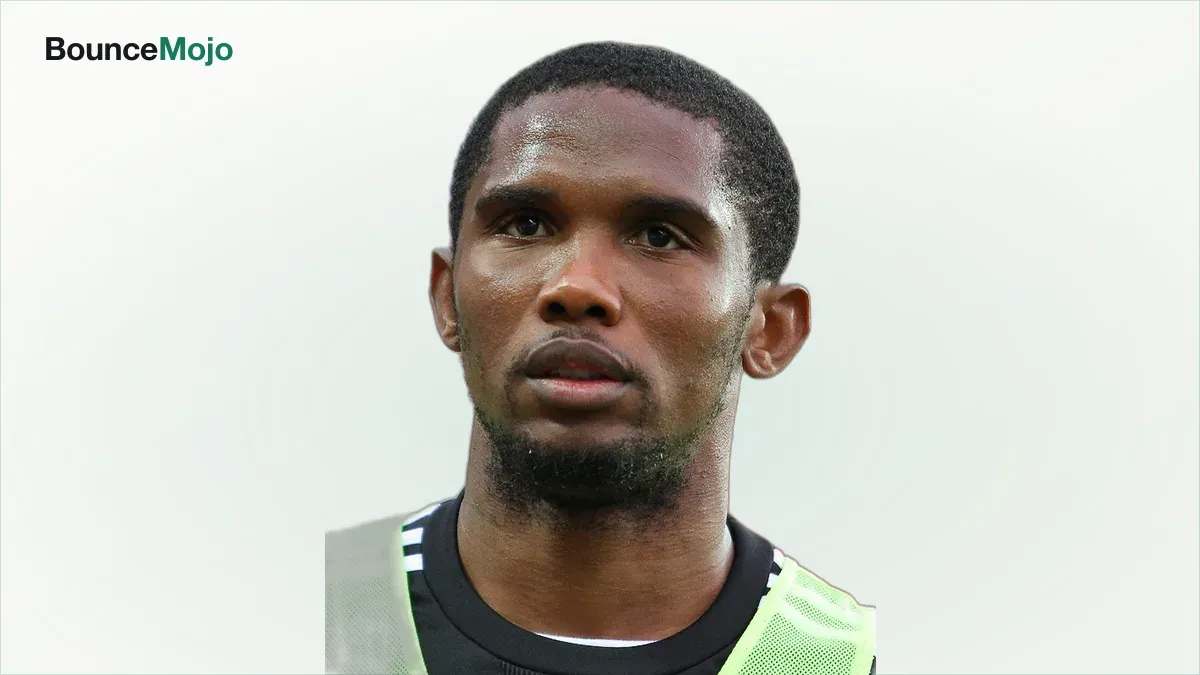
Most people know Samuel Eto’o as a goal machine, the fearless striker who tormented Europe’s best defenders for over a decade. That’s true. But it barely scratches the surface.
Here’s what most people miss: the kid from Douala who left home with almost nothing became not just Africa’s greatest footballer, but a man powerful enough to run the entire game in his country.
The Myth vs. The Reality
The myth is a highlight reel. Samuel Eto’o: pure goalscorer, all instinct and finishing, a striker who simply scored because that’s what strikers do.
The reality is a fighter’s story.
Here’s the deal: Eto’o’s goals were never the whole picture. He was a competitor with a chip on his shoulder the size of a continent, a man who felt he had to prove not just himself but that an African striker could stand at the very top of the European game. Every finish carried that weight. Every trophy was an argument.
And the “just a scorer” framing misses his intelligence and ambition off the pitch. Eto’o was always thinking beyond the next goal, toward business, toward influence, toward power in the sport itself. The federation presidency wasn’t a surprise ending. It was where he was always heading.
You might be wondering: how does a boy from Douala end up conquering Europe and then ruling his country’s football? To understand that, you have to understand where he came from.
The World That Made Samuel Eto’o
Eto’o was born in 1981 in Douala, Cameroon, in a country where football was everything and opportunity was scarce.
Cameroon had a proud football tradition, its national team, the Indomitable Lions, had lit up the 1990 World Cup, but the path from a Cameroonian childhood to European stardom was brutally narrow. For every kid who made it, thousands didn’t. Talent alone wasn’t enough. You needed relentless drive, a bit of luck, and the courage to leave everything behind young.
Now: that environment bred a particular kind of player. Eto’o grew up understanding that nothing would be handed to him, that he’d have to be twice as good and twice as determined to be noticed. African players of his era often felt underrated and underpaid compared with European and South American stars, and that sense of injustice sharpened Eto’o’s edge into something formidable.
That backdrop shaped his whole identity, a champion who represented not just himself but a continent that felt overlooked. And his journey out began with one of the biggest clubs in the world.
The Crucible: Early Life and the Climb
The Environment That Shaped Him
Eto’o’s talent was obvious early, and it carried him from Cameroon to Europe as a teenager. Real Madrid, the biggest club on earth, brought him into their system.
But there was no easy path even then. Blocked from the star-studded Madrid first team, Eto’o was loaned out repeatedly to gain experience, bouncing between clubs, learning Spanish football the hard way. It would have broken many young players, far from home, struggling for a foothold, watching from the fringes.
Here’s the truth: those years of frustration made him. The rejection, the loans, the sense of being overlooked at a giant club fed the hunger that would define him. Eto’o didn’t wilt. He got angrier, and better.
His breakthrough came at Mallorca, where he finally got regular football and exploded, scoring goals that made the rest of Europe take notice. The kid Madrid couldn’t fit in was becoming a star they’d let go.
The Catalyst
The move that changed everything was Barcelona in 2004.
At Barcelona, Eto’o became world-class. He formed a devastating attack alongside Ronaldinho and a young Lionel Messi, scoring prolifically and winning back-to-back La Liga titles and the 2006 Champions League, in whose final he scored. He was named African Footballer of the Year again and again, cementing his place as the continent’s finest.
It gets better: he didn’t stop there. A move to Inter Milan led to the 2010 treble under Jose Mourinho, with Eto’o even sacrificing his natural role for the team’s defensive shape. Another Champions League, at a second club, in the same city where he’d been rejected years earlier at a rival giant. The proof was complete.
That success set up the most lucrative move of his life. But no career like this is built alone, and Eto’o’s story is full of the people who shaped and challenged him.
The Key Players
No champion rises without a cast around them, and Eto’o’s is a vivid one.
Ronaldinho. At Barcelona, the Brazilian magician was the creative heart of the team and a friend, feeding Eto’o chances and sharing in the club’s revival. Their partnership defined an era at the Camp Nou.
Lionel Messi. Eto’o played alongside a teenage Messi as the Argentine emerged into greatness. The striker witnessed, up close, the birth of a generational talent, and held his own in an attack that was becoming the best in the world.
Jose Mourinho. At Inter, the charismatic manager got the very best out of Eto’o, convincing a proud goalscorer to work selflessly for the team. The result was a historic treble and a second Champions League medal.
The Cameroon national team. Eto’o’s relationship with his country was intense and sometimes stormy. He carried the Indomitable Lions for years, an Olympic gold medalist and Africa Cup of Nations winner, but clashed at times with officials, a foreshadowing of the political battles to come.
Think about it: every one of these relationships pushed Eto’o higher, or tested his will. Both made him who he is. And the peak of that journey brought a fortune to match the fame.
The Turning Point
The Pinnacle
Eto’o’s peak was staggering: three Champions League titles, two with Barcelona and one with Inter, and a record four African Footballer of the Year awards.
He scored in two Champions League finals, won league titles in Spain and Italy, and stood, for years, as the undisputed greatest African player of his time. Few strikers of any nationality can match that trophy haul at the very top of European football.
Then came the move that shocked the football world. In 2011, Eto’o joined Anzhi Makhachkala in Russia for a contract reportedly worth around 20 million euros a year, making him one of the highest-paid footballers on the planet. As his own net worth story explains, that decision, cashing in at his commercial peak, did enormous work in building the fortune that ranks him among the richest soccer players in the world.
The Price
Here’s the kicker: the Anzhi move drew as much criticism as admiration.
Some accused Eto’o of chasing money over glory, of stepping away from the elite European stage for a Russian project that ultimately collapsed. The scrutiny was relentless, and the club’s financial troubles meant the fairy tale ended messily. Eto’o defended his choice fiercely, but the “mercenary” label stuck for some observers.
There was a deeper cost too. Eto’o’s career became increasingly nomadic in its later years, Chelsea, Everton, Turkey, Qatar, a legend chasing the last drops of a great career across the globe. The wandering paid financially. But it lacked the settled glory of his prime.
The Unvarnished Truth
Eto’o is a complicated, combative figure, and his career was rarely free of conflict.
He clashed with teammates, coaches, officials and journalists over the years, never shy about voicing his opinion or defending his interests. His relationship with the Cameroon federation was famously turbulent long before he ran it, marked by disputes over bonuses, treatment and respect for the players.
Now: none of that makes him a villain. Much of his combativeness came from a genuine sense of injustice, the feeling that African players were undervalued and disrespected, that he had to fight for what European and South American stars received more easily. That fight, sometimes ugly, was often justified.
But it’s an honest part of the picture. Eto’o is proud, stubborn and confrontational, qualities that made him a ferocious competitor and, at times, a difficult colleague. He has never pretended otherwise.
Controversies and Criticisms
Eto’o’s post-playing life has been at least as eventful as his career.
The Anzhi criticism. His record Russian contract drew accusations of selling out, a charge Eto’o rejected forcefully, arguing he’d earned the right to maximize his short career.
Player revolts. Eto’o was involved in several disputes and near-strikes with the Cameroon national team over pay and conditions, positioning himself as a leader willing to fight the federation, the very body he’d later lead.
The FECAFOOT presidency. Since winning the presidency in 2021, Eto’o’s tenure has been marked by controversy, including allegations of interference, conflicts of interest and public clashes. Running Cameroonian football has proven every bit as combustible as playing for the country.
Legal and financial matters. Like many high-earning players of his era, Eto’o faced tax-related legal issues in Spain, resolving a case tied to his image-rights income. It was a reminder of how complex the finances of a global star can become.
None of it has erased his standing as an icon. If anything, the willingness to fight, on the pitch and off, is central to who Eto’o is.
What We Can Learn From Samuel Eto’o
Navigating Hard Times
The lesson from Eto’o’s climb is that rejection can be rocket fuel. Cast aside at Real Madrid, loaned around, overlooked, he could have faded. Instead he used the slights as motivation, returning to haunt the giants who doubted him.
Here’s the truth: how you respond to being underestimated often matters more than the talent itself. Eto’o turned every doubt into a reason to prove himself, and that engine drove him to the very top.
The Success Blueprint
If you want the replicable part, it’s ambition without ceilings. Eto’o refused to accept that an African striker couldn’t be the best in the world, or that a footballer couldn’t become a power broker after retirement. He kept setting bigger goals.
That mindset, backing yourself completely and maximizing every peak, placed a Cameroonian kid in the same conversation as the game’s biggest names, from goal-scoring giants like Cristiano Ronaldo to modern stars like Kylian Mbappe. The lesson isn’t “be a striker.” It’s “refuse the limits other people set for you, then cash in when your moment comes.”
Becoming Better
The deepest lesson is about representation and legacy. Eto’o always understood he was playing for more than himself, for Cameroon, for Africa, for every kid told the path was too narrow. That sense of purpose gave his career meaning beyond trophies and money.
In other words, greatness that lifts others outlasts greatness that serves only yourself. Whatever the controversies, Eto’o opened doors and raised expectations for a whole continent, a legacy far bigger than any single goal.
Final Verdict
Samuel Eto’o is one of football’s most remarkable figures: arguably the greatest African player ever, a three-time Champions League winner, a record earner, and now a power broker running his country’s game.
And here’s the twist that reframes everything: the “pure goalscorer” was always a fighter and a strategist, a man who saw football as a battle for respect, money and power, and won on all three fronts. The goals were the weapon. The real war was proving that a kid from Douala belonged at the very top, and staying there long after the boots came off.
The full financial side of that fight, the record wages, the endorsements, the federation power, lives in his net worth breakdown. Read it if you want to understand how the most determined striker of his generation turned a game into an empire, and never once accepted the limits the world tried to set for him.
Shop Samuel Eto'o on Amazon
Books, audiobooks, merch and more, handpicked for fans.
As an Amazon Associate we earn from qualifying purchases.
Frequently Asked Questions
Where is Samuel Eto'o from?+
Samuel Eto'o was born on March 10, 1981, in Douala, Cameroon, and grew up in the country before leaving as a teenager to chase a professional career in Europe.
What clubs did Samuel Eto'o play for?+
Eto'o starred for Mallorca, Barcelona and Inter Milan, winning multiple Champions League titles, before big-money moves to Anzhi Makhachkala, Chelsea, Everton and clubs in Turkey and Qatar.
How many African Player of the Year awards did Samuel Eto'o win?+
Eto'o won the African Footballer of the Year award four times, a record that helped cement his reputation as arguably the greatest African player in history.
Did Samuel Eto'o win the Champions League?+
Yes. Eto'o won the Champions League three times, twice with Barcelona and once with Inter Milan as part of Jose Mourinho's 2010 treble-winning side, scoring in two finals.
What is Samuel Eto'o doing now?+
Since 2021, Eto'o has served as president of the Cameroonian Football Federation (FECAFOOT), a powerful and often turbulent role at the head of his country's game.
Want the money side of the story?
Read Samuel Eto'o's Full Net Worth Breakdown →Shop Samuel Eto'o on Amazon
Books, audiobooks, merch and more, handpicked for fans.
As an Amazon Associate we earn from qualifying purchases.