Ryan Howard Biography: The Late Bloomer Who Became The Big Piece
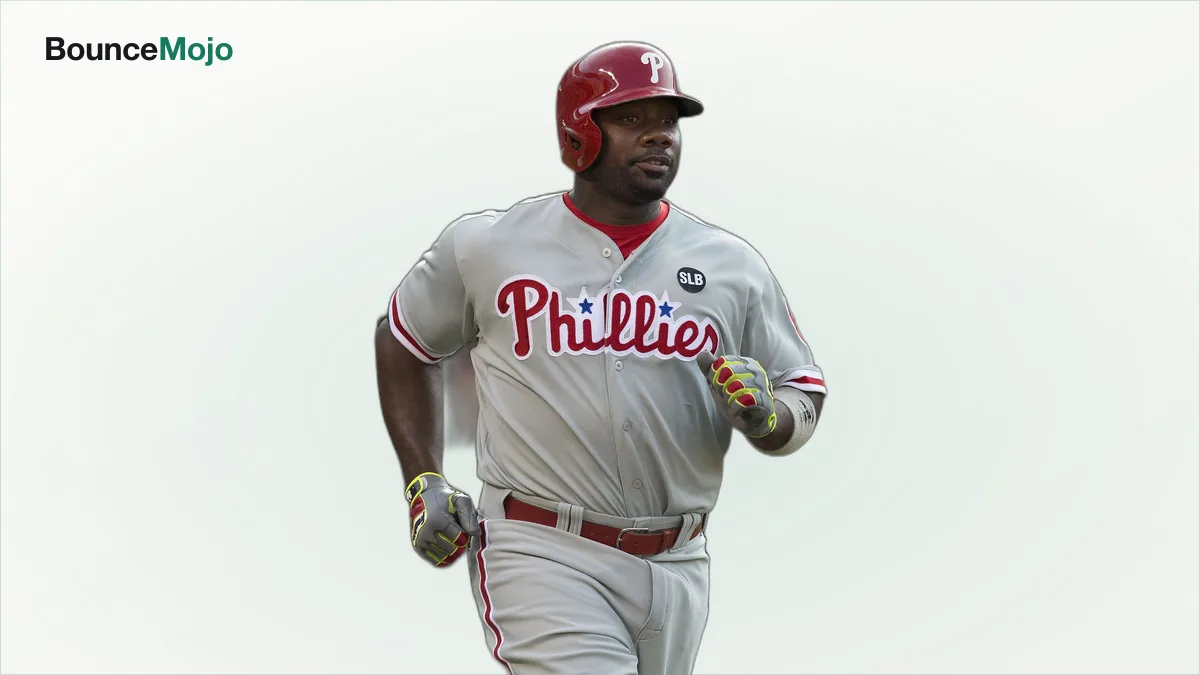
Everybody in Philadelphia knows Ryan Howard as The Big Piece. Almost nobody remembers how long the sport made him wait to become it.
Here’s what most people miss: one of the most explosive power hitters of his era was, for years, a blocked prospect stuck behind a star, wondering if his chance would ever come.
The Myth vs. The Reality
The myth is thunder. Ryan Howard, a towering left-handed slugger, launching home runs into the Philadelphia night, the fearsome centerpiece of a championship team.
That version is real. It just skips the wait.
Here’s the truth: the explosive star who seemed to arrive fully formed was actually a late bloomer, a prospect so thoroughly blocked in the minor leagues that his career nearly stalled before it started. The overnight sensation spent years being overlooked. His power was never the question. His opportunity was.
Think about it: the man Philadelphia came to worship as its indispensable slugger, “The Big Piece,” was once a redundant piece, stuck behind an established All-Star with nowhere to play. The story of Ryan Howard is really the story of what happens when a delayed chance finally arrives.
Now, that patience and that power both came from somewhere specific. So where did Ryan Howard come from?
The World That Made Ryan Howard
To understand Howard, you have to picture a St. Louis household where the mind mattered as much as the muscle.
He was born on November 19, 1979, in St. Louis, Missouri, one of five children in a tight-knit, education-focused family. His father worked as an engineer at IBM, and that detail matters more than it first appears. Howard grew up around technology, discipline, and the value of a sharp mind, the seeds of the businessman he’d later become.
This wasn’t a family that treated sports as the only path. Academics were serious business in the Howard home. Baseball was a passion, but so was doing things the right way, with intelligence and structure.
The game Howard would enter in the 2000s was also entering the analytics era, a sport increasingly obsessed with measurable power and on-base skills, exactly the profile he fit.
But here’s the kicker: the smart, powerful kid from St. Louis would have to be more patient than almost any future star, because the road to the majors ran straight into a roadblock. And that’s where the real climb begins.
The Crucible: Early Life and the Climb
The environment that shaped him
Howard’s environment prized both the bat and the brain.
He attended Lafayette High School in the St. Louis suburbs, then went to Southwest Missouri State University, where he set school and conference home-run records. He wasn’t a flashy prospect ranked at the top of every list. He was a big, powerful hitter who simply produced, wherever he played.
That grounded upbringing, five kids, an engineer father, a focus on doing things well, built a player who was patient and level-headed. Those traits would be tested almost immediately in pro ball.
You might be wondering: if he hit so well, why the wait? Because the Philadelphia Phillies, who drafted him in 2001, already had a superstar at his position.
The catalyst
The catalyst, and the obstacle, was Jim Thome.
Howard tore through the minor leagues, putting up video-game power numbers. But the Phillies’ first-base job belonged to Thome, a beloved All-Star slugger. There was simply no room. Howard kept mashing in the minors while the big-league door stayed shut, a frustrating limbo for a player clearly ready.
Here’s the deal: when Thome got hurt and was eventually traded, the door finally opened, and Howard kicked it off the hinges. He didn’t just seize the chance. He obliterated it.
And what came next made the long wait look almost worth it.
The Key Players
No story this big is a solo act, and Howard’s is anchored by a golden-era Phillies core.
Start with Jim Thome, the obstacle who became a mentor of sorts. Thome blocked Howard’s path, but he was also a gracious veteran, and his eventual departure created the opening Howard needed. The two are forever linked in Phillies history.
Then there’s Charlie Manuel, the folksy manager who gave Howard his nickname and believed in his bat. Manuel guided the Phillies to their championship and trusted Howard as the heart of the lineup. It was Manuel who called him “The Big Piece.”
And there was the core: Chase Utley, Jimmy Rollins, and Cole Hamels, teammates who formed the backbone of the Phillies’ most successful era in a generation. Howard’s power, paired with Utley and Rollins up the middle and Hamels on the mound, built a champion.
Now: with a supporting cast like that, the peak was electric. But the same career carried a cost that arrived all at once.
The Turning Point
The pinnacle
The pinnacle came fast and bright.
After winning the 2005 NL Rookie of the Year, Howard exploded in 2006, hitting 58 home runs and winning the National League MVP. He became one of the most feared power hitters in baseball, the kind of slugger opposing managers game-planned around. He earned a five-year, $125 million extension that locked in his fortune.
The crowning moment came in 2008, when the Phillies won the World Series. Howard, “The Big Piece,” was the centerpiece of a champion, cementing himself as a Philadelphia legend.
Here’s the truth: for a stretch in the mid-to-late 2000s, few hitters on Earth were more dangerous.
The price
But the price came in a single, cruel instant.
In 2011, on the final play of a playoff loss, Howard ruptured his Achilles tendon running to first base. It was a devastating injury, and it effectively marked the end of his prime. He was never the same explosive force afterward, battling to return while his production faded.
The back half of his career became a difficult, often frustrating stretch, a great slugger diminished by his body, playing out a big contract under the weight of expectations he could no longer fully meet. The wait to reach the majors had cost him years on the front end; the Achilles cost him the back end.
It gets more human, though. Because the decline exposed the ordinary vulnerability behind the superstar.
The Unvarnished Truth
Howard’s career carried real flaws, and the champion’s glow sometimes hid them.
Even at his peak, Howard struck out at a very high rate and struggled against left-handed pitching, the trade-offs for his enormous power. Analysts debated whether his gaudy home-run and RBI totals overstated his overall value. It was a fair, if uncomfortable, critique of a beloved slugger.
His large contract also became a burden after the Achilles injury. As his production dropped, the deal that once celebrated him turned into a symbol of decline, a hard thing for any proud competitor to carry publicly.
Here’s what’s easy to miss: Howard handled the decline with grace. He never made excuses, kept working to return, and eventually walked away with his dignity intact, then reinvented himself entirely.
None of that spared him criticism, though.
Controversies and Criticisms
Howard’s career is low on scandal but not on debate.
The loudest criticism is analytical: that his peak value was overrated, propped up by home runs and RBIs in an era that increasingly favored on-base skills and defense. Sabermetric-minded fans argued his massive contract was an overpay even before the injury. It’s a legitimate, if bloodless, critique.
There was also a defamation lawsuit Howard filed over a report that named him in connection with a performance-enhancing drug distributor, a claim he strongly denied and pursued in court. It was a rare public dispute for an otherwise low-drama star.
And the contract itself remains a case study in the risk of long deals for aging sluggers, a cautionary tale teams still cite. Howard, through no fault of his character, became the face of that lesson.
So what does a career like this actually teach? Quite a bit.
What We Can Learn From Ryan Howard
Navigating hard times
Howard’s life is a lesson in patience and reinvention.
He waited years for a chance the sport kept denying him, then made the most of it. When injury ended his prime, he didn’t cling to the past. He built an entirely new career. The lesson isn’t just to be patient. It’s that a closed door and a lost prime are both survivable if you keep preparing for the next opening.
In other words: your first career doesn’t have to be your only one. Howard proved it.
The success blueprint
The blueprint here is about turning fame and capital into a second act.
Howard leveraged his championship profile, his earnings, and his family’s technology roots into a career as a venture investor, backing startups and building wealth far from the diamond. Want the fuller money picture? The full net worth breakdown shows how a slugger became an investor. And to see where he ranks, the richest baseball players list puts it in context.
The deeper takeaway is about identity. Howard refused to be defined only by baseball. He treated his playing career as the seed capital for a whole new life, exactly the kind of forward thinking his engineer father modeled.
Which brings us to the final word.
Final Verdict
Ryan Howard will be remembered as The Big Piece, and that’s exactly right, with a twist.
Most people will file him under “big power hitter, 2008 champion” and move on. The fuller story is a smart, patient St. Louis kid who waited years behind an All-Star for a chance, exploded when he finally got it, carried a franchise to a title, lost his prime to a single brutal injury, and then reinvented himself as a technology investor.
Here’s the bottom line: the 58-homer MVP season and the World Series ring are huge, and they still don’t capture him. The point is the arc. Howard was overlooked, then indispensable, then diminished, then reborn as something new entirely.
He didn’t just hit home runs for Philadelphia. He became the piece the whole thing was built around, then built something else once the game was done. And that’s the version worth remembering.
Shop Ryan Howard on Amazon
Books, audiobooks, merch and more, handpicked for fans.
As an Amazon Associate we earn from qualifying purchases.
Frequently Asked Questions
Where did Ryan Howard grow up?+
Howard grew up in St. Louis, Missouri, one of five children in a close, education-focused family. His father worked as an IBM engineer, shaping Ryan's later interest in technology.
Why was Ryan Howard called 'The Big Piece'?+
Manager Charlie Manuel nicknamed him 'The Big Piece' because Howard was the central, indispensable slugger of the Phillies' championship-era lineup.
What was Ryan Howard's biggest achievement?+
Howard won the 2005 NL Rookie of the Year, the 2006 NL MVP, and helped the Phillies win the 2008 World Series, becoming a Philadelphia legend.
Why did Ryan Howard reach the majors late?+
Howard was blocked in the minors by All-Star first baseman Jim Thome, forcing him to wait for his chance despite dominating minor-league pitching.
What does Ryan Howard do now?+
Howard became a venture capital and technology investor after retiring, co-founding SLAM Ventures, returning in part to his family's technology roots.
Want the money side of the story?
Read Ryan Howard's Full Net Worth Breakdown →Shop Ryan Howard on Amazon
Books, audiobooks, merch and more, handpicked for fans.
As an Amazon Associate we earn from qualifying purchases.