Robbie Lawler Biography: The Prodigy Who Became a Legend Twice
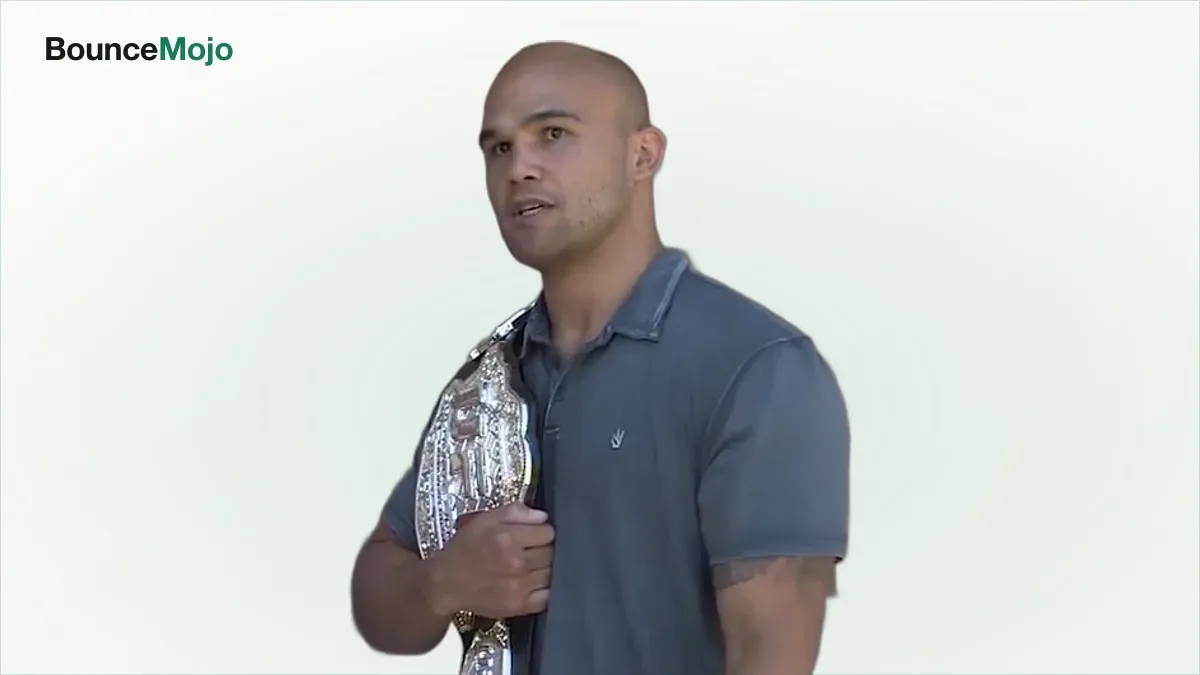
Most people remember Robbie Lawler for one thing: violence. The kind that made you wince and lean closer at the same time.
Here’s what most people miss: the most feared brawler of his era was once a washed-up prospect that the sport had quietly left for dead.
The Myth vs. The Reality
The myth of Robbie Lawler is pure carnage. He’s the guy who walks forward, eats a shot to land two, and turns technical bouts into street fights. Fans loved him because he was reliable in the most primal way: with Robbie in there, something was going to happen.
Here’s the truth: that image only tells the second half of the story.
The real Robbie Lawler is a comeback story dressed up as a knockout artist. Before he was the beloved champion, he was a burnout, a prodigy who peaked too soon and spent years drifting through the sport’s middle tier. The violence was always there. The greatness took a decade longer to arrive than anyone expected.
You might be wondering: how does a can’t-miss prospect nearly miss entirely? To understand that, you have to go back to the era that made him.
The World That Made Robbie Lawler
Robbie came up in the wild, unregulated early days of American mixed martial arts. Born in San Diego in 1982, he grew up mostly in Bettendorf, Iowa, corn country, where he became a serious high-school wrestler.
Iowa mattered. It happened to be home to Miletich Fighting Systems, run by UFC legend Pat Miletich, one of the first great fight camps in the sport. That gym turned out champions and tough men, and it became Robbie’s launchpad.
This was a time when MMA was still fighting for legitimacy, when purses were small and the sport lived on the fringes. In other words, a young fighter had to love the violence, because the money and fame weren’t there yet. Robbie loved it.
The Miletich camp gave that love a structure. It was a proving ground full of hard, unglamorous men who fought for pride as much as pay, and it forged a particular kind of toughness. Robbie absorbed that culture completely. He learned to walk forward, to accept punishment as the price of dealing it, and to treat a fight as a test of will. That ethos would define his entire career, for better and, physically, for worse.
That world gave him his toughness and his platform. It also set the stage for a rise so fast it nearly broke him. Let’s look at how it started.
The Crucible: Early Life and the Climb
The Environment That Shaped Them
Robbie was a wrestler first. On the mats of Iowa, he learned the discipline and physicality that would anchor his fighting style, but it was striking that captured his imagination.
At Miletich Fighting Systems, surrounded by hardened professionals, the teenager developed frightening power and a fearless willingness to trade. He wasn’t a technician in the classic sense. He was a hitter, and in a room full of grinders and grapplers, that made him stand out immediately.
Here’s the deal: talent that raw attracts attention fast. The UFC came calling before Robbie was old enough to fully understand what he was walking into.
The Catalyst for Breakout
Robbie debuted in the UFC in 2002, barely twenty years old, and instantly became a sensation. He knocked people out. He looked like the future of the welterweight division, a young star with a highlight reel and a nickname that fit.
Then reality hit. The competition caught up. Losses piled up, and the promotion released him. Robbie bounced through EliteXC, Strikeforce, and the independent circuit, sometimes winning, often losing, a former phenom who seemed to have stalled out.
Now: this is the part of the story where most careers quietly end. Robbie’s didn’t. What happened next is why anyone remembers his name at all.
The Key Players
Two forces defined Robbie’s arc: the mentor who built him and the rival who immortalized him.
The mentor was Pat Miletich. The Hall of Famer gave Robbie his foundation, his toughness, and his professional home. The Miletich camp shaped the fighter Robbie became, and that lineage stayed with him for his entire career.
The rival was Rory MacDonald. Their 2015 title fight at UFC 189 became the defining night of Robbie’s life. Both men were battered, bloodied, and refusing to fall, trading in the fifth round like their lives depended on it. Robbie won by knockout. The fight is routinely called one of the greatest in the sport’s history, and it cemented his legacy as the ultimate warrior.
There were others: Johny Hendricks, whom he beat to win the title; Carlos Condit and Matt Hughes, welterweight legends who tested him across eras.
But here’s the kicker: the version of Robbie who beat MacDonald almost never existed. His path to that night ran straight through the lowest point of his career.
The Turning Point
The Pinnacle of Achievement
After years in the wilderness, Robbie returned to the UFC in 2013, this time as a welterweight and a more complete fighter. What followed was one of the great revivals in the sport.
He tore through the division and won the UFC Welterweight Championship in December 2014, beating Johny Hendricks in a rematch. A fighter written off years earlier was suddenly a world champion in his thirties. He then defended the belt in a string of instant classics, the MacDonald war chief among them, that made him a fan favorite for life.
The Price of Admission
That greatness came at a cost measured in damage.
Robbie’s style, walking forward, eating shots, trading in the pocket, is thrilling to watch and brutal to live. The wars that made him a legend also aged him fast. He lost the title in 2016 and entered a tough stretch, absorbing punishment against younger, fresher opponents as the miles caught up.
Here’s the trade Robbie made, whether he meant to or not. Every unforgettable war added to his legend and subtracted from his longevity. The MacDonald fight, the Johny Hendricks battles, the brawls that made fans adore him, all of it accrued as damage. A more cautious fighter might have won more decisions and lasted longer. Robbie chose the other path, and the sport gave him exactly what that choice earns: glory and wear in equal measure. His late-career losses weren’t a mystery. They were the bill coming due for a style built entirely on giving and taking punishment.
Think about it: the very violence that made his career unforgettable is the same violence that shortened his prime and left its marks.
That toughness hid a quieter truth about the man himself.
The Unvarnished Truth
For all his savagery in the cage, Robbie Lawler is famously soft-spoken outside it. He rarely talked trash. He gave short, humble interviews and seemed almost uncomfortable with the attention his violence earned him.
That contrast is the heart of who he is. The “Ruthless” persona lived entirely in competition. Away from it, he was a family man and a professional who did his job and went home.
Here’s the truth: his greatest vulnerability was the same as his greatest gift. His willingness to take damage to deliver a great fight thrilled fans and defined his legacy, but it’s also the kind of career that extracts a physical price no highlight reel shows. He gave the sport everything, and the sport takes that literally.
Robbie never courted controversy, which makes his story unusual among big-name fighters. Still, his career raised the questions that shadow the whole sport.
Controversies and Criticisms
Robbie Lawler’s career was remarkably free of the scandal that follows many stars. There were no arrests that defined him, no long feuds, no public meltdowns. His controversies, such as they were, lived inside the cage.
The real criticism aimed at Robbie was tactical: that his hittable, come-forward style cost him fights he might have won with more caution, and that it aged him prematurely. Some argued he stayed in the sport too long, absorbing punishment in the twilight of his career.
That criticism doubles as the sport’s central ethical question. How much damage is too much, and who decides when a warrior should stop? Robbie’s late-career losses put that question in front of fans who loved him and hated to watch him hurt. There are no easy answers, and this biography won’t pretend otherwise.
You might be wondering what a fan can actually take from a life this violent and this redemptive. Quite a lot.
What We Can Learn From Robbie Lawler
Navigating the Darkness
Robbie’s story is one of the great second acts in sports. Written off in his mid-twenties, he rebuilt himself into a world champion nearly a decade later. That’s the lesson: an early peak is not a life sentence, and a slump is not the end of the story.
He kept working when the hype was gone and nobody was watching. When his chance came again, he was ready. Persistence through the quiet, unglamorous years is what separated Robbie from the countless prospects who flamed out and never returned.
Now: this is the part that should stick with anyone facing a slump. Robbie didn’t have a magic breakthrough or a lucky break. He simply kept training, kept fighting, and kept refining his craft while the sport’s attention drifted elsewhere. The redemption wasn’t sudden. It was the slow payoff of years spent doing the work when nobody was watching or expecting anything from him. That’s the least glamorous and most reliable path back from the bottom, and Robbie walked it all the way to a world title.
The Success Blueprint
Robbie’s revival came from patience and refinement. The wild young knockout artist became a smarter, more measured champion without losing the power that made him special. He evolved just enough to win at the highest level while keeping his identity.
Here’s the blueprint: don’t abandon your natural gift, sharpen it. Robbie stayed true to who he was, a hitter, but added the maturity to finally cash it in. Raw talent got him noticed. Discipline made him a champion.
Becoming Better
Above all, Robbie let his work speak. In an era of manufactured feuds and loud personas, he proved you can reach the top on substance alone. Humility and effort still count.
There’s real value in that quiet example. Robbie never needed a villain act or a viral outburst to matter. He earned his place with fists and follow-through, and fans respected him precisely because none of it felt fake. In a world that increasingly rewards noise, his career is a reminder that being genuinely good at your craft, and letting the results carry you, is still a viable path. He was beloved not despite his silence but because of it. The work always spoke loudly enough.
Final Verdict
Robbie Lawler is a rare thing in combat sports: a fighter who became a legend twice, once as the prodigy and once as the redeemed champion. The stretch in between, the lost years, is what makes the second act so meaningful.
His fortune, an estimated $4 million, reflects a rare two-decade career and the title run that finally rewarded his talent. For the full breakdown of how those purses, PPV shares, and fight-night bonuses added up, read his complete net-worth story.
Remember him for the war with Rory MacDonald and the walk-forward violence that thrilled a generation. But remember, too, the quiet man behind it, the burnout who refused to quit and came back to win it all. That’s the real story of “Ruthless.”
Shop Robbie Lawler on Amazon
Books, audiobooks, merch and more, handpicked for fans.
As an Amazon Associate we earn from qualifying purchases.
Frequently Asked Questions
Where did Robbie Lawler grow up?+
Robbie Lawler was born on March 20, 1982, in San Diego, California, and grew up largely in Bettendorf, Iowa, where he became a standout high-school wrestler before turning to mixed martial arts.
Who trained Robbie Lawler?+
Lawler came up under UFC Hall of Famer Pat Miletich at Miletich Fighting Systems in Iowa, one of the sport's original elite camps. He later trained at American Top Team in Florida.
When did Robbie Lawler win the UFC title?+
Lawler won the UFC Welterweight Championship in December 2014, beating Johny Hendricks in a rematch. It capped a stunning career revival after years of struggle in the middle of his career.
What is Robbie Lawler's most famous fight?+
His 2015 title defense against Rory MacDonald at UFC 189 is widely regarded as one of the greatest and most brutal fights in MMA history, a back-and-forth war that ended in the fifth round.
Why is Robbie Lawler called 'Ruthless'?+
The nickname reflects his aggressive, all-action style and knockout power. Lawler built a reputation as one of the most exciting and violent fighters of his generation across a two-decade career.
Want the money side of the story?
Read Robbie Lawler's Full Net Worth Breakdown →Shop Robbie Lawler on Amazon
Books, audiobooks, merch and more, handpicked for fans.
As an Amazon Associate we earn from qualifying purchases.