Rob Van Dam Biography: The Whole F'n Show and the Man Behind It
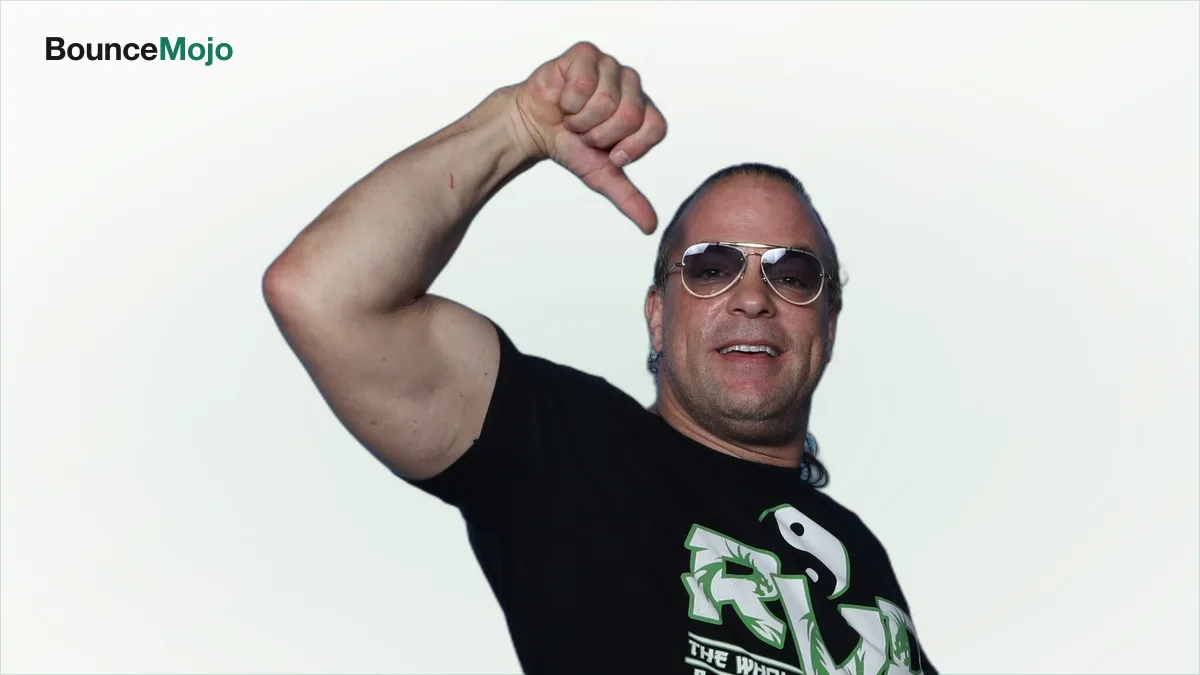
Rob Van Dam made looking effortless into an art form. Fans chanted his initials for whole matches, and he barely seemed to break a sweat.
Here’s what most people miss: the laid-back cool was real, but so was the discipline underneath it. Behind the relaxed persona was a martial artist trained by one of the toughest men in the business.
The Myth vs. The Reality
The myth is that Rob Van Dam was just a mellow, laid-back guy who happened to be good at flips.
Here’s the truth: the ease was earned.
The reality is that RVD was a disciplined martial artist and a serious athlete who trained under one of the harshest teachers in wrestling. The relaxed persona masked a performer with real precision and a body honed by years of dedicated conditioning. The flips only looked casual because he had drilled them into instinct.
What makes RVD different is that he changed the game quietly. He fused martial arts with high-flying wrestling into a style so distinct that a generation of wrestlers copied it. He did not shout about being a revolutionary. He just was one.
And to understand that discipline, you have to go back to a Michigan teenager searching for direction.
The World That Made Rob Van Dam
Robert Szatkowski was born on December 18, 1970, in Battle Creek, Michigan, a mid-sized Midwestern town far from any wrestling spotlight.
Picture it: an ordinary blue-collar setting with no obvious route to fame.
Here’s the deal: as a teenager, Robert found focus in martial arts and bodybuilding. Those disciplines gave a restless kid structure, confidence, and a physical foundation that would later set him apart in the ring. He was building the athlete before he ever knew what he would become.
Michigan in the 1980s was not a wrestling breeding ground with training schools on every corner. It was a place where a determined young man had to seek out the craft himself. But the martial-arts background gave RVD something no standard wrestling training could: a completely original movement vocabulary. That foundation would eventually make him unlike anyone else on any roster.
He just needed someone to turn the athlete into a wrestler.
The Crucible: Early Life and the Climb
The Environment That Shaped Them
RVD found his way into professional wrestling under the tutelage of The Sheik, Ed Farhat, a legendary and notoriously tough veteran promoter and performer. Training under The Sheik was no easy path.
The environment was demanding and old-school. The Sheik was known for putting recruits through grueling, unforgiving instruction, and surviving it required real toughness.
Now: that hard schooling mattered. It instilled in RVD a professional discipline that balanced his flashy style, and it connected him to the tradition of the business even as he prepared to reinvent it.
The Catalyst for Breakout
The break came in Extreme Championship Wrestling. ECW, the rebellious Philadelphia promotion run by Paul Heyman, was the perfect stage for RVD’s unconventional style.
But here’s the truth: he did not just fit in ECW. He became its franchise. As “Mr. Monday Night” and ECW Television Champion, RVD held that title for a record-setting reign and built a fanbase so devoted they chanted his name for entire matches. He earned the nickname “The Whole F’n Show.”
Now: understand what ECW represented. It was the outlaw promotion, the anti-establishment alternative to the polished giants of the industry. Its fans were fiercely loyal, drawn to performers who felt authentic and dangerous rather than corporate and packaged. RVD, with his martial-arts flair and laid-back rebellion, embodied that spirit perfectly. He was not just popular in ECW. He was the face of everything ECW stood for, the living proof that a wrestler could break every convention and still bring the house down.
That connection to the ECW faithful never faded. Decades later, those same fans still fill convention halls to meet him, still pop for his entrance, still chant the initials. RVD did not just entertain a fanbase. He earned a relationship with one, and that relationship became the foundation of everything he built afterward.
He was a star in the cult world of ECW. The mainstream was next.
The Key Players
RVD’s story runs through a handful of essential figures.
The first is his trainer, The Sheik, whose brutal old-school instruction gave RVD the discipline that anchored his flashy offense. That foundation shaped everything.
Then there is Paul Heyman, the ECW mastermind who recognized RVD’s unique appeal and built him into a franchise player. Heyman’s vision gave RVD the platform to become a legend.
You might be wondering about his in-ring partners.
His real-life friend and frequent tag partner Sabu was central to his ECW years, and their high-risk chemistry produced some of the promotion’s most memorable matches. The two shared a bond that ran deeper than storylines.
Those relationships shaped him. And they set up the moment that finally took him to the top of the mainstream.
The Turning Point
The Pinnacle of Achievement
The turning point came in 2006. In a memorable match at ECW One Night Stand, in front of a rabid hometown-style crowd, RVD defeated John Cena to become WWE Champion, and he simultaneously held the reactivated ECW Championship.
It gets better: for one shining stretch, the ECW cult hero was standing at the very top of the biggest company in the industry, holding two titles at once. The fans who had chanted his name for years finally saw him crowned.
It was the validation of a decade of grinding in a promotion the mainstream once ignored.
The Price of Admission
But the peak came with a fall. Shortly after his championship win, RVD was involved in a legal incident that led to his titles being dropped and his momentum stalled. The dream run ended almost as fast as it began.
Here’s the kicker: the high-flying style that made him famous also punished his body over the years, and the physical toll shaped how and when he chose to work later in his career.
The mainstream summit, so hard-won, proved brief. RVD had reached the top, but circumstances pulled the ladder away before he could stay there.
Behind the cool exterior was a man who tasted the peak and had to make peace with how quickly it passed.
The Unvarnished Truth
RVD has always been refreshingly honest about who he is.
He has never hidden his lifestyle or his views, becoming one of the most openly outspoken cannabis advocates in wrestling long before it was widely accepted. That candor cost him at times but also defined his authentic brand.
He has also spoken frankly about the incident that derailed his championship run and about the choices that shaped his career, refusing to rewrite his own history. He owns the ups and the downs.
Think about it: that honesty is central to his appeal. RVD does not perform a false image. The relaxed, principled, do-it-his-own-way persona is genuinely who he is, on camera and off.
That authenticity has drawn both admiration and criticism.
Controversies and Criticisms
RVD’s career has not been without controversy.
The 2006 legal incident that cost him his championship momentum remains the most significant, an abrupt end to what could have been a defining run. He has addressed it openly rather than dodging it.
His outspoken advocacy for cannabis, while authentic, put him at odds with certain corporate and public expectations over the years, drawing criticism from those who felt it conflicted with his role as a top star.
Here’s the deal: RVD has generally stayed true to himself through all of it. He has not softened his views to please critics or sanitized his past to protect his image. That consistency has earned him lasting respect, even from those who disagree with his choices.
His own words capture that unwavering self-belief.
Quote Analysis and Literary Breakdown
RVD speaks with an easy confidence that reveals his mindset.
“I’m the Whole F’n Show.” The catchphrase was more than hype. It captured a genuine belief that he alone could carry an entire card, a confidence built on real ability.
“1 of a Kind.” He has long framed himself as fundamentally unique, and the phrase became both a nickname and the title of his podcast. It reveals a man who never wanted to be a copy of anyone.
On staying true to himself: RVD has repeatedly emphasized doing things his own way, refusing to conform to expectations. It explains both his originality and the friction it sometimes caused.
Read together, the quotes show a self-assured innovator, a performer who trusted his own vision even when it made him an outsider.
There is a clear lesson in that.
What We Can Learn From Rob Van Dam
Navigating Hard Times
RVD’s career teaches resilience and self-acceptance. He reached the top and lost it fast, weathered controversy, and kept working on his own terms without bitterness. He adapted his schedule and his business rather than clinging to a fading peak.
His lesson is that authenticity endures. By staying genuinely himself, RVD kept a loyal fanbase for decades, long after his championship spotlight dimmed.
The Success Blueprint
The professional lesson is about originality as a moat. RVD’s unique style made him impossible to replace and permanently marketable, which is why he still commands bookings and merchandise sales. That distinctiveness is why he sits among the durable earners on our richest wrestlers list.
The financial lesson is turning identity into income. He built a podcast and lifestyle brand around who he genuinely is, a diversification strategy that mirrors the smartest earners on our richest athletes list.
Becoming Better
The deepest lesson from RVD is about the courage to be different. In an industry that often rewards conformity, he built a whole career on refusing to blend in. He fused martial arts with wrestling when no one else did, advocated for his beliefs when it was unpopular, and turned his own personality into a lasting brand. Most people file down their edges to fit in. RVD sharpened his and made them the point. There is real freedom in a man who decided that being one of a kind was worth more than being accepted.
That conviction points to a clear final take.
Final Verdict
Rob Van Dam’s story is about the power of being genuinely original. From a Michigan gym to the top of ECW and a dual championship in WWE, he built a legendary career by looking and moving like no one before him.
He trained under a brutal old-school master, became a cult god in wrestling’s most rebellious promotion, reached the mainstream summit, and handled its abrupt end with characteristic cool. Through all of it, he never stopped being himself.
What lingers is the originality. RVD changed how a generation of high-flyers wrestled, and he did it while staying so relaxed that fans thought it came easy. It never did. Behind the laid-back “Whole F’n Show” was a disciplined athlete and a principled individualist who trusted his own path completely. Rob Van Dam proved that the surest way to be unforgettable is to be, truly and fully, one of a kind.
Look at the wrestlers who followed him. The fusion of martial arts and high-flying offense that RVD pioneered became standard vocabulary for an entire generation of performers. His influence is stitched into the modern style, whether or not younger fans know his name. That is the mark of a true innovator: the ideas outlast the individual and become part of the language itself. RVD did not just have a great career. He left the whole art form a little different than he found it, and he did it his own way, without ever losing the easygoing cool that made fans love him in the first place.
Shop Rob Van Dam on Amazon
Books, audiobooks, merch and more, handpicked for fans.
As an Amazon Associate we earn from qualifying purchases.
Frequently Asked Questions
Where did Rob Van Dam grow up?+
Rob Van Dam was born Robert Szatkowski on December 18, 1970, in Battle Creek, Michigan. He got into martial arts and bodybuilding as a teenager before discovering professional wrestling.
Who trained Rob Van Dam?+
RVD was trained by The Sheik (Ed Farhat), a legendary and notoriously tough veteran, which helped shape his disciplined, martial-arts-influenced style.
Why is Rob Van Dam famous?+
RVD became a cult icon in ECW with an innovative, high-flying, martial-arts style, then reached the top of WWE as a dual WWE and ECW Champion.
Is Rob Van Dam in the Hall of Fame?+
Yes. Rob Van Dam was inducted into the WWE Hall of Fame, honoring his influence on the high-flying style that shaped modern wrestling.
What is Rob Van Dam known for outside wrestling?+
RVD is known for his outspoken cannabis advocacy and lifestyle brand, plus his long-running '1 of a Kind' podcast.
Want the money side of the story?
Read Rob Van Dam's Full Net Worth Breakdown →Shop Rob Van Dam on Amazon
Books, audiobooks, merch and more, handpicked for fans.
As an Amazon Associate we earn from qualifying purchases.