Rivaldo Biography: The Hungry Kid From Recife Who Became a Genius
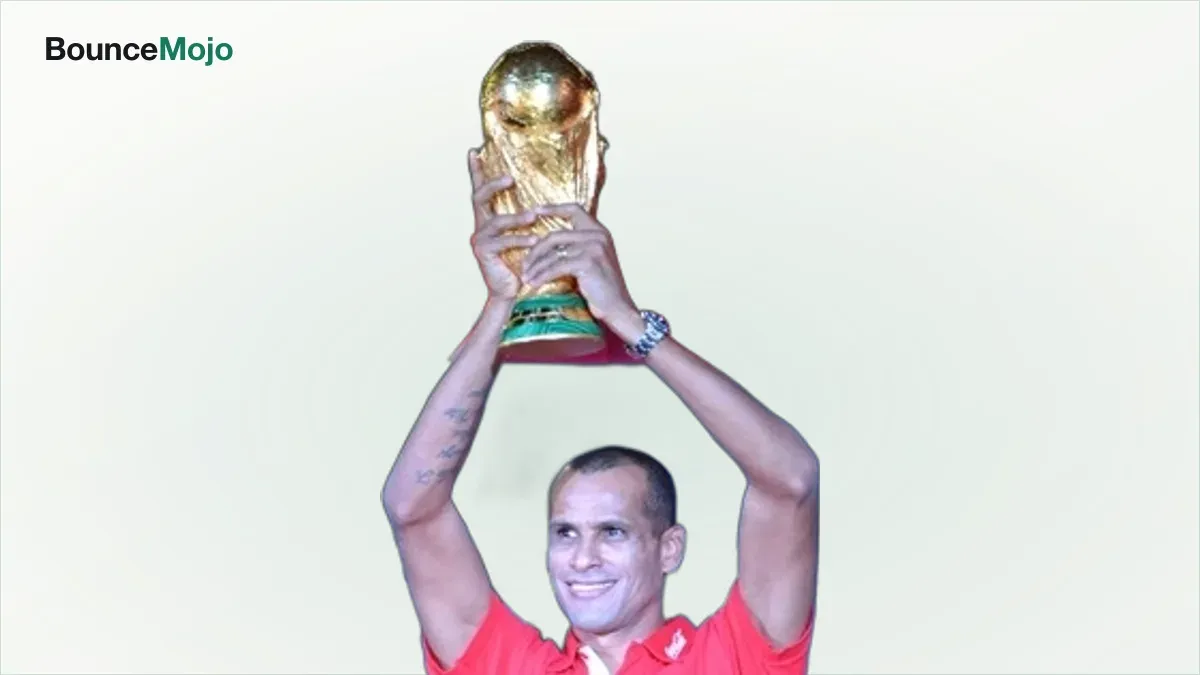
Most people remember Rivaldo for one thing: that impossible left foot, and maybe that overhead kick against Valencia. Both the genius and the drama hide the real story.
Here’s what most people miss: the man who won the Ballon d’Or was once a hungry, bow-legged boy who couldn’t afford to eat properly, and he carried that hunger onto every pitch he ever walked.
The Myth vs. The Reality
The myth is golden. Rivaldo: the Ballon d’Or genius, the left-footed magician of Barcelona, one third of Brazil’s dazzling “3 Rs,” a World Cup winner. Pure joy in cleats. Roll credits.
The reality is grittier and more human.
Here’s the deal: Rivaldo’s brilliance was born out of desperation, not comfort. He grew up so poor and malnourished that his legs were visibly bowed, and doctors and scouts worried his body was too frail for the professional game. The magic feet were built on a childhood of going without.
And the golden image has a shadow. His 2002 World Cup, one of the great tournaments a player can have, is forever marked by an ugly act of cheating against Turkey that FIFA fined him for. The genius and the con man shared the same body on the same day.
You might be wondering: how does a starving kid with bent legs become the best player on Earth? To understand that, you have to understand where he came from.
The World That Made Rivaldo
Rivaldo was born in 1972 in Recife, in Brazil’s northeast, one of the poorest regions of the country.
This was a Brazil where football was the only visible escape hatch for millions of poor kids, and the northeast, far from the wealth of Sao Paulo and Rio, was especially harsh. Boys played barefoot on hard dirt, and only the very best clawed their way out. The competition was brutal, and the margin for failure was nonexistent.
Now: Rivaldo’s poverty was severe even by those standards. He has spoken openly about being undernourished as a child, losing teeth, and developing bow legs from a lack of proper nutrition. His body was, by conventional standards, not built for elite sport.
That backdrop is everything. Rivaldo didn’t come from a football academy or a comfortable home. He came from hunger, and hunger gave him a work ethic and a refusal to fail that no coaching could teach.
But before the glory, there was a loss that reshaped his entire drive.
The Crucible: Early Life and the Climb
The Environment That Shaped Him
The center of young Rivaldo’s world was his father, Romildo, who believed fiercely in his son’s talent and pushed him toward football as the family’s way out.
The family had almost nothing. Rivaldo helped sell goods on the street and played whenever he could, dreaming of a professional career that seemed impossibly far away for a skinny, bow-legged kid from Paulista.
Here’s the truth: his frailty nearly cost him everything. Clubs turned him away over concerns about his physique. He had to prove, again and again, that his impossible skill outweighed his fragile frame.
The Catalyst
Then came the tragedy that defined him.
When Rivaldo was 16, his father Romildo was killed in a road accident. The man who believed in him most was gone. It gets darker before it gets better: the loss could have crushed a fragile teenager. Instead, it hardened his resolve. He would succeed for his father, no matter what.
You might be wondering how a grieving, undernourished teenager broke through. Through sheer refusal to quit. He fought his way into professional football in Brazil, first at Mogi Mirim and Corinthians and Palmeiras, forcing scouts to see past his body to his extraordinary technique. A move to Europe, and Deportivo La Coruna, finally opened the door to the world stage.
But the man who would truly make his name needed one club, and one manager, to unleash him.
The Key Players
No genius rises alone, and Rivaldo’s climb is marked by a handful of defining figures.
Romildo Ferreira, his father. The emotional foundation of the entire story. His belief planted the dream, and his death gave Rivaldo a lifelong reason to fight. Everything Rivaldo achieved was, in part, for him.
Louis van Gaal. The Barcelona manager whose relationship with Rivaldo was famously combustible. Van Gaal wanted him to play on the left wing; Rivaldo wanted to play centrally. They clashed, yet under that pressure Rivaldo produced some of his greatest football.
Ronaldo and Ronaldinho. His partners in Brazil’s “3 Rs” at the 2002 World Cup. Together they formed one of the most feared attacking trios in history and delivered a fifth world title.
Rivaldinho, his son. The next generation, who followed his father into the professional game and even shared a pitch with him at Mogi Mirim, closing a beautiful family circle.
Think about it: the same stubbornness that made Rivaldo clash with Van Gaal is exactly what let a fragile, poor kid refuse to accept the limits everyone placed on him. That defiance reached its peak on the biggest stages.
The Turning Point
The Pinnacle
Rivaldo’s mountaintop has two peaks, one individual and one collective.
The first came in 1999, when he was named FIFA World Player of the Year and won the Ballon d’Or, officially the best footballer alive. A boy from a Recife slum stood at the very summit of the sport.
The second came at the 2002 World Cup in Korea and Japan, where Rivaldo, Ronaldo and Ronaldinho tore through the tournament and Brazil lifted the trophy. Along the way, Rivaldo produced unforgettable moments, including his legendary last-minute overhead-kick goal against Valencia the year before, a strike replayed forever. His full net worth story shows how that fame kept paying long after.
The Price
Here’s the kicker: the same 2002 tournament that crowned him also exposed his worst instinct.
In a group game against Turkey, an opponent kicked the ball at Rivaldo’s legs. He fell to the ground clutching his face, feigning a head injury, and got the Turkish player sent off. The replay was damning. FIFA fined him, and the incident became one of the most infamous acts of simulation in football history. A career of genius carries that asterisk.
The pinnacle and the shame arrived in the same summer. Which brings us to the flaws behind the magic.
The Unvarnished Truth
Rivaldo was a genius, but he was not a saint, and the honest account includes the ugly parts.
The Turkey dive is the clearest example. It was cynical, theatrical, and beneath a player of his stature, and he has faced criticism for it ever since. It revealed a competitive edge willing to bend the rules to win.
Now: it would be dishonest to pretend this was a one-off in a certain footballing culture. Simulation was, and remains, part of the game at the highest level, and Rivaldo was hardly alone. But he was punished and named, and he owns that moment whether he likes it or not.
His stubbornness off the ball caused friction too, most notably his running battles with Van Gaal over where he should play. He knew his own worth and refused to be shoehorned into a role he thought wasted his gifts, admirable in one light, difficult in another.
The most honest thing you can say about Rivaldo is that his hunger made him both magnificent and, occasionally, willing to do whatever it took, fair or not.
Controversies and Criticisms
Rivaldo’s career, for all its brilliance, carried a few lasting marks.
The 2002 Turkey dive. The defining controversy of his career, a blatant act of simulation that drew a FIFA fine and permanent criticism. For many neutrals, it colors the memory of an otherwise glorious World Cup.
The Van Gaal feud. His public disagreements with his Barcelona manager over position and tactics made headlines and contributed to a difficult final period at the club before he left in 2002.
The endless late-career journey. Rivaldo kept playing into his forties across Greece, Uzbekistan, Angola and Brazil. Some admired the love of the game; others saw a legend stretching his career past its natural end for the paycheck and the joy of playing.
None of these erase his greatness. But they complicate the fairy tale, and a full picture has to hold both the magic and the mud.
Quote Analysis and Literary Breakdown
Rivaldo’s reflections reveal a man shaped permanently by hardship.
On his childhood hunger and bow legs. His willingness to speak plainly about being malnourished tells you he never hid where he came from. The subtext: everything he built, he built from nothing, and he wanted the world to know it.
On his father’s death. His descriptions of losing Romildo at 16 reveal the engine of his career. The grief became fuel. Every goal was, in a sense, a message to the man who believed first.
On playing for the love of the game late in his career. His refusal to retire, chasing contracts around the world into his forties, shows a man who never took the game for granted, because he remembered a time when he had nothing else.
Read together, the words of a player who understood exactly how far he had traveled, and who never forgot the boy in Recife.
What We Can Learn From Rivaldo
Navigating Hard Times
The first lesson is that your starting point does not decide your ceiling. Rivaldo was malnourished, bow-legged, fatherless at 16, and repeatedly rejected for his frail body. He became the best player in the world anyway. Hardship refined him instead of finishing him.
But here’s the truth his story makes plain: pain can be a weapon or a wound, and Rivaldo chose weapon. He turned grief and hunger into a relentless drive rather than an excuse, and that choice is the difference.
The Success Blueprint
If you want the replicable part, it’s this: master the one thing no one can take from you. Rivaldo’s technique, that magical left foot, was so good it overrode every doubt about his physique. He built an undeniable skill and let it answer every critic.
That singular talent, plus careful management of the money it earned, put him among the game’s most financially secure legends, as our richest soccer players ranking shows, and it stands beside the fortunes on our richest athletes list.
Becoming Better
The deepest lesson is about coming home. Rivaldo took his fortune back to Brazil and invested it where he understood the ground, including the humble club where it all began. He never lost his roots, and that rootedness protected both his money and his identity.
In other words, remembering where you came from isn’t sentimental weakness. For Rivaldo it was a strategy, one that kept him grounded, solvent, and whole. And that leads to the quiet twist that closes his story.
Final Verdict
Rivaldo is one of the greatest footballers Brazil ever produced, and his story is proof that genius can grow in the harshest soil. A starving boy with bent legs became a Ballon d’Or winner and a world champion, and he did it while carrying the memory of a father who never saw the summit.
And here’s the twist that reframes everything: the man who left Recife with nothing chose to bring it all back. He returned to Mogi Mirim, the tiny club where his journey started, invested in it, and even shared the pitch there with his own son. The kid who was once too poor and too frail became the owner of the very place that first believed in him. The full mechanics of how his career funded that homecoming live in his net worth breakdown, and it is the most fitting ending imaginable: a genius who never forgot the hunger that made him.
Shop Rivaldo on Amazon
Books, audiobooks, merch and more, handpicked for fans.
As an Amazon Associate we earn from qualifying purchases.
Frequently Asked Questions
Where did Rivaldo grow up?+
Rivaldo grew up in Recife, in the poor northeast of Brazil, specifically the Paulista area. His family lived in deep poverty, and he has said he was so undernourished as a child that he was bow-legged and lost teeth to malnutrition.
What happened to Rivaldo's father?+
His father, Romildo, was his biggest supporter and pushed him toward football. He was killed in a road accident when Rivaldo was 16, a devastating loss that drove Rivaldo to succeed in his memory.
Why was the 1999 Ballon d'Or so significant for Rivaldo?+
Winning the 1999 Ballon d'Or and FIFA World Player of the Year confirmed a boy from a Brazilian slum as the best footballer on the planet, a stunning rise from poverty to the sport's highest individual honor.
What was the Rivaldo diving controversy at the 2002 World Cup?+
In a group game against Turkey, Rivaldo clutched his face after a ball was kicked at his legs, getting an opponent sent off. He was fined by FIFA and the incident became one of the most infamous acts of simulation in World Cup history, a permanent stain on an otherwise glorious tournament.
Did Rivaldo play with his son?+
Yes. Late in his long career, Rivaldo played alongside his son Rivaldinho at Brazilian club Mogi Mirim, a rare father-and-son professional pairing on the same pitch.
Want the money side of the story?
Read Rivaldo's Full Net Worth Breakdown →Shop Rivaldo on Amazon
Books, audiobooks, merch and more, handpicked for fans.
As an Amazon Associate we earn from qualifying purchases.