Petra Kvitova Biography: The Champion Who Survived the Knife
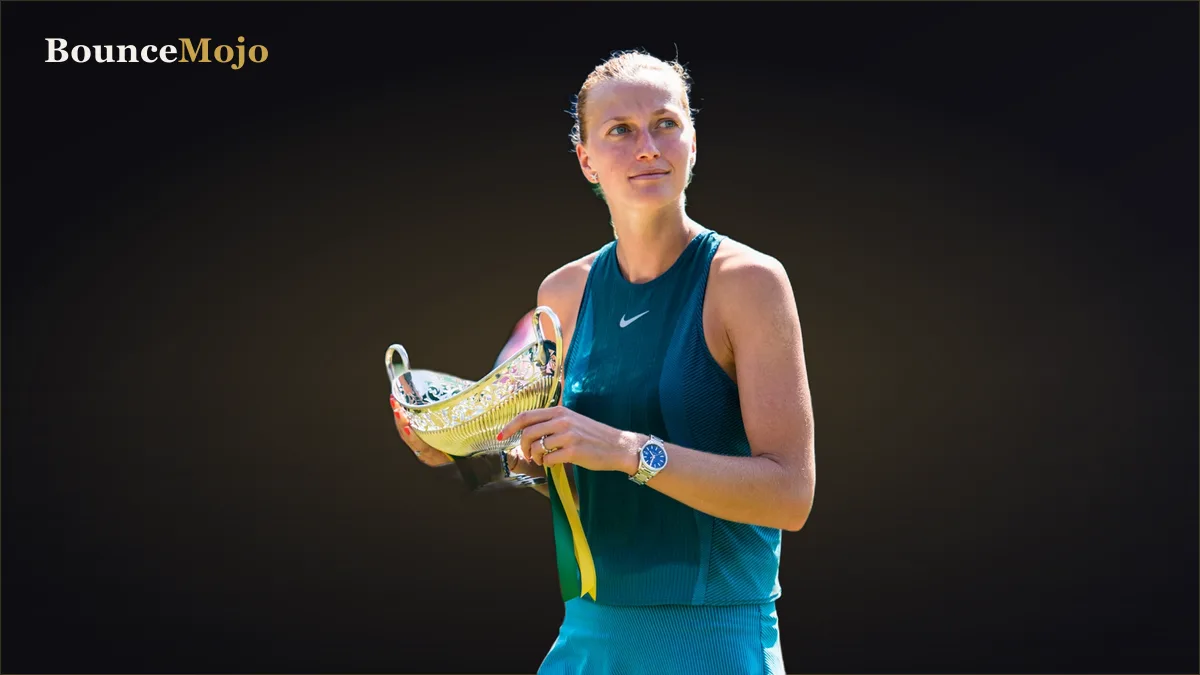
Most people know Petra Kvitova as a two-time Wimbledon champion who hits the ball incredibly hard. That’s the easy part of her story.
Here’s what most people miss: she rebuilt her entire career after an intruder took a knife to the very hand she plays tennis with.
The Myth vs. The Reality
The myth is straightforward: Petra Kvitova, big-hitting lefty, two Wimbledons, a great grass-court player.
The reality is a story of survival that has almost no equal in sports.
Here’s the deal: Kvitova’s career has two distinct halves, before and after December 2016. Before, she was a two-time major champion and one of the most feared hitters in the game. After, she was a woman who had to relearn whether her playing hand would ever function at an elite level again.
The “big-hitting champion” label captures the tennis. It captures none of the human being who came back from a violent attack to reach another Grand Slam final. Her story is one of the most extraordinary comebacks the sport has ever witnessed, and her net worth breakdown reflects a career that could easily have ended at 26.
You might be wondering: how does someone come back from that? To understand the comeback, you first have to understand the champion, and where she came from.
The World That Made Petra Kvitova
Kvitova came up inside one of the most productive tennis systems on earth.
She was born in 1990 in Bilovec and raised in the small town of Fulnek, in the Czech Republic. The Czech tennis tradition is deep and storied, producing legends across decades. Unlike players from nations with no pedigree, Kvitova had giants to look up to, most notably her namesake Martina Navratilova.
Now: the women’s game she entered was moving toward power, and few players embodied that shift more naturally than a tall, left-handed hitter with a huge serve. Kvitova wasn’t fighting the trend. She was the trend, taking the ball early and flat and blasting opponents off the court.
The Czech system gave her structure and belief. Her hometown gave her humility. Together they produced a champion who never lost her grounded, down-to-earth character, even at the top of the sport.
But before Wimbledon and the trophies, there was a girl in Fulnek hitting balls with her father.
The Crucible: Early Life and the Climb
The Environment That Shaped Her
Kvitova’s first coach was her father, Jiri, a teacher, who introduced her to tennis on modest local courts.
This wasn’t a glamorous, high-budget upbringing. It was a small-town Czech childhood built on hard work and family support. She was tall and gangly, blessed with natural power but needing years to harness it. Her development was patient, rooted in the strong Czech coaching tradition rather than a flashy academy.
That environment shaped her personality as much as her game. She stayed modest, unpretentious, and closely tied to her roots, qualities that would matter enormously when disaster struck years later.
You might be wondering how a small-town girl developed such a devastating game. The answer is a combination of natural gifts and patient coaching. She was tall and left-handed, a rare and awkward package for opponents, and her father encouraged her to swing freely rather than play it safe. The Czech system then refined that raw aggression over years of junior competition. She wasn’t a manufactured prospect from a mega-academy. She was homegrown, built slowly, and all the more durable for it.
Here’s the truth: the toughness she built in those unglamorous early years, grinding through the ranks without fanfare, became the foundation of the resilience the world would witness in 2016.
The Catalyst
The breakthrough came fast and spectacularly. In 2011, at just 21, Kvitova won Wimbledon.
She overpowered the field on the grass, announcing herself as a new force in the women’s game and rising toward the top of the rankings. A star was born, and a big one. The flat, fearless left-handed game that had been raw potential was suddenly winning the sport’s most prestigious title.
It gets better: a second Wimbledon title would follow in 2014, cementing her as an elite champion. But the darkest, and ultimately most defining, chapter of her life was still to come. And it had nothing to do with tennis.
The Key Players
No one climbs, or survives, alone. Kvitova’s story turns on a few crucial people.
Jiri Kvita. Her father and first coach built her game from the ground up in Fulnek and instilled the work ethic and humility that defined her.
David Kotyza. Her longtime coach through her first Wimbledon-winning era, who helped channel her raw power into a title-winning weapon during her early peak.
Her medical team. After the 2016 attack, the surgeons and therapists who repaired and rehabilitated her hand became, arguably, the most important people in her career. Their work made the impossible comeback possible.
Martina Navratilova. The Czech legend and namesake inspiration who represented what a player from her country could achieve on the world stage.
Jiri Vanek. Her coach who later became her husband, part of the support system that carried her through the second half of her career.
Think about it: the first half of that list built a champion. The second half saved one. That division falls on a single December night.
The Turning Point
The Pinnacle
Kvitova’s on-court pinnacle came at Wimbledon, twice. In 2011 and again in 2014, she conquered the grass, beating the best in the world with overwhelming power.
She reached world No. 2, won titles across the tour, and led the Czech Republic to multiple Fed Cup triumphs, becoming one of her nation’s most decorated athletes. Her prize money climbed into the tens of millions, a haul detailed on our richest tennis players ranking. By her mid-twenties, she had a Hall-of-Fame-caliber resume.
Everything was on track. And then, in December 2016, everything nearly ended.
The Price
Here’s the kicker: the greatest threat to Kvitova’s career didn’t come from an opponent. It came through her own front door.
An intruder posing as a utility worker forced his way into her home. In the struggle, he slashed her left hand, her playing hand, severing tendons and damaging nerves across all five fingers. The injury was catastrophic. Doctors performed lengthy surgery and warned that her career might be over. The very tool of her trade, the hand that had won two Wimbledons, was in ruins.
The price of that night was measured in blood, months of rehabilitation, and profound psychological trauma. That she even considered returning was extraordinary. What she did next was almost unbelievable.
The Unvarnished Truth
Kvitova’s career carries a rare kind of vulnerability: the scars, physical and mental, of a violent crime.
The attack left more than a damaged hand. It left fear, anxiety, and the difficult, ongoing work of feeling safe again. She has spoken with honesty about the psychological toll, the nightmares, the vigilance, the reality that her sense of security was shattered along with her tendons.
Now: on the court, even in her prime, she was known for streakiness. When her power flowed, she was nearly unbeatable. When it misfired, the same aggressive game could produce a flood of errors. That inconsistency was the flip side of her firepower, the honest cost of playing so aggressively.
But the deepest truth is about what the comeback actually required. Returning wasn’t just physical rehab. It was a woman choosing, again and again, to walk back onto a stage that reminded her of vulnerability, and to compete at the highest level despite carrying that weight.
Think about the specifics of what she rebuilt. The attack damaged the tendons and nerves controlling all five fingers of her playing hand, the fine motor control a tennis player relies on for grip, feel and touch. She had to relearn how to hold a racquet, how to generate the very power that defined her, how to trust a hand that had been cut open. Doctors weren’t sure she’d regain full function for daily life, let alone elite competition. That she came back to win titles is close to a medical miracle, and it was powered entirely by her refusal to accept the ending everyone assumed was coming.
The most honest thing you can say is this: Kvitova’s greatest title was never a trophy. It was the simple, staggering fact that she came back at all.
Controversies and Criticisms
Kvitova’s career was largely free of controversy, and the hardest chapters were things done to her, not by her.
The consistency debate. Critics pointed to her streakiness, the maddening gap between her best tennis and her worst. Supporters argued it was inseparable from the go-for-broke power that made her a champion in the first place.
The comeback scrutiny. As she returned in 2017, some questioned whether she could ever be the same player. She answered on the court, reaching the 2019 Australian Open final and winning titles again, silencing the doubt.
The aftermath of the attack. The intruder was eventually caught, tried and convicted. Kvitova faced the ordeal of the legal process on top of her physical recovery, handling an unthinkable situation with a dignity that drew universal respect.
What We Can Learn From Petra Kvitova
Navigating Hard Times
The first lesson is almost too large for sport: you can come back from things that look like the end. Kvitova faced an injury that doctors feared was career-ending, and she returned to a Grand Slam final within roughly two years.
Here’s the truth: resilience isn’t the absence of fear or damage. It’s choosing to move forward while carrying both. Kvitova’s return is a study in exactly that kind of courage.
The Success Blueprint
If you want the replicable part, it’s this: build a game, and a life, around your genuine strengths. Kvitova’s power was her identity. She never tried to become a grinder or a counter-puncher. She doubled down on the fearless, flat-hitting style that made her great.
That’s transferable. Commit fully to your real weapon rather than hedging. That commitment is what put her among the wealthiest names on our richest athletes list, on the strength of titles only her style could win.
Becoming Better
The deepest lesson is about perspective. After the attack, Kvitova often spoke about gratitude, about how nearly losing everything reframed what winning and losing even meant.
In other words, adversity gave her a clarity most champions never find. She competed with the freedom of someone who understood exactly how much a career, and a healthy hand, is worth. That perspective is the heart of the final verdict.
Final Verdict
Petra Kvitova is one of the finest grass-court champions of her generation, a two-time Wimbledon winner with one of the biggest games the sport has seen. But that’s not why her story matters most.
And here’s the twist that reframes everything: the defining moment of her career wasn’t a title. It was a comeback from a violent attack that should have ended her playing days for good. Her fortune, detailed in her net worth breakdown, belongs to a career that had every reason to stop at 26 and instead pushed on for years.
She was the girl from Fulnek who blasted her way to two Wimbledon crowns, then survived the unthinkable and blasted her way to another Grand Slam final. Petra Kvitova didn’t just win tennis matches. She showed what it looks like to lose almost everything and choose, with a scarred hand, to pick up the racquet again anyway.
Shop Petra Kvitova on Amazon
Books, audiobooks, merch and more, handpicked for fans.
As an Amazon Associate we earn from qualifying purchases.
Frequently Asked Questions
Where did Petra Kvitova grow up?+
Kvitova was born in Bilovec, Czech Republic, in 1990 and grew up in the nearby town of Fulnek, learning tennis from her father, a teacher, on modest local courts.
How many Wimbledon titles did Petra Kvitova win?+
Kvitova won two Wimbledon singles titles, in 2011 and 2014, establishing herself as one of the best grass-court players of her generation.
What happened to Petra Kvitova in 2016?+
In December 2016, an intruder posing as a utility worker broke into her home and attacked her with a knife, severely injuring the tendons and nerves in her playing (left) hand. Doctors initially feared she might never play again.
Did Petra Kvitova recover from the attack?+
Yes. After surgery and months of rehabilitation, she returned to the tour in 2017 and reached the 2019 Australian Open final, one of the most remarkable comebacks in tennis history.
What is Petra Kvitova known for?+
Kvitova is known for her explosive left-handed power, especially her serve and flat groundstrokes, her two Wimbledon titles, and her inspiring return from a career-threatening attack.
Want the money side of the story?
Read Petra Kvitova's Full Net Worth Breakdown →Shop Petra Kvitova on Amazon
Books, audiobooks, merch and more, handpicked for fans.
As an Amazon Associate we earn from qualifying purchases.