Pep Guardiola Biography: The Philosopher Who Reinvented Football
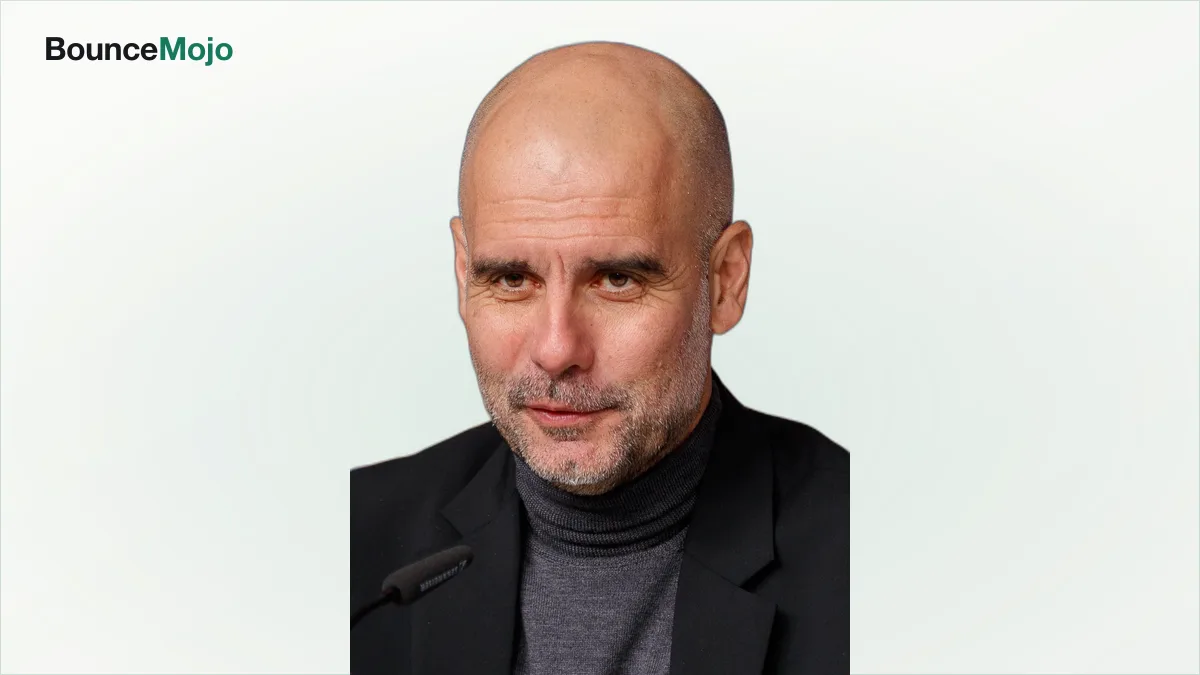
Everybody remembers the trophies and the tiki-taka. Almost nobody remembers the skinny kid from a Catalan factory town who was told he was too slow and too slight to make it.
Here’s what most people miss: the man who reinvented modern football wasn’t a physical marvel. He was a thinker, a player who survived on intelligence alone, and that limitation is exactly what made him see the game differently from everyone else.
The Myth vs. The Reality
The myth is the mastermind. Pep Guardiola, the tactical genius in the sweater, pacing the touchline, bending football to his will with possession, patterns and control. Trebles. League titles in three countries. A philosophy so influential that a generation of coaches copies it.
That version is real. It’s also wildly incomplete.
Here’s the truth: the “genius” story erases how ordinary his raw gifts were. Guardiola was never fast, never strong, never the most naturally talented kid on the pitch. He was a slight, cerebral midfielder who made it purely by understanding the game more deeply than anyone around him. The mastermind was, first, a survivor who had no choice but to out-think his opponents.
Think about it. We love a story of effortless genius because it makes greatness feel like a gift from the heavens. But Guardiola’s genius was learned, absorbed from mentors, refined through obsession, built out of necessity. He couldn’t win with his body, so he learned to win with his mind, and then he taught the world to play that way.
Now, that mind didn’t form in a vacuum. It was shaped by a place, a family, and one extraordinary teacher. Which raises the question: what world produces a footballer this thoughtful and this driven?
The World That Made Pep Guardiola
To understand Guardiola, you have to understand the small-town Catalonia he came from, and the Barcelona identity that runs through everything he does.
He was born on January 18, 1971, in Santpedor, a modest town in the province of Barcelona. His father, Valentí, was a bricklayer; the family was hardworking and unpretentious, rooted in the rhythms of local Catalan life. It was a childhood of ordinary means and strong community, and Guardiola has always carried Santpedor’s grounded values with him.
But the culture mattered too. Guardiola grew up steeped in Catalan identity, for which FC Barcelona is far more than a football club, it’s a symbol of a region and a people. To a boy from a Catalan town, Barça represented something close to sacred. That deep emotional connection would shape his entire life.
Here’s the deal: Guardiola was a gifted young footballer, but a slight one, and success was never guaranteed for a boy his size. What set him apart wasn’t his physique. It was his football brain, an unusual ability to read the game, to see space and passes before they opened up.
But to turn that intelligence into a career, he had to leave home young. And that departure is where the real story begins.
The Crucible: Early Life and the Climb
The environment that shaped him
Two things defined the young Pep Guardiola: a football academy and a dream that meant leaving everything behind.
At just 13 years old, Guardiola left Santpedor to join La Masia, Barcelona’s legendary youth academy, the residential school where the club raises its own players. For a boy that age, it meant living away from his family, growing up inside the institution he worshipped. La Masia became his home, his school and his church all at once, and it drilled into him the club’s distinctive philosophy of football.
He worked his way up through the ranks, a slight, technically gifted midfielder in a system that valued exactly his kind of intelligence. He wasn’t the biggest or the fastest, and plenty of doubters wondered whether his body could survive senior football. But his positional understanding was extraordinary, and it kept carrying him upward.
You might be wondering: how does a kid too slight for the physical game reach the top of it? The answer is that La Masia, and the man about to take charge of it, prized his exact gifts. In a system built on passing, movement and control rather than power, Guardiola’s brain was worth more than muscle. He wasn’t fighting his limitations anymore. He was in the one place that turned them into strengths.
He was about to be chosen by the most important figure in his life.
The catalyst
The catalyst had a name: Johan Cruyff.
When the Dutch legend took over as Barcelona manager, he saw in the young Guardiola the perfect embodiment of his footballing ideas. Cruyff plucked him from the youth ranks and made him the pivot, the deep-lying playmaker, at the heart of his first team. It was an enormous bet on a slight, unproven talent, and it defined Guardiola’s career.
Here’s the kicker: Cruyff didn’t just make Guardiola a player. He handed him a philosophy. The ideas about possession, positional play and controlling the game through the ball, ideas Guardiola absorbed as a young man, would become the foundation of everything he later built as a manager. He was, in effect, being taught to think like a coach while still playing.
Guardiola became the metronome of Cruyff’s “Dream Team,” the side that won four straight La Liga titles and, in 1992, Barcelona’s first-ever European Cup. He later captained the club, an emotional peak for the boy from Santpedor who had grown up idolizing it.
The player was a champion. But the philosophy he’d been given was destined for something even bigger.
The Key Players
No life this rich is a solo act, and Guardiola was surrounded by people who shaped his path.
Start with Johan Cruyff, the single most important influence on his football life. Cruyff gave Guardiola his chance, his position and, above all, his ideas. Everything Guardiola later achieved as a manager traces back to the philosophy Cruyff planted in him as a young player. He was the mentor whose vision Guardiola would carry forward and perfect.
Then there’s Lionel Messi, the generational talent Guardiola built his Barcelona team around as a manager. Their partnership produced some of the greatest football ever played, and Guardiola’s willingness to reshape his side to unleash Messi showed a coach’s genius for adapting his principles to his best player.
And there’s Txiki Begiristain, the former Barcelona teammate turned director of football, who has worked alongside Guardiola across clubs, most notably bringing him to Manchester City. Their long professional alliance has been a quiet constant behind the trophies.
There was also his family and his Catalan roots, the grounding force behind a man who has always seemed to carry the values of Santpedor into the glamorous world of elite football.
Now: absorb the right ideas from the right mentor and surround yourself with the right talent, and you can change how an entire sport is played. Guardiola was about to do exactly that. But greatness at this level asks for total immersion.
The Turning Point
The pinnacle
The pinnacle came not as a player, but on the touchline.
After retiring and a brief apprenticeship coaching Barcelona’s B team, Guardiola was handed the first team in 2008, a bold appointment for a rookie manager. What followed was one of the great runs in football history. His Barcelona side, built around Messi, Xavi and Iniesta, played a mesmerizing possession game and won 14 trophies in four years, including two Champions Leagues and, in 2009, a historic sextuple that began with the first treble ever won by a Spanish club.
Then he proved it wasn’t tied to one club. He won three straight league titles at Bayern Munich, then moved to Manchester City in 2016 and built an English dynasty, multiple Premier League titles, including four in a row, and finally, in 2023, the Champions League as part of another treble.
Add it up and Guardiola stands as one of the most decorated and influential managers the sport has ever seen, a coach who won at the highest level in three different countries.
Here’s the truth: he didn’t just win. He changed how the game is played, and it still demanded everything he had.
The price
Because the same total immersion that produced the football took a real toll.
Guardiola is famously consumed by his work, an obsessive who lives inside the details of the game, and that intensity is exhausting to sustain. He has spoken about the emotional weight of management, the sleepless nights, the constant pressure to solve the next problem. The obsession that fuels the brilliance also burns hot.
That toll is why, after four glorious but draining years, he walked away from Barcelona in 2012 and took a full year off from football entirely, moving to New York to recharge. He understood that a mind as engaged as his couldn’t run indefinitely without breaking. The sabbatical wasn’t a whim. It was survival.
He had given football his complete attention for decades, first as a player, then as the most demanding of managers. The game had made him a legend. It had also asked for a level of immersion few could endure.
The Unvarnished Truth
Guardiola is not a flawless figure, and the philosopher image hides real complications.
His obsessive nature can tip into overthinking. Critics point to big Champions League nights, especially at Bayern and early at City, where his tendency to tinker with his lineup and tactics arguably cost his teams, a genius occasionally undone by his own restless mind. The same intelligence that builds masterpieces can, on the wrong night, complicate what should be simple.
There’s also the uncomfortable matter of resources. Guardiola has managed three of the richest, most talented squads in world football. Skeptics argue that his philosophy has only ever been tested with elite players and vast budgets, and that his brilliance has never had to survive real scarcity. It’s a fair question about how much of the success is method and how much is means.
Here’s what’s easy to miss: his greatest strength and his notable weakness are the same trait. The relentless, detail-obsessed mind that revolutionized football is also the one that sometimes outsmarts itself under the brightest lights. The obsession is the gift and the flaw at once.
None of that erases the trophies. But it does make him a more human figure than the mastermind myth allows.
Controversies and Criticisms
Guardiola’s career has carried real debate, and it’s worth being honest about it.
The “overthinking” charge is the most persistent, the sense that in the biggest one-off matches he occasionally abandons what works in search of a clever edge that backfires. For a manager of his stature, those high-profile stumbles draw enormous scrutiny.
There’s also the broader argument about context. His entire managerial career has unfolded at superclubs with enormous financial backing, and some critics contend that this undercuts comparisons with coaches who have worked minor miracles on modest budgets. Guardiola has never managed a small club, and we simply don’t know how his ideas would fare with fewer resources.
And his teams have not been free of the controversies that surround elite football’s biggest-spending clubs, the off-field debates about money and regulation that shadow the modern game. Guardiola has generally stood by his employers, which invites its own criticism from those who see the sport’s finances as a problem.
So what does a life like this actually teach the rest of us? More than the trophy count suggests.
What We Can Learn From Pep Guardiola
Navigating hard times
Guardiola’s real lesson isn’t about winning. It’s about knowing when to step away.
At the height of his Barcelona success, drained and depleted, he had the wisdom to stop, to take a full year off and protect the very mind that made him great. In a culture that glorifies relentless grinding, Guardiola understood that rest was not weakness but maintenance, that a thinking mind, like any engine, needs to cool down to keep running.
In other words: the sabbatical was as smart as any tactic. Sustainability is a skill, and Guardiola has it.
The success blueprint
The blueprint here is about mastering ideas, not just executing them.
Guardiola didn’t invent his football philosophy; he inherited it from Cruyff. But he studied it, questioned it, refined it and adapted it until he understood it more completely than anyone alive. His genius wasn’t originality so much as total mastery, taking a set of principles and pushing them further than their creator ever did.
Want the fuller picture of how that translated into wealth? The full net worth breakdown shows how a record salary and smart investments built a nine-figure fortune. And to see how he ranks among the sport’s biggest coaching fortunes, the richest coaches list puts it in context.
The deeper takeaway is about turning limitation into insight. Guardiola couldn’t win with his body, so he learned to win with his mind, and that forced intelligence became the foundation of a philosophy that reshaped a sport. The constraint was the making of him.
Which brings us to the final reckoning on the man.
Final Verdict
Pep Guardiola is going to be remembered for the wrong thing.
Most people will file him under “tactical genius,” the trophies, the possession football, the mastermind in the sweater. A smaller, smarter group will remember something more human: a slight, cerebral kid from a Catalan factory town who was never the most gifted athlete, who survived on intelligence alone, and who turned that necessity into a philosophy that changed how the world plays football.
Here’s the bottom line: the trophies made him famous. The ideas made him matter. Guardiola proved that you don’t have to be the strongest or the fastest to be the best, that a deep enough understanding of your craft can beat raw talent every time.
He is one of the most decorated and influential managers in football history. He is also living proof that the mind, properly obsessed and properly rested, can outrun the body’s limits. And in the long run, that thoughtful, human story is the version worth remembering.
Shop Pep Guardiola on Amazon
Books, audiobooks, merch and more, handpicked for fans.
As an Amazon Associate we earn from qualifying purchases.
Frequently Asked Questions
Where did Pep Guardiola grow up?+
Guardiola was born on January 18, 1971, in Santpedor, a small town in Catalonia, Spain, the son of a bricklayer. At 13 he left home to join Barcelona's famed La Masia youth academy.
Did Pep Guardiola play for Barcelona?+
Yes. Guardiola was a defensive midfielder for Barcelona from 1990 to 2001, a key member of Johan Cruyff's 'Dream Team' that won four straight La Liga titles and the club's first European Cup in 1992. He later captained the side.
Who was Pep Guardiola's biggest influence?+
His greatest influence was Johan Cruyff, the Dutch legend who coached him at Barcelona and shaped the possession-based, positional football philosophy that Guardiola would later perfect as a manager.
What has Pep Guardiola won as a manager?+
Guardiola has won league titles in Spain, Germany and England and multiple Champions Leagues, including trebles with Barcelona in 2009 and Manchester City in 2023, making him one of the most decorated managers in football history.
Where does Pep Guardiola manage now?+
Guardiola has managed Manchester City since 2016 and signed a contract extension in November 2024. He previously managed Barcelona (2008-2012) and Bayern Munich (2013-2016).
Want the money side of the story?
Read Pep Guardiola's Full Net Worth Breakdown →Shop Pep Guardiola on Amazon
Books, audiobooks, merch and more, handpicked for fans.
As an Amazon Associate we earn from qualifying purchases.