Pele Biography: The Shoeshine Boy Who Became the King of Football
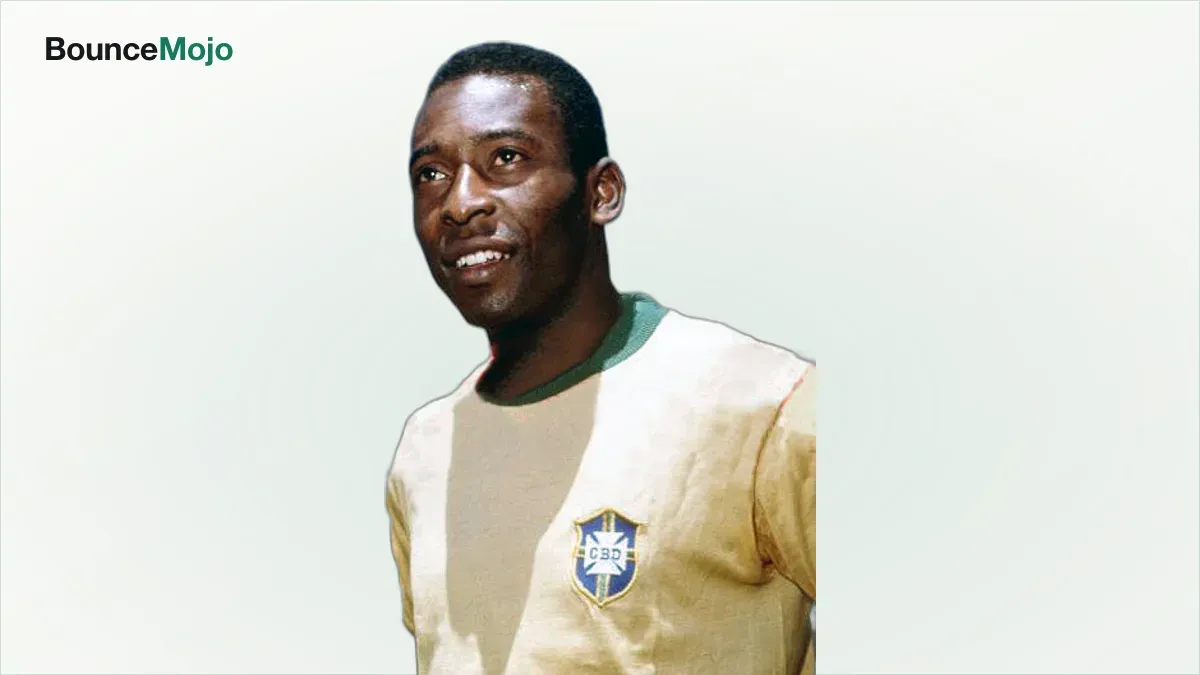
Most people know Pele as the King of Football, the smiling legend in the yellow Brazil shirt. That crown hides a childhood most fans never imagine.
Here’s what most people miss: before the three World Cups and the global fame, Pele was a barefoot boy in Brazil who shined shoes for coins and practiced with a ball made of rags.
The Myth vs. The Reality
The myth is golden. Pele: the perfect footballer, born to greatness, gliding effortlessly to three World Cups and a fortune that placed him among the legends on our richest soccer players ranking.
The reality started far lower.
Here’s the deal: Pele was born into real poverty. His family struggled to afford food, let alone a football. He learned the game barefoot in the streets of Bauru, with a sock stuffed full of rags or a grapefruit standing in for a ball. There was no academy, no golden pathway, just a poor kid with an extraordinary gift.
And the “effortless genius” image undersells the pressure. From the moment he broke through, Pele carried the hopes of an entire nation on his shoulders, a burden that shaped every triumph and every strain.
You might be wondering: how does a barefoot boy from Bauru become the most famous athlete on earth? To understand that, you have to understand the world he came from.
The World That Made Pele
Pele was born in 1940, in a Brazil hungry for a hero.
The country was football-mad but heartbroken. Brazil had never won a World Cup, and the crushing loss in the 1950 final on home soil, the “Maracanazo,” left a national wound. Football was more than a sport there. It was identity, pride, and escape for millions living in poverty.
Now: into that world came a poor boy named Edson Arantes do Nascimento, named after Thomas Edison. He grew up in Bauru, playing street football and shining shoes for money. His father, Dondinho, was a footballer whose own career was cut short by injury, and he taught his son the game.
That backdrop, a football-obsessed nation desperate for glory and a gifted boy with nothing to lose, is the setting for everything Pele became. He didn’t just win matches. He healed a country’s pride and gave it a global icon.
But before any of that, there was a boy learning the game with a ball he had to make himself.
The Crucible: Early Life and the Climb
The Environment That Shaped Him
The young Pele grew up with little. His family moved to Bauru in search of a better life, but money was scarce, and he took odd jobs, including shining shoes, to help.
He couldn’t afford a proper football, so he improvised, a sock stuffed with newspaper or rags, tied with string. He played constantly, in the streets and for local youth teams, and his talent was impossible to miss.
Here’s the truth: those hard early years built the hunger that never left him. A boy who learns to love the game with a rag ball plays with a joy and a drive that money can’t manufacture.
His father’s coaching and his own relentless practice turned raw talent into something frightening. By his early teens, scouts were circling.
The Catalyst
The turning point came fast and young.
A former Brazil player spotted his talent and helped bring him to Santos, one of the country’s top clubs, when he was still a teenager. He made his debut at 15 and scored almost immediately. Within a year he was in the Brazil national team.
Then came 1958. At just 17 years old, Pele was taken to the World Cup in Sweden. He scored a hat-trick in the semifinal and two goals in the final, becoming the youngest player ever to score in a World Cup final and, overnight, a global sensation. He wept on the pitch as Brazil won its first World Cup.
It gets better, and stranger. Pele became so valuable that, according to widely repeated accounts, he was effectively declared a national treasure to keep European clubs from buying him away from Brazil. That’s where his legend and his commercial power truly began.
The Key Players
No legend rises alone, and Pele’s story is full of people who guided, partnered, and shaped him.
Dondinho. His father was his first coach and his emotional anchor. A footballer whose own career was ended by injury, he poured his knowledge and his unfulfilled dreams into his son, teaching him technique and heading in the family home.
Waldemar de Brito. The former Brazil international discovered Pele and famously took him to Santos, reportedly telling the club he would become the greatest player in the world. He was right.
Garrincha. His Brazil teammate and fellow World Cup winner was the other genius of that golden era. Together they formed one of the most devastating attacking partnerships the game has seen, and Brazil rarely lost when both played.
Franz Beckenbauer. Late in his career, at the New York Cosmos, Pele shared a locker room with the German legend, part of a star-studded team that helped sell soccer to America.
Think about it: every one of these figures pushed Pele toward the same destiny, carrying Brazilian football, and then world football, to new heights. That weight peaks in 1970.
The Turning Point
The Pinnacle
Pele’s mountaintop was the 1970 World Cup.
The Brazil side of that tournament is often called the greatest team ever assembled. Playing beautiful, flowing football, they swept to the title in Mexico, and Pele was its beating heart. His performances, capped by an iconic assist and a header in the final, made it his third World Cup win, a record that still stands.
By then his career numbers were staggering. He is credited with more than 1,000 career goals, a figure Santos and Brazil celebrated as a milestone few could imagine. He was, by acclamation, the King of Football.
As his own net worth story lays out, that global fame became the foundation of a fortune that paid him for the rest of his life.
The Price
Here’s the kicker: carrying a nation is heavy.
From 17, Pele lived under a spotlight almost no athlete had faced before. He was Brazil’s pride, its ambassador, and its escape from hard times, all at once. Every match carried the weight of a country’s expectations, and every dip drew national anguish.
He also played in a brutal era for skilled forwards. Defenders hacked at him mercilessly, and injuries, including in the 1962 and 1966 World Cups, cut short some of his tournaments. The genius was constantly targeted. Which brings us to the complications behind the crown.
The Unvarnished Truth
Pele was a human being, not the flawless saint the highlight reels suggest, and the fuller picture is more interesting.
His financial life was not always smooth. Despite his fame, he faced business setbacks, tax issues, and disputes over ventures that bore his name. Managing a global brand in an era before modern sports agencies was messy, and not every deal served him well.
Now: none of that diminishes him. A poor boy from Bauru navigating sudden global fame and enormous money, with no roadmap, was always going to hit turbulence. The wonder is how much of the Pele brand he preserved for so long.
His personal life drew scrutiny too. Pele married more than once, and details of his family life, including children born outside marriage, occasionally surfaced in the press. He was, in short, a real and complicated man beneath the smiling icon.
His later years brought health struggles too. Pele faced various physical ailments as he aged, including hip and mobility problems that limited his public appearances, and a long battle with the illness that eventually took his life in December 2022. Through it all, he remained an ambassador for the game, but the smiling icon of the highlight reels was, in his final decade, a man contending with real frailty far from the cameras.
The honest read is this: Pele’s greatest gift, his ability to be everything to everyone, also meant a life lived almost entirely in public, with all the strain and scrutiny that brings.
Controversies and Criticisms
Even a legend as beloved as Pele attracted debate.
The Pele versus Maradona argument. For decades, fans have argued over whether Pele or Diego Maradona was the greatest ever. Pele’s defenders point to his three World Cups; Maradona’s point to a single man dragging a lesser team to glory in 1986. The debate never fully settles.
The “diplomat” criticism. Some critics felt Pele was too cautious and too corporate in his public statements, reluctant to take strong political stands during Brazil’s difficult years. Others saw a man simply trying to remain a unifying figure for everyone.
The goal-tally debate. His famous “1,000-plus goals” figure includes friendlies and unofficial matches, leading some statisticians to question the headline number. Supporters counter that no one scored more consistently against the best of his era.
Business missteps. The various financial and business troubles that followed his name over the years drew occasional criticism, a reminder that on-field genius doesn’t automatically translate to boardroom success.
What We Can Learn From Pele
Navigating Hard Times
The first lesson is about beginnings: poverty is a starting line, not a sentence. A boy who learned football with a rag-stuffed sock became the most famous athlete on earth.
But here’s the truth his story makes plain: Pele didn’t wait for perfect conditions. He practiced relentlessly with whatever he had, and that improvised, joyful grind built the foundation for everything that followed.
The Success Blueprint
If you want the replicable part, it’s this: Pele turned a rare gift into a lifelong brand. He didn’t just play brilliantly. He understood, earlier than most, that his name itself had value, and he protected and licensed it for decades, as his placement among the game’s wealthiest legends on our richest soccer players ranking shows.
That’s transferable. Do one thing at a world-class level, then build an identity around it that keeps paying long after the performance ends. His fame opened America to the sport and inspired generations, including modern global icons whose fortunes, like that of Cristiano Ronaldo, scaled his blueprint into the billions.
Becoming Better
The deepest lesson is about carrying others. Pele didn’t just win for himself. He gave a nation pride and gave a global sport its first universal hero, using his fame to grow the game everywhere he went.
In other words, the truest measure of greatness isn’t just what you achieve, but how many people you lift with you. Pele lifted a country, and then a world.
Final Verdict
Pele is the most important figure in football history, and “important” carries as much weight here as “great,” though he was unquestionably that. He won three World Cups, scored more than a thousand goals, and turned a poor boy’s improvised street game into a global crown.
And here’s the twist that reframes everything: the barefoot kid who couldn’t afford a ball became a name so valuable it paid him for over 50 years, and helped introduce an entire nation, America, to the sport he loved. He didn’t just play football. He became its first true king, and its greatest ambassador.
For the full picture of how that legend translated into lasting wealth, read his net worth breakdown, where the endorsements, ambassadorships, and licensing behind the crown all add up. It’s a fitting ending for a man who proved that genius, born anywhere, can conquer the world.
Shop Pele on Amazon
Books, audiobooks, merch and more, handpicked for fans.
As an Amazon Associate we earn from qualifying purchases.
Frequently Asked Questions
Where did Pele grow up?+
Pele grew up poor in Bauru, in the Brazilian state of Sao Paulo. His family had little money, and as a boy he shined shoes and played football with a sock stuffed with rags because they could not afford a real ball.
How many World Cups did Pele win?+
Pele won three World Cups with Brazil, in 1958, 1962, and 1970, a record no other player has matched. He remains the youngest player to score in a World Cup final, at 17 in 1958.
Why is Pele called the King of Football?+
Pele earned the nickname 'O Rei' (The King) for his dominance, his three World Cups, and his estimated 1,000-plus career goals. He became the sport's first truly global superstar and a symbol of Brazilian football.
What was Pele's real name?+
Pele's real name was Edson Arantes do Nascimento. He was named after inventor Thomas Edison. The nickname 'Pele' came from his school days and its exact origin is uncertain, but it stuck for life.
What was Pele's impact on soccer in America?+
Pele's move to the New York Cosmos in 1975 brought huge attention to soccer in the United States, drawing record crowds and helping plant the seeds of the sport's later growth in America.
Want the money side of the story?
Read Pele's Full Net Worth Breakdown →Shop Pele on Amazon
Books, audiobooks, merch and more, handpicked for fans.
As an Amazon Associate we earn from qualifying purchases.