Padraig Harrington Biography: The Grinder Who Refused to Quit
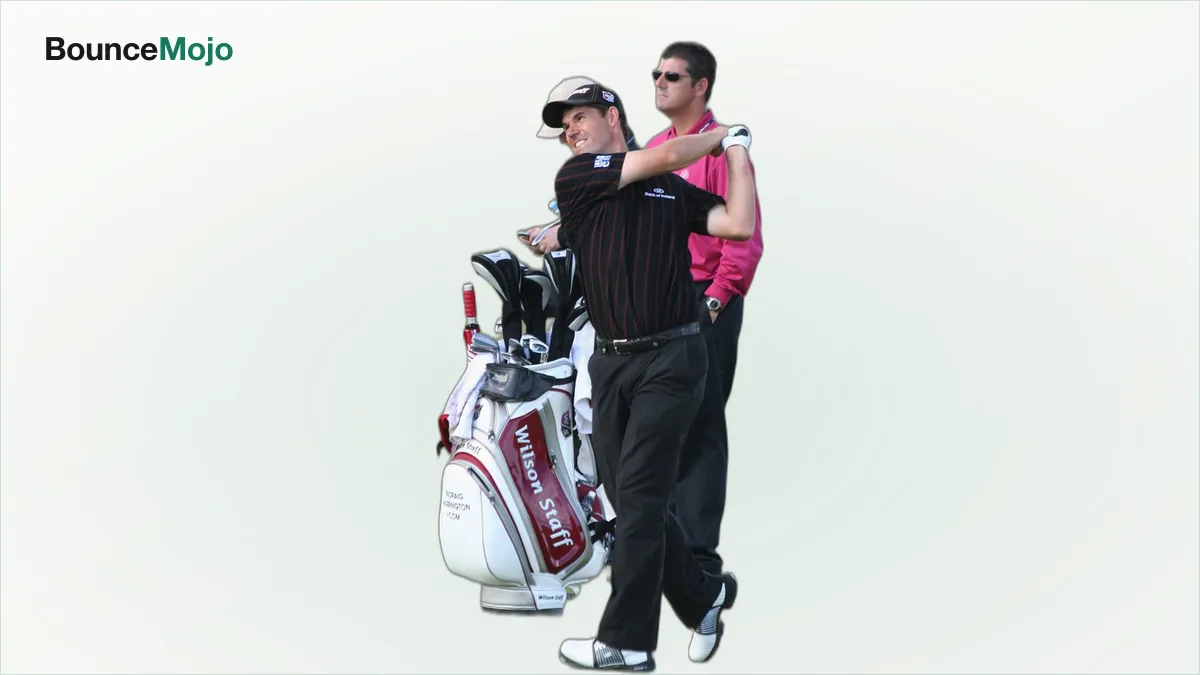
Most golf fans remember Padraig Harrington as the smiling Irishman who won three majors in barely a year. What they forget is how long, and how painfully, he waited for the first one.
Here’s what most people miss: Harrington built one of the great careers in modern golf not on raw talent but on stubbornness, an almost unreasonable refusal to stop grinding, tinkering, and believing.
The Myth vs. The Reality
The myth is comfortable. Padraig Harrington: the cheerful, lucky Irishman who caught fire for one magical season and collected three majors.
The reality is harder and more admirable.
Here’s the deal: Harrington was never the most naturally gifted player of his generation. He wasn’t the longest hitter or the purest striker. What he had was a bottomless work ethic and a mind that never stopped searching for one more small edge.
For years, that grinder’s brain was as much a curse as a gift. He would build a lead and let it slip. Critics whispered that he lacked the killer instinct, that he was destined to be the eternal contender who never quite won the big one.
You might be wondering: how does a man like that end up with three majors and a Ryder Cup captaincy? To understand that, you have to understand where he came from, and how badly he wanted it.
The World That Made Padraig Harrington
Harrington was born in 1971 in Dublin, the youngest of five brothers in a sporting Irish family. His father was a police officer and a keen Gaelic footballer, and competition was woven into daily life.
Golf in Ireland at the time was a respected but modest pursuit compared to the global machine it is now. There was no assembly line producing millionaire prodigies. A talented Irish golfer was expected to be practical about it.
Now: Harrington actually trained as an accountant before committing fully to golf. He had a fallback, a sensible profession, and for a while it looked like the safer path.
Think about it: the man who would win Open Championships was, in his 20s, weighing whether golf was even a realistic living. That practical, cautious streak never left him. It made him disciplined, methodical, and relentless, exactly the qualities that would carry him to the top.
The Crucible: Early Life and the Climb
The Environment That Shaped Him
Growing up with four older brothers meant Harrington learned to compete hard and lose often, useful training for a sport built on failure. He came up through amateur golf in Ireland, sharpening his game without the hype that surrounds today’s teenage stars.
Here’s the truth: his greatest weapon was between his ears. Harrington became famous for endlessly analyzing his swing, his putting, and his mental game, working with sports psychologists long before it was fashionable and drilling for hours after everyone else had gone home.
He turned professional in 1995 and quickly established himself on the European Tour as a consistent, dependable presence. But consistency came with a shadow. He kept finishing near the top of big events without winning them.
The Catalyst
By the mid-2000s, Harrington had built a reputation as one of the best players never to win a major, a label that stings a proud competitor.
Then came Carnoustie, 2007.
Let that land. In the final round of The Open Championship, Harrington hit two balls into the Barry Burn on the 72nd hole, a disaster that looked like it would confirm every doubt about him. Somehow he scrambled a double bogey, made the playoff against Sergio Garcia, and won it. His first major, snatched from the edge of catastrophe.
It gets better. Because that win didn’t just break a drought. It unlocked something. Over the next 13 months, Harrington would win two more majors and cement himself among the elite. And the way he did it revealed exactly who he was.
The Key Players
No one climbs alone, and Harrington’s story is full of the people who shaped him.
Caroline Harrington. His wife since 1997 and the steady partner behind a life spent traveling the world chasing tournaments. Family grounded him through the highs and the crushing near-misses.
Bob Torrance. His longtime swing coach and mentor, the late Scottish teacher who helped rebuild Harrington’s technique and instilled a relentless practice philosophy. Their partnership was central to his major breakthroughs.
Sergio Garcia. The rival he defeated in that 2007 Open playoff. Garcia was devastated, and the rivalry carried real emotional weight for years, but it also defined Harrington’s defining triumph.
The sports psychologists. Harrington leaned on mental-game specialists throughout his career, an early adopter of the idea that golf is won in the head. That edge helped him finally close out the biggest events.
By the way, notice the theme: Harrington surrounded himself with people who fed his obsession to improve. And that obsession, his greatest strength, would soon become his greatest risk.
The Turning Point
The Pinnacle
Harrington’s peak was one of the best short stretches any golfer has ever produced.
He won The Open Championship in 2007, defended it in 2008, and then, weeks later, captured the 2008 PGA Championship at Oakland Hills. Three majors in just over a year, putting him alongside the greats of the modern game and making him the most successful Irish golfer of his era to that point.
He didn’t stop collecting honors. He would later captain Team Europe at the 2021 Ryder Cup, one of the most prestigious jobs in the sport. As his net worth breakdown details, that body of work built a fortune estimated near $40 million.
The Price
Here’s the kicker: the very obsession that made him a champion nearly wrecked him afterward.
After his major run, Harrington kept tinkering, chasing an even better swing, and it backfired. He fell into a competitive slump, unable to recapture the form that had made him unbeatable. The grinder’s compulsion to improve had, for a time, taken away the very thing that worked.
It was a hard lesson in a career built on hard lessons: sometimes the pursuit of perfect is the enemy of great. Harrington had to learn to trust himself again.
The Unvarnished Truth
Harrington’s flaws were the flip side of his gifts, and he has always been honest about them.
He was, by his own admission, a compulsive tinkerer, so obsessed with improving that he sometimes broke what wasn’t broken. That restlessness cost him prime years after his majors, when he chased technical changes instead of riding his strengths.
Now: he could also be maddeningly slow and deliberate on the course, a byproduct of the analytical mind that made him great. Some found his pace and his overthinking frustrating to watch.
The most honest thing about Harrington is that he owns all of it. He talks openly about the doubts, the near-misses, and the slumps. There’s no polished myth-making, just a man who fought his own perfectionism as hard as he fought any opponent, and mostly won.
Controversies and Criticisms
Harrington’s career was relatively clean, but not without friction.
The “chokers” narrative. For years before 2007, critics questioned whether Harrington had the nerve to win a major. The label was cruel and, ultimately, spectacularly wrong, but it followed him for a long time.
The tinkering debate. His post-major slump fueled criticism that he had overthought his way out of greatness. Analysts pointed to Harrington as a cautionary tale about chasing perfection.
Pace of play. His slow, deliberate approach drew occasional complaints, a common criticism of highly analytical players.
LIV Golf era commentary. As the sport split over the LIV Golf breakaway, Harrington, a respected voice, weighed in thoughtfully on golf’s divisions, navigating a sensitive topic without alienating either side, a reflection of his diplomatic reputation.
The 2007 Carnoustie finish. Purists sometimes note that Harrington’s breakthrough Open win came partly because Sergio Garcia faltered in the playoff, and because Harrington himself survived hitting two balls into the water on the 72nd hole. It was a messy, dramatic finish rather than a flawless coronation. But great champions are often made in exactly those chaotic moments, and Harrington’s ability to recover from near-disaster is precisely what separated him.
Overthinking as a public trait. Harrington’s openness about his endless technical tinkering, while endearing to many, occasionally drew eye-rolls from those who felt he complicated a game he’d already mastered. His willingness to talk at length about swing theory made him a fascinating figure, and, to some, a frustrating one.
What We Can Learn From Padraig Harrington
Navigating Hard Times
The first lesson is about persistence through failure. Harrington lost big tournaments, earned a painful reputation, and kept showing up. When his moment finally came at Carnoustie, he had the resilience to survive a near-disaster and still win.
But here’s the truth his career makes plain: the near-misses were not wasted. Every heartbreak taught him something he used when it finally mattered. Failure was tuition, and he paid it in full.
There’s a deeper point here about labels. For years the golf world told Harrington who he was: a talented player who couldn’t win the big one. He could have believed it. Instead he treated that verdict as unfinished, not final. When a whole sport has decided what you can’t do, the only way to rewrite the story is to keep showing up until you prove them wrong. Harrington did exactly that, and then some.
The Success Blueprint
If you want the replicable part, it’s this: outwork and outthink, then know when to stop.
Harrington’s relentless preparation gave him an edge, and his career-long lesson was learning that discipline has limits, that at some point you have to trust the work and let go. That balance of grind and trust is exactly why he sits among the wealthy names on our richest golfers list, and among the richest athletes his longevity stands out.
The practical takeaway is nuanced. Hard work is necessary but not sufficient, and it can even become counterproductive when it curdles into overthinking. Harrington’s post-major slump taught him that improvement is not infinite, that there’s a point where fiddling with a winning formula does more harm than good. Knowing when to push and when to trust is a skill in itself, and it took one of the game’s hardest workers years to learn it.
Becoming Better
The deepest lesson is about longevity and reinvention. When his prime tour years faded, Harrington didn’t retire quietly. He found a whole new competitive life on the senior tour, still winning, still grinding, still improving in his 50s.
In other words, he treated aging as a new chapter, not an ending. The man once mocked as a nearly-man became a model of how to stay great, and stay hungry, for decades.
Final Verdict
Padraig Harrington is one of the most admired figures golf has produced, and “admired” fits him better than “flashy,” though his achievements are enormous. Three majors, a Ryder Cup captaincy, and a career that refused to end on schedule.
And here’s the twist that reframes everything: the man everyone once called a choker became one of the toughest closers of his generation, then proved it all over again on the senior tour. The full picture of the fortune he built, and the family and coaches who anchored it, lives in his net worth breakdown. His story proves that talent opens the door, but grit, honesty, and a refusal to quit are what carry you all the way through it.
Shop Padraig Harrington on Amazon
Books, audiobooks, merch and more, handpicked for fans.
As an Amazon Associate we earn from qualifying purchases.
Frequently Asked Questions
Who is Padraig Harrington?+
Padraig Harrington is an Irish professional golfer and three-time major champion, winner of the 2007 and 2008 Open Championships and the 2008 PGA Championship, and one of the most respected figures in the modern game.
What was Padraig Harrington's breakthrough?+
His breakthrough was the 2007 Open Championship at Carnoustie, won in a playoff over Sergio Garcia. It was his first major after years of near-misses and unlocked a remarkable run of success.
How is Padraig Harrington known for his work ethic?+
Harrington is famous for being one of the most obsessive practicers and tinkerers in golf, constantly refining his technique and mental approach, a grinder's mentality that defined his long career.
Did Padraig Harrington captain a Ryder Cup team?+
Yes. Harrington captained Team Europe at the 2021 Ryder Cup at Whistling Straits, capping a distinguished career as both player and leader.
Is Padraig Harrington still competing?+
Yes. Harrington competes on the PGA Tour Champions, the senior tour for players over 50, where he has continued to win and remain a force in the game.
Want the money side of the story?
Read Padraig Harrington's Full Net Worth Breakdown →Shop Padraig Harrington on Amazon
Books, audiobooks, merch and more, handpicked for fans.
As an Amazon Associate we earn from qualifying purchases.