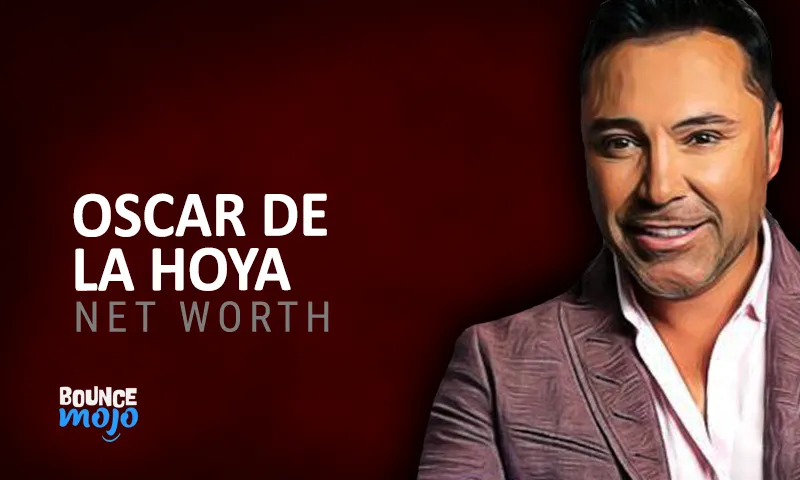
Oscar De La Hoya Net Worth (2026): The Golden Boy's $200M Empire
On This Page
- What Is Oscar De La Hoya’s Net Worth?
- How Does Oscar De La Hoya Make Money?
- How Did Oscar De La Hoya Build His Fortune?
- What Does Oscar De La Hoya Own?
- 🏠 Real Estate
- 🥊 The Golden Boy Company
- 🚗 Cars & Lifestyle
- Oscar De La Hoya’s Business & Investments
- How Does Oscar De La Hoya Compare?
- Net Worth: Year by Year
- Connected Wealth
- Top Takeaways to Success
- Frequently Asked Questions
Everyone assumes Oscar De La Hoya got rich from the Olympic gold and the record pay-per-views. They helped. But the purses were only the down payment on something much bigger.
Here’s the reality: De La Hoya is worth an estimated $200 million, and the single biggest reason is a company he built, not a fight he won.
What Is Oscar De La Hoya’s Net Worth?
Oscar De La Hoya’s net worth is an estimated $200 million in 2026. That figure puts him firmly among the wealthiest fighters in history, and the bulk of it sits in Golden Boy Promotions, the boxing-promotion empire he built rather than in leftover purse money.
The number is an estimate pulled from public reporting, and estimates vary. Some outlets peg him at around $200 million, others lower, because the value of a privately held promotion company is not published on a balance sheet. Treat it as a well-researched approximation, not an audited total.
Think about it: most boxers are defined by their last big check. De La Hoya is defined by the company that keeps writing them. Here’s how that money actually flows.
How Does Oscar De La Hoya Make Money?
De La Hoya’s income is a stack of streams, and the fighting is no longer the top of the pile. The main pillars:
- Golden Boy Promotions, the flagship. The promotion company he co-founded in 2002 is the largest driver of his fortune. It sells tickets, television rights, and pay-per-views for a stable of fighters, and De La Hoya takes the promoter’s share.
- Career purses and pay-per-view. As a fighter he earned more than $500 million in purses and promoter dividends, and his fights generated roughly $700 million in pay-per-view revenue across more than 14 million buys.
- Endorsements and sponsorships. His clean-cut, crossover image made him one of the most marketable athletes of his era, pulling sponsor money most boxers never touch.
- Real estate. Trophy properties in Pasadena and Nevada anchor the portfolio with assets that hold and grow value.
- Media and event production. Golden Boy has extended into broader combat-sports and entertainment events, widening the revenue base.
In other words, the fighter became the house. And the house always keeps a cut. Next, let’s trace how a kid from East LA built it.
How Did Oscar De La Hoya Build His Fortune?
The foundation was laid at the 1992 Barcelona Olympics, where De La Hoya won lightweight gold after promising his late mother he would. That medal gave him the “Golden Boy” name and a marketing platform no other American fighter had at the time.
Then came the paydays. He turned pro and went on to win ten world titles across six weight divisions, retiring at 39-6 with 30 knockouts. Along the way he headlined the biggest events of his era. His 1999 unification bout with Felix Trinidad drew 1.25 million buys and $64 million in pay-per-view income, smashing non-heavyweight records. His 2007 super-welterweight showdown with Floyd Mayweather pulled a then-record 2.4 million buys and roughly $136 million in revenue, handing De La Hoya a career-best purse near $52 million.
Here’s how he did it differently, though. In 2002, while still an active headliner, he co-founded Golden Boy Promotions with banker-turned-executive Richard Schaefer. That move let him capture the promoter’s share of his own mega-fights, something almost no modern fighter had done. Instead of handing that cut to an outside promoter, he kept it in his own company. Over a full career the pay-per-view total tells the scale of what he was building on: roughly $700 million in buys, once the highest figure in the sport before Floyd Mayweather and Manny Pacquiao surpassed it. Every one of those events proved the same point. The audience would pay premium money for boxing, and De La Hoya wanted to own the ticket booth, not just stand in the ring. The company was the real windfall, and it kept paying after he retired. We’ll get to the assets it bought next.
What Does Oscar De La Hoya Own?
The De La Hoya portfolio leans on trophy real estate and a marquee company. Here’s the breakdown.
🏠 Real Estate
- Pasadena, California mansion, ~$18 million today. He bought this longtime family home in 2001 for $5.2 million, and it is now valued around $18 million.
- Henderson, Nevada estate, listed at $19.5 million. In 2022 he purchased an unfinished home for $14.6 million, poured millions into custom finishes, then listed it in June 2025 for $19.5 million.
🥊 The Golden Boy Company
- Golden Boy Promotions. His single most valuable asset. The promotion company represents elite fighters, stages major cards, and has held business stakes beyond boxing, including a reported ownership piece of a Houston Dynamo soccer investment. Its exact value is private, but it is the engine of his $200 million estimate.
🚗 Cars & Lifestyle
- De La Hoya has enjoyed the trappings of a top-earning athlete over the years, from luxury vehicles to a high-profile Los Angeles social life, though the durable wealth sits in the company and the property, not the garage.
Trust me, the flashy stuff is the smallest line item. The business is the story, so let’s open the books on it.
Oscar De La Hoya’s Business & Investments
Strip away the fight highlights and De La Hoya looks like the owner of a media-and-events company that happens to sell boxing. Golden Boy Promotions grew into one of the most powerful outfits in the sport after 2002, promoting stars such as Canelo Alvarez and Ryan Garcia and staging pay-per-view cards that generated revenue De La Hoya no longer had to bleed for.
Here’s why that matters. A boxer’s earning window is brutally short. Promoters, by contrast, get paid every time someone else fights. By building the company while he was still the main attraction, De La Hoya turned a finite fighting career into a recurring business, the same “own the platform” logic that separates lasting sports fortunes from one-night windfalls.
His path had setbacks worth noting factually. He settled a 1998 legal claim out of court, and in 2001 he settled a widely reported $62.5 million palimony suit filed by Shanna Moakler. He has also spoken publicly about past struggles with addiction. He addressed these openly, and the promotion business carried the fortune through them. Next, let’s see where that leaves him against the sport’s richest.
How Does Oscar De La Hoya Compare?
Among boxing’s wealthiest, De La Hoya’s $200 million places him in elite company, but not at the very top. Floyd Mayweather, the man who beat him in 2007 and then built his own promotion company and record-breaking pay-per-view brand, sits far higher at an estimated $400 million. George Foreman is the outlier who made more from a grill than from gloves. Mike Tyson earned more in the ring than almost anyone yet famously lost it, a cautionary contrast to De La Hoya’s build-and-keep arc. And Manny Pacquiao, whom De La Hoya faced in 2008, built a separate empire in politics and business.
What sets De La Hoya apart is the promotion play. He was the first modern fighter to capture the promoter’s share of his own mega-fights, and that decision is why he stayed wealthy long after the last bell. For the full picture of how he ranks against the sport’s biggest earners, see our richest boxers list, and compare his path to the broader field on our richest athletes rankings.
Oscar De La Hoya Net Worth: Year by Year
| Year | Net Worth |
|---|---|
| 2007 | $200 Million |
| 2015 | $180 Million |
| 2020 | $200 Million |
| 2024 | $200 Million |
| 2026 | $200 Million (est.) |
Connected Wealth
Shop Oscar De La Hoya on Amazon
Books, audiobooks, merch and more, handpicked for fans.
As an Amazon Associate we earn from qualifying purchases.
🏆 Top Takeaways to Success
- 1
Own the promotion, not just the purse. De La Hoya launched Golden Boy in 2002 so he could take the promoter's cut of his own mega-fights, then keep earning it long after he stopped fighting.
- 2
Turn fame into a platform. He converted a marketable name and Olympic gold into a company that sold tickets, TV rights, and pay-per-views for other stars.
- 3
Diversify before the body quits. Boxing careers are short. He built the business while still headlining, so retirement was a pivot, not a cliff.
- 4
Cash in on crossover appeal. His clean-cut image pulled endorsement money most fighters never see, adding a second revenue stream on top of purses.
- 5
Buy assets that hold value. Trophy real estate in Pasadena and Nevada gave the fortune ballast beyond fight-night income.
Frequently Asked Questions
What is Oscar De La Hoya's net worth in 2026?+
Oscar De La Hoya's net worth is an estimated $200 million, built mostly from Golden Boy Promotions rather than his fight purses alone.
How did Oscar De La Hoya make most of his money?+
The largest share comes from Golden Boy Promotions, the boxing-promotion company he founded in 2002, which turned him into a mogul long after retiring. His career also generated over $500 million in purses and roughly $700 million in pay-per-view revenue.
How much did Oscar De La Hoya earn as a fighter?+
He earned more than $500 million in ring purses and promoter dividends across his career, headlined by a record $52 million payday against Floyd Mayweather in 2007.
What is Golden Boy Promotions?+
It is the boxing-promotion company De La Hoya co-founded in 2002. It became one of the most powerful outfits in the sport, staging major cards and representing stars including Canelo Alvarez and Ryan Garcia.
Is Oscar De La Hoya still one of the richest boxers?+
Yes. At an estimated $200 million he ranks among the wealthiest fighters ever, though below Floyd Mayweather and George Foreman on our richest boxers list.
Shop Oscar De La Hoya on Amazon
Books, audiobooks, merch and more, handpicked for fans.
As an Amazon Associate we earn from qualifying purchases.