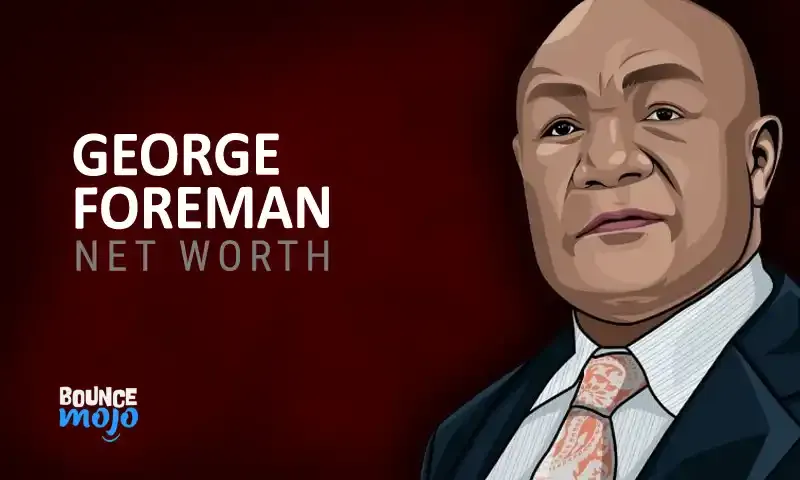
George Foreman Net Worth (2026): How a $300M Grill Fortune Beat Boxing
On This Page
- $300 Million, And Almost None Of It From The Ring
- Olympic Gold, Then Frazier On The Floor
- Zaire, 1974: Five Million Dollars And The Rope-A-Dope
- The Quiet Years, And Being Nearly Broke By 1987
- Champion Again At Forty-Five
- Forty Percent Of Every Grill Sold
- The $137.5 Million Signature
- The Huffman Ranch And The 55-Car Garage
- Why His Money Outlasted The Boxing Money
- Net Worth: Year by Year
- Connected Wealth
- Top Takeaways to Success
- Frequently Asked Questions
George Foreman died in March 2025 at the age of 76, and the obituaries had to hold two men at once: the terrifying puncher who ruled the heavyweight division, and the warm, unhurried grandfather who sold America a small hot grill. The second man made far more money than the first. This profile follows that arc in the order he lived it.
$300 Million, And Almost None Of It From The Ring
Foreman’s net worth was an estimated $300 million at the time of his death, ranking him among the wealthiest fighters ever. His purses across a long career added up to an estimated $50 to $60 million. The George Foreman Grill put well over $200 million in his pocket. The appliance beat the athlete, and it was not close.
That figure is an estimate assembled from public reporting including Celebrity Net Worth and Wikipedia, so treat it as a well-researched approximation rather than an audited statement.
Olympic Gold, Then Frazier On The Floor
He won Olympic gold in 1968 as a teenager out of Marshall, Texas, and turned professional as one of the most physically frightening heavyweights the sport had produced. In 1973 he took the world title by flattening Joe Frazier, a demolition so complete it reset the division’s hierarchy overnight.
Zaire, 1974: Five Million Dollars And The Rope-A-Dope
The following year came the fight that made him permanently famous even in defeat. The Rumble in the Jungle in Zaire pitted him against Muhammad Ali, who absorbed rounds of punishment on the ropes and then knocked out an exhausted Foreman. Promoter Don King paid each man five million dollars, extraordinary money for the era and a purse that would headline most careers.
The Quiet Years, And Being Nearly Broke By 1987
Foreman retired in 1977, poured money into bad investments, and by 1987 was reportedly close to broke. A former heavyweight champion of the world had effectively spent his way back to the bottom. Anyone assessing his fortune has to reckon with the fact that the $300 million was built entirely after this point, from something close to zero.
Champion Again At Forty-Five
So he did the implausible thing and came back at 38, overweight and years out of practice. Seven seasons of grinding later, at 45 years old, he knocked out Michael Moorer to reclaim the heavyweight title and become the oldest heavyweight champion in history, banking a career-best $12.5 million purse in the process.
The title mattered less than what it manufactured: a second wave of fame, this time attached to an older, funnier, unmistakably trustworthy public character. A company called Salton wanted precisely that.
Forty Percent Of Every Grill Sold
The fat-draining electric grill launched in the mid-1990s and became a household staple on the back of Foreman’s affable pitch, eventually selling more than 100 million units worldwide. The structure of his deal is the reason it made him rich rather than merely paid.
He refused a flat appearance fee and took a share of the profit on every unit, reportedly around 40%. At the peak he was pulling in between $4.5 million and $8 million a month. By 1998 grill sales were running near $200 million a year and accounted for a large slice of Salton’s entire revenue.
The $137.5 Million Signature
In 1999, rather than keep paying those royalties indefinitely, Salton bought the perpetual rights to use Foreman’s name for roughly $137.5 million in cash and stock. Add the earlier royalties and years of later product extensions and the grill conservatively earned him well over $200 million in total.
Set that against $50 to $60 million in career purses and the conclusion is unavoidable: he made several times more money selling grills than throwing punches. It remains one of the most successful celebrity licensing deals in business history, and a case study for every fighter on our richest boxers list.
The Huffman Ranch And The 55-Car Garage
He spent the back half of his life large, and mostly in Texas. His main residence in Huffman was a roughly 12,000-square-foot Mediterranean estate on around 29 acres, built in the early 2000s and later listed near $9.5 million, with a garage designed to hold about 55 vehicles. He filled it with classic and exotic cars, then auctioned off more than 50 of them in late 2023 to global bidders.
Back in his hometown of Marshall he kept a 300-acre ranch stocked with horses and cattle, where he ran his youth and community programs, and on the coast a Malibu beach townhouse worth around $2.3 million. Books, speaking and his own ministry kept producing income long after the last bell.
Why His Money Outlasted The Boxing Money
Boxing produces the biggest one-night paydays in sport and the most famous boom-to-bankruptcy stories, a fate that has touched fighters from Mike Tyson to Evander Holyfield. Foreman lived both sides of it, broke in 1987 and worth nine figures a decade later.
The difference was discipline about ownership. Ali built lasting wealth from his name and image after retirement; Foreman took the same idea further by attaching his name to one blockbuster product, collecting on every unit, and then selling the asset outright when the offer justified it. See where he ranks on our richest athletes list and among the sport’s biggest earners on our richest boxers ranking. He threw some of the hardest punches the division ever saw. The most profitable one landed in the kitchen.
George Foreman Net Worth: Year by Year
| Year | Net Worth |
|---|---|
| 1987 | Near Broke |
| 1995 | $40 Million |
| 1999 | $200 Million |
| 2015 | $250 Million |
| 2025 | $300 Million (est.) |
Connected Wealth
Shop George Foreman on Amazon
Books, audiobooks, merch and more, handpicked for fans.
As an Amazon Associate we earn from qualifying purchases.
🏆 Top Takeaways to Success
- 1
License your name, don't just rent your fame. Foreman took a slice of every grill sold instead of a flat endorsement fee, turning his face into an asset that paid him for years.
- 2
Take the equity, then take the buyout. He earned royalties on 100 million+ grills, then sold the rights to his name for roughly $137.5 million in cash and stock. Build the brand, cash the multiple.
- 3
Reinvention beats nostalgia. A washed-up former champ at 38, he came back, won the title at 45, and used that renewed fame to launch a kitchen empire.
- 4
Your second act can dwarf your first. The grill earned him well over $200 million, more than his entire boxing career combined.
- 5
Losing money once isn't the end. Foreman was nearly broke by 1987, then rebuilt a $300 million fortune from scratch.
Frequently Asked Questions
What was George Foreman's net worth?+
George Foreman's net worth was an estimated $300 million at the time of his death in March 2025, making him one of the richest boxers ever.
How much did George Foreman make from the grill?+
He earned well over $200 million from the George Foreman Grill, including royalties and a roughly $137.5 million buyout of his name rights, far more than he made boxing.
How many George Foreman Grills were sold?+
The grill sold more than 100 million units worldwide, one of the best-selling kitchen appliances in history.
Did George Foreman make more from boxing or the grill?+
The grill. His boxing career earned an estimated $50 to $60 million in purses, while the grill brought in more than $200 million.
How did George Foreman spend his money?+
On a 12,000-square-foot Texas mansion, a 300-acre ranch in his hometown, a 55-car garage of exotic cars, and a Malibu beach home, plus his youth center and ministry.
Shop George Foreman on Amazon
Books, audiobooks, merch and more, handpicked for fans.
As an Amazon Associate we earn from qualifying purchases.