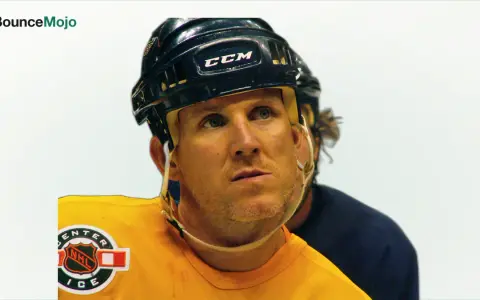
Nicklas Lidstrom Biography: The Story of the Perfect Defenseman

The calm face. The perfect positioning. The stick that always seemed to be exactly where the puck was going. That’s the Nicklas Lidstrom most fans remember.
Here’s what most people miss: the greatest defenseman of his generation was a quiet Swede who nearly got overlooked, drafted 53rd, and had to prove that a player without menace or flash could dominate the toughest league on earth.
The Myth vs. The Reality
The myth is serene. Nicklas Lidstrom is the flawless defenseman who never panicked, never got beaten, and made the hardest position in hockey look effortless.
The reality took more grit than the calm suggests.
Here’s the truth: Lidstrom was a late second-round pick who arrived in North America as a slender, unproven 21-year-old, unsure whether his cerebral, non-physical style would even survive in a rougher, faster NHL. The serenity fans remember was earned, not gifted. It came from thousands of correct decisions made under pressure until they looked easy.
Now think about that gap. A player labeled too soft for the North American game became the standard by which defensemen are measured.
To understand how, you have to start in a hockey town in central Sweden.
The World That Made Nicklas Lidstrom
Nicklas Erik Lidstrom was born on April 28, 1970, in Vasteras, Sweden. He grew up in a country whose hockey tradition prized skill, skating, and intelligence over brute force.
That environment shaped everything about him. Swedish hockey taught positioning and puck movement, a game of angles and anticipation rather than collisions. Lidstrom absorbed those lessons completely, developing into a defenseman who controlled the ice with his brain and his stick instead of his fists.
But here’s the deal: in the early 1990s, the NHL was still a bruising, North American-dominated league that often doubted whether elegant European players could handle its physical grind. Lidstrom was about to test that doubt.
He played his early hockey with Vasteras in the Swedish leagues, sharpening the calm, error-free style that would define him. Detroit drafted him 53rd overall in 1989, a pick that looked modest at the time and later became one of the great draft-day steals in league history. Scouts saw a smooth, intelligent defenseman, but plenty doubted whether that finesse would survive the smaller rinks and rougher play of North America. For two more years he stayed in Sweden, maturing, adding strength and confidence to a game already built on brains, before finally making the leap in 1991 as a 21-year-old ready to prove the skeptics wrong.
Leaving home was no small thing. He was crossing an ocean, a language barrier, and a wall of skepticism about his style, all at once.
The Crucible: Early Life and the Climb
The environment that shaped him
Lidstrom arrived in Detroit in 1991 as a quiet, polished, but unproven talent. The Red Wings were a franchise on the rise, building toward greatness, and they needed a defenseman who could think the game.
He fit immediately. His calm never wavered, even as a rookie, and his positioning was so sound that he rarely needed to be physical. He simply took away time and space until opponents ran out of options.
The talent was obvious. What no one yet knew was how long it would last.
The catalyst
The catalyst was Detroit’s championship era, and Lidstrom’s central role in it.
As the Red Wings grew into a dynasty, Lidstrom became their anchor on the blue line. He logged enormous minutes against the best players in the world and made it look routine. He won his first Stanley Cup in 1997, then another in 1998, and the quiet Swede who was once doubted became the backbone of a champion.
Here’s the deal: how a soft-spoken defenseman handled the weight of a franchise’s expectations would decide whether he was very good or truly great.
Want to know what he did with that pressure? He absorbed it without ever seeming to feel it, and the trophies kept coming.
The Key Players
You cannot tell the Lidstrom story without a few names.
Steve Yzerman is the first, the legendary Red Wings captain who set the tone for the franchise’s culture of professionalism and eventually passed the captaincy to Lidstrom. Yzerman’s leadership gave Lidstrom a model of quiet excellence to follow and then extend.
Scotty Bowman is the second, the Hall of Fame coach who trusted Lidstrom with mountains of ice time and helped guide Detroit to multiple Cups. Bowman understood exactly what he had in Lidstrom, a defenseman who could be relied on in any situation without fail.
Ken Holland, the longtime Red Wings general manager, kept the team elite around Lidstrom for years, and the deep, talented Detroit rosters of that era gave him partners and teammates worthy of his standard.
And Annika, his wife, anchored a private, grounded family life with their four sons. That stability off the ice mirrored the stability he showed on it, and it kept him even-keeled through two decades of pressure. The family split time between Michigan and Sweden, and Lidstrom’s devotion to them was as much a part of his identity as anything he did in a Red Wings sweater.
Here’s the truth: all of that support set up the crowning moment of his career.
The Turning Point: Triumph and Its Hidden Cost
The pinnacle
Start with 2008, because it made history.
Lidstrom, by then the Red Wings captain, led Detroit to another Stanley Cup and became the first European-born captain to lift the Cup as a captain. It was a landmark moment for hockey, proof that the game had truly gone global and that a Swedish defenseman could lead a North American dynasty to the mountaintop.
Around that triumph sat a mountain of individual honors. Lidstrom won the Norris Trophy as the NHL’s best defenseman seven times, one of the highest totals ever. He played in All-Star Games, won an Olympic gold medal for Sweden, and earned a reputation as the most reliable player in the world at his position. Teammates and coaches called him “The Perfect Human,” only half-joking, because he so rarely made a mistake.
He did it all with the same unshakable calm, night after night, season after season, for 20 years with one franchise.
The price
Now the cost, which was quieter than most.
Lidstrom paid for his greatness in the enormous, relentless workload he carried. He logged some of the heaviest minutes in the league year after year, matched against the best opponents, and the mental and physical toll of that responsibility was constant even if he never showed it. He also gave up the comforts of home, spending the prime of his life an ocean away from Sweden, raising a family across two continents.
There was a private strain in that distance, and eventually it shaped his exit.
You might be wondering how a player so dominant walks away. The answer says everything about who he is.
The Unvarnished Truth
Let’s not pretend the calm meant he felt nothing.
Lidstrom’s decision to retire in 2012 came while he was still playing at a high level, still capable of top-pairing minutes. He walked away not because he was finished, but because he wanted to return to Sweden with his family and be present for his sons. That choice revealed the tension he lived with for two decades: the pull between an all-consuming career in America and a home life waiting across the Atlantic.
His style also carried a hidden vulnerability that critics sometimes raised. Because he relied on positioning rather than physicality, some doubters early on questioned whether he was tough enough for the grind of playoff hockey. He answered that doubt with four Cup rings, but the question followed him in his younger years.
Here’s the truth: Lidstrom’s greatest strength, his calm, cerebral game, was the very thing skeptics first used against him. He turned a supposed weakness into the blueprint for modern defense.
Even so, the doubts never rattled him, and that composure became his signature.
Controversies and Criticisms
For a player this respected, Lidstrom’s controversies are almost nonexistent.
The biggest knock was never about behavior. It was the early-career question of whether a non-physical European could truly dominate in the NHL. He silenced it completely, but it lingered in his first seasons.
Some also debated whether his quiet, undemonstrative style made him underappreciated compared to flashier stars. He rarely sought attention, gave measured interviews, and let his play speak, which meant casual fans sometimes overlooked just how great he was. For years, hardcore hockey people ranked him among the very best in the world while the broader sports public barely knew his name, precisely because he did nothing to draw the spotlight. He did not fight, did not celebrate wildly, did not chase headlines. He simply never made mistakes, and mistakes, ironically, are what get players noticed.
Beyond that, there is little to criticize. No scandals, no feuds, no drama. In a sport full of big personalities, Lidstrom’s biggest sin was making excellence look boring.
Here’s the thing though: none of it dents the legacy. Because seven Norris Trophies and four Cups answered every question a doubter ever raised.
What We Can Learn From Nicklas Lidstrom
Navigating the darkness
When people doubt your way of doing things, you can change or you can prove them wrong.
Lidstrom proved them wrong. Told his skill-first, non-physical style would not survive the NHL, he refused to abandon it and instead perfected it until it became the model everyone copied. The lesson is not to ignore doubt. It is that authenticity, executed flawlessly, can rewrite the rules.
The success blueprint
Now the part that built both the legend and the fortune.
Lidstrom played 20 seasons with one franchise, stayed healthy, and performed at an elite level far longer than almost anyone. He treated his career as a long game and his life as something to protect, which is why he ranks among the richest hockey players in the world. The full money breakdown lives in our Nicklas Lidstrom net worth analysis, and you can see where he sits among the richest athletes overall. His path echoes that of fellow quiet champions like Joe Sakic, who also built lasting wealth on loyalty and consistency.
Becoming better
The deepest lesson is about composure. Lidstrom showed that you do not have to be loud, physical, or dramatic to be the best. You can win with intelligence, discipline, and calm, and you can do it for 20 years without burning out.
So what’s the final word on the most flawless defenseman the game has seen?
Final Verdict
Nicklas Lidstrom is the rare legend whose greatness came from the absence of mistakes rather than the presence of flash.
On the ice, he is a four-time champion, a seven-time Norris winner, a Hall of Famer, and the man who redefined how defense is played. Off it, he is a devoted family man who left the game at the top to go home to Sweden, on his own terms.
Here’s the bottom line: the calm was never the whole story. Behind it was a doubted late-round pick who crossed an ocean, ignored the skeptics, and built the most consistent career any defenseman has ever put together.
Anyone who remembers only the serene expression has missed the will underneath. Lidstrom’s real story is quiet defiance, and it is more impressive than any highlight reel of big hits ever could be.
Shop Nicklas Lidstrom on Amazon
Books, audiobooks, merch and more, handpicked for fans.
As an Amazon Associate we earn from qualifying purchases.
Frequently Asked Questions
Where did Nicklas Lidstrom grow up?+
Nicklas Lidstrom was born on April 28, 1970, in Vasteras, Sweden, where he learned the game before Detroit drafted him and brought him to North America in 1991.
Why is Nicklas Lidstrom called 'The Perfect Human'?+
Teammates and coaches nicknamed him 'The Perfect Human' because he almost never made a mistake, played with total calm, and stayed injury-free and consistent for two decades.
How many Stanley Cups did Nicklas Lidstrom win?+
Lidstrom won four Stanley Cups with the Detroit Red Wings and in 2008 became the first European-born captain to lift the Cup as captain.
Did Nicklas Lidstrom play his whole career with one team?+
Yes. He spent all 20 NHL seasons with the Detroit Red Wings, a rare display of loyalty that defined his career and his legacy.
Is Nicklas Lidstrom in the Hall of Fame?+
Yes. Lidstrom was inducted into the Hockey Hall of Fame in 2015, in his first year of eligibility, as one of the greatest defensemen ever.
Want the money side of the story?
Read Nicklas Lidstrom's Full Net Worth Breakdown →Shop Nicklas Lidstrom on Amazon
Books, audiobooks, merch and more, handpicked for fans.
As an Amazon Associate we earn from qualifying purchases.