Mo Farah Biography: The Trafficked Boy Who Became a Running Great
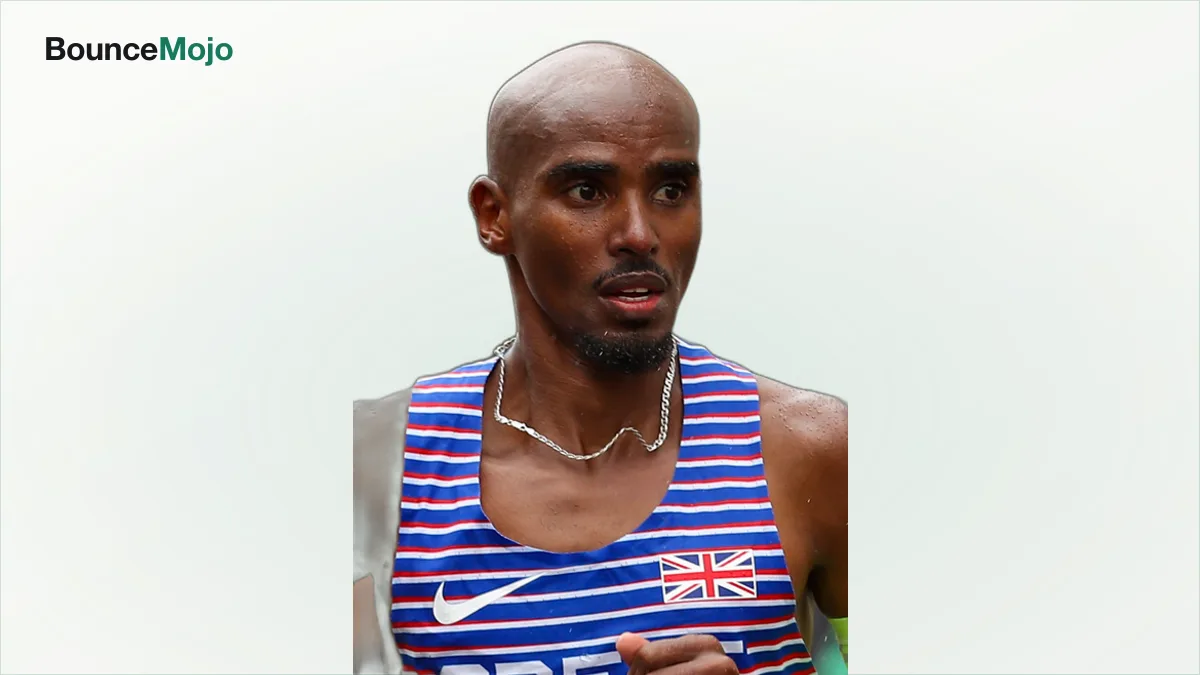
Most people know Mo Farah as the smiling Brit who did the “Mobot” and won everything on the track. That picture is missing the darkest and most important chapter of all.
Here’s what almost nobody knew until recently: the name on those four gold medals wasn’t even his real name.
The Myth vs. The Reality
The myth is cheerful. Mo Farah: beloved British runner, the man of the “Mobot,” a national treasure who ran laps around the world and hugged everyone at the finish line. Feel-good story. Immigrant made good. Roll credits.
The reality is far heavier, and far braver.
Here’s the deal: for most of his life, Farah carried a secret that could have unravelled everything he’d built. The cheerful champion the public adored was a survivor of child trafficking and forced domestic servitude, a boy whose real identity had been erased before he ever ran a race.
And the “immigrant made good” framing misses the specifics that matter. Farah didn’t simply arrive and thrive. He was brought to Britain illegally under another child’s identity, separated from his family, and made to work in a stranger’s home. The path from that house to an Olympic podium is one of the most improbable in sport.
You might be wondering: how does a trafficked, undocumented child end up as one of Britain’s most decorated athletes? To understand that, you have to understand the world he was torn out of.
The World That Made Mo Farah
Farah was born in 1983 in Somaliland, a self-declared republic in the Horn of Africa that most of the world does not formally recognise.
It was a region scarred by conflict. Somalia’s long civil war shattered families and displaced millions, and Farah’s own father was killed by a stray bullet when Farah was very young. This was a childhood shaped by instability, danger and separation, the kind of upbringing that makes the phrase “against the odds” feel like an understatement.
Now: the world Farah was born into had almost no on-ramp to the life he would eventually lead. There were no academies, no talent pipelines, no safety net. Survival was the project, not sport.
That backdrop, war, displacement, a father lost, is essential to everything that followed. Farah didn’t come from a system that produced champions. He came from a place that produced refugees, and he was one of them before he was anything else.
But before the running, there was the journey that nearly ended his story before it began.
The Crucible: Early Life and the Climb
The Environment That Shaped Him
Farah was separated from his family and brought to the United Kingdom at around the age of nine, under circumstances he kept hidden for decades.
In his 2022 documentary, Farah revealed the truth: he was trafficked. Given the name “Mohamed Farah” by the adults who transported him, he was taken to west London and made to care for another family’s children and do domestic work. He was told that if he wanted to see his real family again, he had to say nothing. For a long time, he obeyed.
This is crazy: the child who would one day carry the hopes of a nation at the Olympics spent his early years in Britain isolated, unschooled at first, and afraid. He has described locking himself in a bathroom to cry.
Here’s the truth: that boy had almost no reason to expect a future. And then someone looked closely enough to see one.
The Catalyst
The turning point wore a whistle.
At school, a physical education teacher named Alan Watkinson noticed two things about Farah: he was miserable and withdrawn at home, and he was extraordinary on the running track. Watkinson intervened. He advocated for Farah, helped surface his real situation, and pushed him toward the sport that would become his salvation.
Running gave Farah something the rest of his life didn’t: control, structure and a way to be seen for a gift rather than pitied for a circumstance. He improved fast, competing in cross-country and on the track as a teenager and drawing attention from British athletics.
It gets better, and stranger. The undocumented boy who’d been told to stay silent would eventually gain British citizenship and pull on the national vest. But the people who helped him climb, and the ones who complicated the ascent, would shape the runner he became.
The Key Players
No one escapes a start like Farah’s alone. His story is full of people who lifted him, guided him, and, in one case, cast a long shadow over his legacy.
Alan Watkinson. The PE teacher is the hinge of the entire story. He recognised the talent, understood the trauma, and helped Farah toward both a running career and legal status. Farah has repeatedly credited him as the man who changed his life. Watkinson even attended Farah’s wedding.
Tania Nell. Farah’s wife became far more than a partner. She has helped manage his career, his brand and his affairs, providing stability for a man whose early life had almost none. Their family became the anchor his childhood never gave him.
Alberto Salazar. The American coach at the Nike Oregon Project guided Farah through his greatest years. Salazar was a brilliant, driven coach, and later a deeply controversial one. That relationship delivered Farah’s peak and, eventually, a cloud he had to run out from under.
The British public. In a sense, an entire nation became a key player. The crowd that roared him home in 2012 gave Farah a belonging that had been stolen from him as a child.
Think about it: every one of these relationships answered a need created by his origins, safety, stability, coaching, belonging. That convergence set up the fortnight that made him a legend.
The Turning Point
The Pinnacle
The summer of 2012 is Farah’s mountaintop.
On home soil at the London Olympics, in front of a delirious British crowd, Farah won gold in the 10,000m and then, days later, the 5,000m. The “Super Saturday” and the double that followed made him a national icon overnight. He backed it up at Rio 2016, winning both events again to complete the “double-double,” a feat that puts him among the greatest distance runners in Olympic history.
Add multiple World Championship golds, and the record is overwhelming. As his own net worth story explains, that dominance is exactly what turned him into a commercial force, one of the most bankable British athletes of his era.
The image endured: Farah crossing the line, arms out, then bending them into the “Mobot” as a stadium screamed his name. A trafficked, undocumented boy had become the pride of the nation that once nearly failed him.
The Price
Here’s the kicker: the higher Farah climbed, the more scrutiny came with it.
Distance running at the elite level is a punishing grind, thousands of miles, years of altitude camps, family time sacrificed to training bases far from home. And with fame came the questions. His association with a coach who would later be banned meant Farah, though never charged himself, spent years answering for someone else’s controversy. The pinnacle came with a price tag of suspicion he did nothing to earn but couldn’t fully escape.
Which brings us to the harder truths behind the smile.
The Unvarnished Truth
Farah is not a flawless figure, and treating him as a simple feel-good story does his real courage a disservice.
He has admitted to years of silence about his true identity, a secret he kept even as it created legal and personal risk. He carried anger and pain from his childhood that took decades to process. He has spoken candidly about the isolation and fear of his early years in Britain, and about how long it took to feel safe.
Now: none of this is a failing. It’s the residue of trauma. A child taught that speaking up meant losing his family will keep secrets long into adulthood. That’s survival, not deceit.
But it does complicate the tidy narrative. Farah’s status as a British athlete rested on a legal identity built on a lie he was forced into as a child. When he finally told the truth in 2022, he did so knowing it could raise hard questions about his citizenship and his past. He told it anyway.
The most honest thing anyone can say about Farah is this: his greatest strength, the discipline and control that made him a champion, was forged in a childhood defined by having no control at all.
Controversies and Criticisms
Farah’s career ran alongside one of the biggest doping controversies in modern athletics, even though he was never the one accused.
The Salazar affair. His coach, Alberto Salazar, was investigated for years and ultimately banned from the sport. Because Farah trained under him at the Nike Oregon Project, he faced relentless questions. Investigations, however, produced no finding against Farah himself, and he has always firmly denied any wrongdoing. The episode nonetheless dogged his reputation during his peak.
The missed test questions. Like many elite athletes, Farah faced scrutiny over anti-doping whereabouts and testing protocols. He addressed them directly and was never sanctioned, but the coverage was intense.
The identity revelation. When Farah disclosed his trafficking and true name in 2022, some questioned the legal implications of a citizenship obtained under a false identity. UK authorities indicated they would not act against him, recognising he had been a child victim of trafficking. Most of the public responded with sympathy and admiration.
The through-line is unfair: a man who survived one of the hardest possible childhoods spent much of his fame defending himself, either for another man’s actions or for a deception forced on him as a boy.
What We Can Learn From Mo Farah
Navigating Hard Times
The first lesson is about survival: your origins do not set your ceiling. A trafficked, silenced child who once cried alone in a bathroom became a four-time Olympic champion. Farah’s life is proof that the worst possible start can still lead somewhere extraordinary, provided one person looks closely enough to help.
But here’s the truth his story makes plain: survival isn’t the finish line. Farah beat war, trafficking and isolation and still spent decades carrying the weight of a secret. Real freedom came only when he finally spoke it aloud.
The Success Blueprint
If you want the replicable part, it’s this: Farah won through relentless, unglamorous consistency. Distance running rewards the athlete who shows up, day after day, for years, when no one is watching. He didn’t have raw sprinter’s flash. He had a work ethic that outlasted everyone.
That’s transferable. The lesson isn’t “run faster.” It’s “compound small efforts over an unreasonable length of time.” That discipline is what carried him from British junior ranks to a place among the greats, and it’s why he sits alongside legends on our richest Olympians ranking of the athletes who built careers on the Games.
Becoming Better
The deepest lesson is about truth. Farah spent his life hiding the most important fact about himself, then chose, at the height of his fame, to reveal it, knowing the risk. He traded comfort for honesty.
In other words, the bravest thing he ever did wasn’t a race. It was telling the world who he really was, and using his own pain to shine a light on the thousands of trafficked children who never get a teacher, a talent, or a way out.
Final Verdict
Mo Farah is one of the greatest distance runners of all time, and the word “greatest” is doing lighter lifting than the word “survivor.” His four Olympic golds are historic. His journey to them is almost unbelievable.
And here’s the twist that reframes everything: the beloved national hero the public thought they knew was, in truth, a trafficking survivor running under a name that wasn’t his. When he finally told that story, he didn’t diminish his achievements. He deepened them. Every medal now reads as a victory over odds far longer than any rival on the track.
If Farah’s story teaches anything, it’s that a single person, a teacher who bothered to look, can change the entire trajectory of a life. And that the courage to run the last honest lap, the one where you tell the truth about where you came from, can be the greatest race of all. The full picture of how that resilience translated into a lasting fortune lives in his net worth breakdown, and it’s the rare champion’s ending where the character behind the medals matters even more than the medals themselves.
Shop Mo Farah on Amazon
Books, audiobooks, merch and more, handpicked for fans.
As an Amazon Associate we earn from qualifying purchases.
Frequently Asked Questions
What is Mo Farah's real name?+
His birth name is Hussein Abdi Kahin. He was trafficked into the United Kingdom as a child and given the name Mohamed Farah by the people who brought him over, a story he revealed publicly in a 2022 BBC documentary.
Where was Mo Farah born?+
Farah was born in Somaliland, in the Horn of Africa. His father was killed in the civil war when Farah was a young child, and he was later separated from his family and trafficked to Britain.
How did Mo Farah get into running?+
A physical education teacher, Alan Watkinson, recognised Farah's talent and his difficult home situation, encouraging him to run and helping him toward citizenship and a life in sport. Farah has credited Watkinson with changing his life.
What are Mo Farah's greatest achievements?+
Farah won four Olympic gold medals, taking the 5,000m and 10,000m at both London 2012 and Rio 2016, plus multiple World Championship titles. He is widely regarded as the greatest distance runner Britain has produced.
Did Mo Farah face doping allegations?+
Farah himself was never charged with any doping offence and has always denied wrongdoing. Questions arose around his former coach, Alberto Salazar, who was later banned, but investigations produced no finding against Farah.
Want the money side of the story?
Read Mo Farah's Full Net Worth Breakdown →Shop Mo Farah on Amazon
Books, audiobooks, merch and more, handpicked for fans.
As an Amazon Associate we earn from qualifying purchases.