Mark Cavendish Biography: The Manx Missile's Road Back
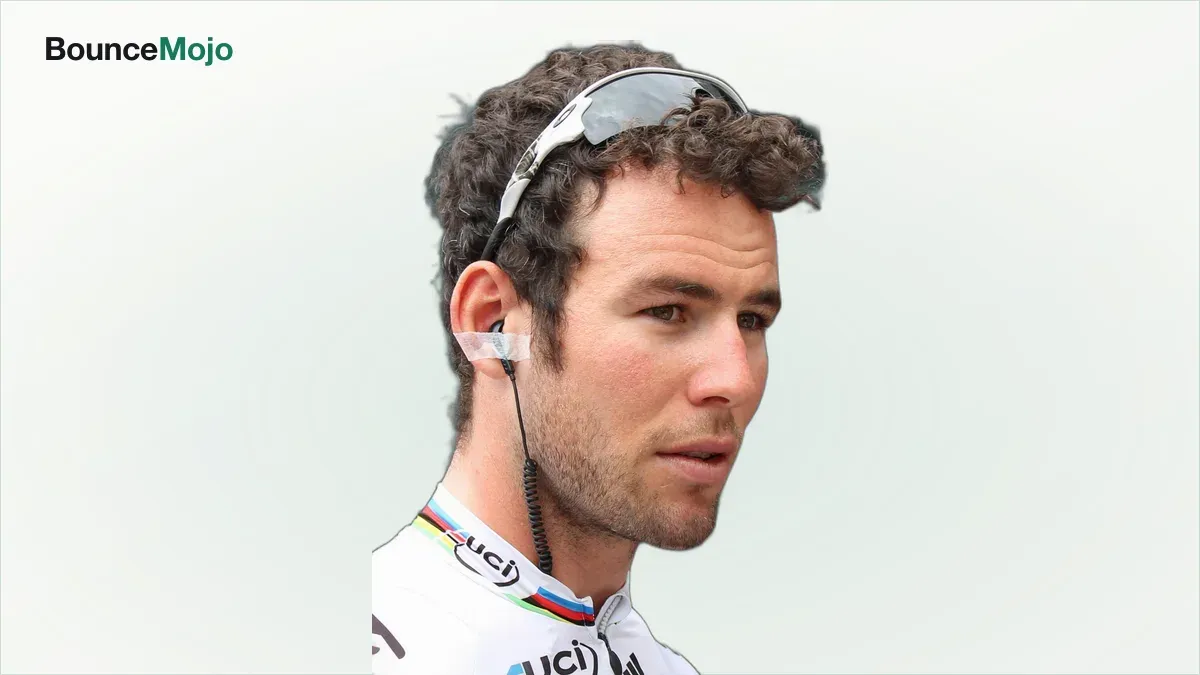
Everyone remembers the sprint, the blur of a rider who could win from nowhere in the final 200 meters. Almost nobody remembers how close he came to never racing again.
Here’s the heart of his story: the greatest sprinter in cycling history spent years unable to get out of bed.
The Myth vs. The Reality
The myth is that Mark Cavendish is invincible, a natural-born winning machine who simply outran everyone for two decades.
The reality is that his career had a long, dark middle where illness and depression left him broken, doubted, and nearly finished. The record books show 35 Tour de France stage wins. They do not show the years he could barely function.
Here’s the truth: his greatness is not the winning. It’s that he came back from a place most people never return from and won again.
You might be wondering: where does a sprinter this relentless even come from? The answer is a small island in the Irish Sea.
The World That Made Mark Cavendish
Cavendish grew up on the Isle of Man, a small, cycling-mad island between England and Ireland. As a boy he was an obsessive fan, taking the ferry to the mainland to race, dreaming of a sport that barely paid attention to kids from Manx.
Now: British cycling in his era was on the rise. A generation of riders, backed by growing investment in the sport, was about to make the UK a cycling superpower.
Cavendish arrived at the front of that wave. He came up through the track program before conquering the road, part of a British golden age that included names like Bradley Wiggins.
Understand what an unlikely origin the Isle of Man is for a cycling superstar. It is a small island in the Irish Sea, better known for its motorcycle races than for producing Grand Tour legends. There was no obvious pipeline from Manx to the professional peloton, no local tradition of world-beating road sprinters. Cavendish had to leave home just to find real competition, taking the ferry to the mainland as a boy to race against better fields. That outsider status, the sense of coming from nowhere the sport expected champions, became a permanent chip on his shoulder and a permanent source of fuel.
It gets better: the island kid with an outsider’s chip on his shoulder would become the fastest finisher the sport had ever seen. But first, he had to prove that a sprinter from the Isle of Man belonged.
The Crucible: Early Life and the Climb
The Environment That Shaped Him
Cavendish’s Isle of Man upbringing gave him two things: a love of the bike and an outsider’s hunger. He was not from a traditional cycling powerhouse, and he raced like someone with something to prove.
Here’s the deal: he made pilgrimages off the island just to compete, then earned his way into Britain’s track program, where the discipline and speed of the velodrome sharpened his finishing kick.
That track background became his weapon. The explosive acceleration that wins Olympic sprints on the boards translated perfectly to the chaotic final meters of a Tour de France stage.
The Catalyst
The breakout came when he moved to the road and started winning stages, fast. By his early twenties he was piling up Tour de France stage victories, announcing himself as the best pure sprinter in the world.
Think about it: he was winning Grand Tour stages before most riders his age had found their footing. The nickname stuck, the Manx Missile.
What made him special was not just speed, it was the finishing instinct. In the chaotic final kilometer of a sprint stage, with dozens of riders jostling at over 40 miles per hour, Cavendish had an uncanny ability to find the right wheel, wait for the exact moment, and explode past everyone. He read a sprint the way a chess master reads a board. Teammates built entire lead-out trains to deliver him to the line, and he rewarded them with wins again and again.
For years, the wins kept coming. Then, at the height of his powers, his body betrayed him, and the real test of his character began.
The Key Players
Three figures shape Cavendish’s story.
Peta Todd, his wife and a former model, has been his anchor through the highs and the darkest lows, a steady presence during the years illness and depression nearly consumed him.
Eddy Merckx, the greatest cyclist of all time, set the 34-stage Tour de France record that stood for 50 years. Merckx became the ghost Cavendish chased, and eventually caught.
Bradley Wiggins and the British cycling generation around him were the teammates and rivals who pushed him, part of the golden era that made Cavendish’s rise possible.
You might be wondering: how does the fastest man in the sport suddenly lose everything? The answer came in 2018, and it was invisible from the outside.
The Turning Point
The Pinnacle
Cavendish’s competitive peak was extraordinary. He won stage after stage at the Tour de France, took a world road race title in 2011, and built a resume that ranks him among the greatest one-day finishers ever.
Now: for a stretch, he was simply unbeatable in a bunch sprint.
The Price
Then it collapsed. In 2018 he was diagnosed with Epstein-Barr virus, and the handling of his recovery went badly. Told he was fit to train while the virus lingered, he cut his food intake to make racing weight and spiraled into clinical depression.
Here’s the kicker: his own team doctor later said he was unsure Cavendish would escape the depression without quitting cycling. He was nearly admitted to hospital. The fastest man in the sport could barely get through a day.
That is the hidden cost behind the record. The pinnacle and the pit were separated by only a few years, and how he climbed out is what defines him.
The wilderness years were brutal in a way statistics cannot capture. Teams stopped believing in him. He went through seasons with barely a win, chasing a contract, wondering if his body would ever respond again. For a man who had defined himself by winning, being unable to win, and being doubted by the sport he loved, was its own kind of torture. Many riders in that position simply retire. Cavendish kept showing up, even when the evidence said he was finished, holding onto a belief that one more chance was all he needed.
The Unvarnished Truth
The honest core of Cavendish’s story is mental health, not medals.
Here’s the truth: he has spoken openly about the depths of his depression, describing a darkness that had nothing to do with bike racing and everything to do with survival. He chose to share it, in a Netflix documentary and in interviews, to make the struggle more relatable to others.
There was also real-world trauma layered on top, including a violent home invasion robbery that shook his family. He carried all of it while trying to resurrect a career many assumed was over.
This is the part the highlight reels skip. The greatest sprinter in history was, for a time, a man just trying to hold himself together.
What’s the bottom line? He could have hidden all of it. Athletes are trained to project invincibility, and admitting to depression carries a stigma that lingers in macho sports culture. Cavendish chose transparency instead. He described lying in the dark, unable to see a way out, and how close he came to walking away from cycling entirely. By putting that on the record, he gave permission to countless others, athletes and ordinary people alike, to admit their own struggles. It reframed his whole legacy. The record is the headline, but the honesty about mental health may be the more important gift he leaves the sport.
Controversies and Criticisms
Cavendish’s career had its share of on-bike controversy. He was a fierce, sometimes abrasive competitor, and his sprints occasionally drew scrutiny for aggressive positioning, as elite sprinting often does.
His outspoken personality made him polarizing. He spoke his mind, clashed with rivals and media, and was never a bland, media-trained figure. That edge cost him some goodwill over the years. It also happened to be inseparable from the ferocity that made him a champion, and few who watched him closely would have traded it away.
But here’s the deal: those criticisms look minor next to what he overcame. The aggressive edge that annoyed some was the same fire that brought him back from illness and depression to break a 50-year-old record. You cannot separate the two.
You might be wondering: what does a comeback like that actually teach the rest of us? Plenty.
What We Can Learn From Mark Cavendish
Navigating Hard Times
Cavendish’s recovery is the lesson. He was written off, nearly hospitalized, and unsure he would ever race well again. He kept going anyway.
Here’s the deal: he did not pretend the darkness away. He named it, got help, and used his platform to tell the truth about depression. That honesty is its own kind of courage.
The Success Blueprint
The blueprint is patience and belief. After years in the wilderness, he returned to Deceuninck-Quick-Step for 2021, earned a late call-up to the Tour, and won four stages to equal Merckx’s record. In 2024 he broke it outright with a 35th stage win.
That refusal to accept a diminished ending built the legacy, and the fortune, detailed in his full net worth breakdown. Like the top names on our richest Olympians list, his wealth is the byproduct of a career that lasted because he would not quit.
The 2021 season deserves its own paragraph, because it is one of the great comeback stories in modern sport. Cavendish was not even guaranteed a Tour de France spot. He earned a late call-up almost by circumstance, then seized it with both hands, winning four stages and the green points jersey to equal Merckx’s record that everyone had assumed was gone forever. Grown men in the cycling world wept watching it. Then, in 2024, he broke the record outright with his 35th stage win before retiring at the end of the season. He did not just come back. He came back all the way to the top of the mountain.
The deeper takeaway is simple. Your worst chapter is not your final one. Cavendish proved that a comeback can be the best part of the whole story.
Final Verdict
Mark Cavendish is not just the greatest sprinter cycling has produced. He is one of sport’s great comeback stories.
He turned an island-kid obsession into more Tour de France stage wins than anyone in history, breaking a record that had stood for 50 years. And he did it after illness and depression had all but ended him.
Here’s the bottom line: the speed made him famous, but the return made him a legend. The Manx Missile will be remembered for the sprints. He deserves to be remembered for the climb back.
Think about where he started and where he finished. A boy on a small island, taking ferries just to find a race, ended his career holding the most famous record in cycling and having spoken openly about the darkness that nearly swallowed him. He gave the sport its fastest sprints and its most honest conversation about mental health. Few athletes leave a mark that runs that deep. Cavendish did, and he did it by refusing to let either his body or his mind have the final word.
Shop Mark Cavendish on Amazon
Books, audiobooks, merch and more, handpicked for fans.
As an Amazon Associate we earn from qualifying purchases.
Frequently Asked Questions
Where is Mark Cavendish from?+
Mark Cavendish is from the Isle of Man, a small island in the Irish Sea. He has called it his real home throughout his career, which earned him the nickname the Manx Missile.
What record does Mark Cavendish hold?+
He holds the record for the most Tour de France stage wins with 35, breaking Eddy Merckx's mark of 34 in July 2024.
What health struggles did Mark Cavendish face?+
He was diagnosed with Epstein-Barr virus in 2018 and later with clinical depression, a period he has described as the darkest of his life.
How did Mark Cavendish's comeback happen?+
After years of struggle, he returned to Deceuninck-Quick-Step for 2021 and, after a late call-up, won four Tour de France stages to equal Eddy Merckx's record.
When did Mark Cavendish retire?+
He retired at the end of the 2024 season, after finally breaking the Tour de France stage-win record earlier that year.
Want the money side of the story?
Read Mark Cavendish's Full Net Worth Breakdown →Shop Mark Cavendish on Amazon
Books, audiobooks, merch and more, handpicked for fans.
As an Amazon Associate we earn from qualifying purchases.