Jaromir Jagr Biography: The Legend Who Refused to Stop Playing
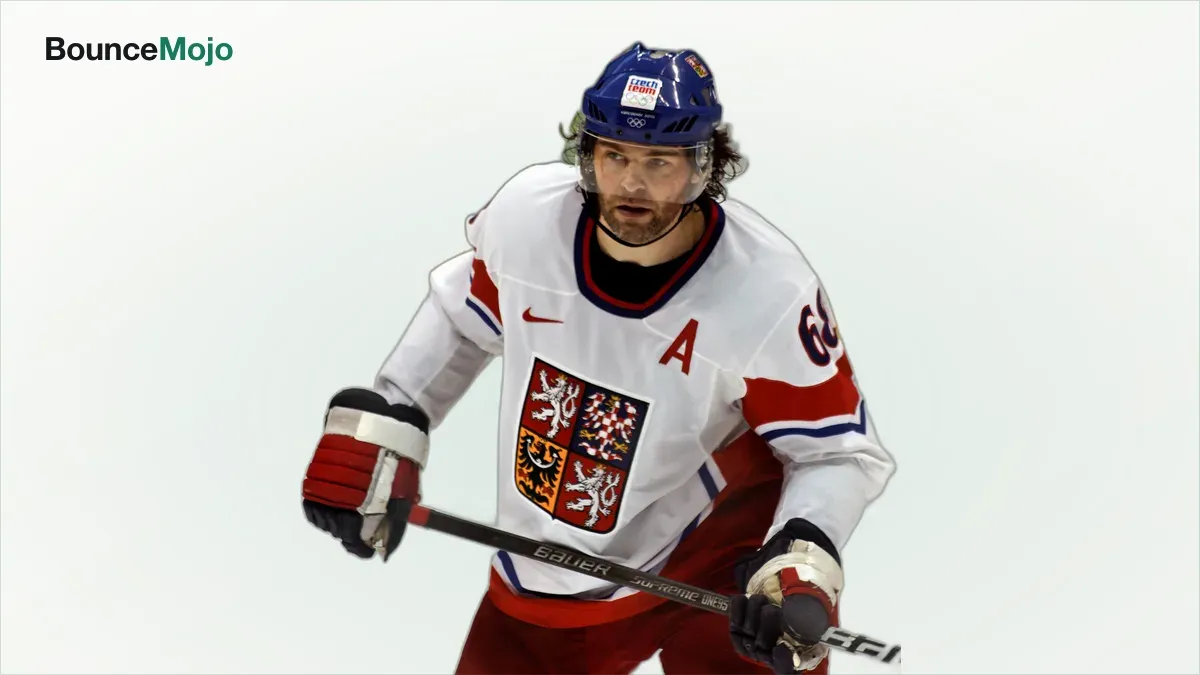
Everybody knows the mullet, the goals, the two Cups. Almost nobody can explain how he was still playing pro hockey when players half his age had already retired.
Here’s what most people miss: Jaromir Jagr isn’t just one of the greatest scorers in history. He’s the closest thing hockey has ever seen to a man who refused to let the game end.
The Myth vs. The Reality
The myth is that Jaromir Jagr was a gifted goal-scorer with flowing hair and dazzling hands, a highlight machine from the golden age of hockey.
That’s true. It’s also the smallest part of who he is.
Here’s the truth: the defining trait of Jagr’s life isn’t his talent. It’s his refusal to quit. Plenty of players have been brilliant. Almost none have been brilliant for parts of five different decades, playing professional hockey into their fifties, long after every contemporary hung up their skates. Jagr’s real gift is an almost inhuman drive, a love of the game so total that retirement became unthinkable.
Think about it: most legends are defined by a peak. Jagr is defined by the fact that he never let his peak be the end. He just kept going, and going, and going.
Now, that kind of obsession doesn’t come from a comfortable childhood. It’s forged in hardship, in a place and a family that understood struggle. Which raises the question. What kind of world produces a man who treats hockey as something worth doing forever?
The World That Made Jaromir Jagr
To understand Jagr, you have to understand the country he was born into.
He arrived on February 15, 1972, in Kladno, a hardworking industrial town in what was then communist Czechoslovakia. This was a nation behind the Iron Curtain, where freedom was scarce and the state controlled daily life. Jagr’s family had suffered directly under the regime. His grandfather, who resisted the communist takeover, died in prison. That history was seared into the boy’s identity.
It’s why Jagr wore the number 68 his entire career, a tribute to the 1968 Prague Spring, when Soviet tanks crushed a Czechoslovak movement toward reform. Most athletes pick a number for luck or superstition. Jagr picked one to honor a national wound and his own family’s sacrifice.
Hockey, meanwhile, was one of the few outlets where Czechoslovaks could express national pride and defy the Soviet Union. The sport carried enormous cultural weight.
But here’s the kicker: Jagr came of age exactly as the Iron Curtain was falling. He was one of the first wave of Eastern European stars free to chase the NHL, arriving in North America as his homeland was reborn.
Which is where the story really starts.
The Crucible: Early Life and the Climb
The environment that shaped him
Jagr’s childhood was defined by relentless work and an unusual physical drive.
Even as a boy in Kladno, he was famous for his self-directed training regimen, doing squats and exercises by the hundreds, building the powerful lower body that would later let him shield the puck from defenders like no one else. He wasn’t handed his conditioning. He built it, obsessively, from childhood.
Growing up under communism instilled a certain toughness and hunger. Nothing was guaranteed. Opportunity, when it came, had to be seized completely. That mentality never left him.
You might be wondering: how does a kid from a small Czech town become one of the best players on earth? Through a combination of freakish natural talent and a work ethic that bordered on the extreme. Jagr had both, and he channeled them into a game that gave a repressed nation something to cheer.
The catalyst
Then came the fall of communism, and the opportunity of a lifetime.
As the political walls came down, Jagr became eligible for the NHL Draft. The Pittsburgh Penguins selected him fifth overall in 1990, and he crossed the ocean as a teenager who barely spoke English, homesick and alone in a foreign country.
Here’s the deal: he arrived at the perfect moment, on a team about to become a dynasty. The Penguins, led by the incomparable Mario Lemieux, were on the verge of greatness, and Jagr walked straight into it. As a teenager, he helped Pittsburgh win the Stanley Cup in 1991 and again in 1992, learning at the side of one of the sport’s all-time giants.
It gets better, though. Those early triumphs were only the foundation of a career shaped by the people around him.
The Key Players
No legend rises alone, and Jagr’s story is filled with the figures who shaped him.
Start with Mario Lemieux, the mentor above all others. Playing alongside Lemieux in Pittsburgh, a young Jagr absorbed how a superstar operated, and won two Cups in the process. Their partnership was one of the most gifted the game has ever seen, and it accelerated Jagr’s development enormously.
Then there’s the shadow of Wayne Gretzky, the scoring standard against which every offensive great is measured. Jagr chased Gretzky’s records for years and climbed to among the highest goal and point totals in league history, cementing his place in the pantheon.
There’s also Dominik Hasek, the brilliant Czech goaltender and fellow national hero, who shared with Jagr the burden and pride of carrying their country’s hockey hopes on the international stage, most memorably at the 1998 Olympics when the Czech Republic won gold.
And later, there was Sidney Crosby, the Penguins superstar who inherited the franchise Jagr once helped make great, a link across generations of Pittsburgh hockey.
Now: reaching the summit is one thing. Refusing to come down from it is another. And Jagr’s greatest triumph wasn’t a single trophy. It was the way he redefined what a career could be, and what that cost.
The Turning Point
The pinnacle
The pinnacle of Jagr’s career isn’t one moment. It’s the sum of an impossibly long one.
He won two Stanley Cups by age 20. He won five Art Ross Trophies as the league’s leading scorer, plus a Hart Trophy as MVP. He captured Olympic gold with the Czech Republic in 1998. He rose to among the very top of the NHL’s all-time goals and points lists, trailing only a handful of the sport’s greatest names.
But the true pinnacle is the longevity. Jagr played in the NHL into his mid-forties, remaining a productive contributor when most players his age were long retired. Then he went home and kept playing in the Czech league into his fifties. No one in the modern era has extended a top-level career the way he did.
Here’s the truth: Jagr didn’t just achieve greatness. He stretched it across time in a way that may never be matched.
The price
But that refusal to stop came with a price few talk about.
Jagr sacrificed a normal life to the game. While peers moved into comfortable retirement, coaching, or business, he kept subjecting his body to the grind of professional hockey, driven by an obsession that left little room for anything else. That single-minded devotion cost him the settled, post-career life most stars eventually build.
There was a financial price too. To keep playing at home, he bought and ran HC Kladno, the club of his youth, and pouring money into a modest Czech team is a costly passion, not a lucrative investment. Reports over the years suggested the club strained his finances. He chose love of the game over the smart financial move, again and again.
It gets deeper, though. Because the same obsession that made him a legend also hints at the vulnerabilities beneath the ageless image.
The Unvarnished Truth
Jagr was not a flawless figure, and honesty requires acknowledging the human beneath the legend.
The relentless drive that defined him carried a shadow. Some who know him have suggested his inability to walk away from hockey reflected a difficulty imagining life without it, an identity so fused to the game that stopping felt like disappearing. That’s a form of vulnerability, not just strength.
His personal life was often complicated and closely watched. His finances, tangled up in the club he owns, have been a recurring source of stress. And earlier in his career, he acknowledged struggles with gambling that cost him significant money. He has never pretended to be perfect, and the complexity is part of what makes him human rather than a myth.
Here’s what’s easy to miss: the same obsessive love of hockey that gave him a career for the ages is also what made ordinary life so hard to accept. The gift and the burden were the same thing.
None of that dims the legend. But it does complicate the image of the smiling, unbreakable superstar.
Controversies and Criticisms
Jagr’s career is light on true scandal, but not free of criticism and complication.
The most persistent chapter is financial. His ownership of HC Kladno has repeatedly been reported as a money-losing venture, and questions about the club’s finances and his own have followed him for years. Running a beloved but unprofitable team is a noble gesture that has also created genuine strain, and critics have questioned the wisdom of it.
Earlier in his career, Jagr’s stint in Russia’s KHL drew debate, as some questioned a Western star chasing big paychecks in a rival league. Others saw it simply as a legendary competitor going where the game, and the money, took him.
And there’s the eternal question of how to rank him. Jagr’s numbers place him among the greatest offensive players ever, yet because he played across so many eras and teams, and because he was often overshadowed by Gretzky and Lemieux, some feel he never received the full acclaim his production deserved.
So what does a career like this teach the rest of us? More than almost any athlete’s.
What We Can Learn From Jaromir Jagr
Navigating hard times
Jagr’s life is a lesson in turning hardship into fuel.
He grew up under a repressive regime that killed his grandfather, in a country with little freedom. Rather than letting that history crush him, he carried it, literally, on his back in the number 68, and used it as a source of pride and motivation. Hardship became identity, and identity became drive.
In other words: the difficult circumstances you’re born into don’t have to be a ceiling. For Jagr, they were a foundation.
The success blueprint
The blueprint here is obsessive love of the craft, and relentless self-improvement.
Jagr succeeded because he genuinely loved hockey more than the rewards it brought, and because he outworked everyone through decades of legendary training. That passion built both his records and his fortune, sustaining a career no one thought possible. Loving the work itself, not just the trophies, is what lets someone keep going long after others quit.
Want to see how that translated into wealth? The full net worth breakdown shows how a five-decade career and a team of his own built, and complicated, an eight-figure fortune. And to see where he ranks among the sport’s biggest earners, the richest hockey players list puts it in context.
The deeper lesson is about home. Jagr never abandoned Kladno. He bought its team, played for it, and poured himself into keeping it alive. He proved that the place that made you is worth honoring, even at a cost.
Which brings us to the final reckoning on the man.
Final Verdict
Jaromir Jagr is going to be remembered as the player who wouldn’t stop, and that’s exactly the point.
The mullet, the goals, the two Cups, the scoring titles, they’re all real and all remarkable. But the truest measure of Jagr is the sheer span of it: a teenager who fled a crumbling communist state to win Cups in Pittsburgh, then kept playing at the highest levels for decades, then went home to skate for the club he owns into his fifties. Nobody has ever loved the game quite like this.
Here’s the bottom line: greatness is usually measured in peaks. Jagr measured his in decades. He turned a childhood shaped by loss into one of the longest, most productive, most fiercely committed careers any athlete has ever had.
He chased Gretzky’s records, learned from Lemieux, honored his family’s sacrifice, and refused to let the game go. In the end, that refusal is the version worth remembering.
Shop Jaromir Jagr on Amazon
Books, audiobooks, merch and more, handpicked for fans.
As an Amazon Associate we earn from qualifying purchases.
Frequently Asked Questions
Where did Jaromir Jagr grow up?+
Jagr grew up in Kladno, in what was then communist Czechoslovakia. He came of age as the Iron Curtain fell, and he wore number 68 throughout his career to honor the 1968 Prague Spring uprising.
Why is the number 68 significant to Jaromir Jagr?+
Jagr wore 68 to commemorate the 1968 Prague Spring, when Soviet forces crushed a Czechoslovak reform movement. His grandfather died in prison after resisting the communist regime, and the number honored that history.
What is Jaromir Jagr most famous for?+
Jagr is famous as one of the highest-scoring players in NHL history, a two-time Stanley Cup champion, and, remarkably, a player who continued competing professionally into his fifties.
Does Jaromir Jagr still play hockey?+
Yes. Jagr has continued to play for HC Kladno, the Czech club he owns in his hometown, extending one of the longest playing careers in the history of professional sports.
Who was Jaromir Jagr's mentor?+
Jagr's greatest mentor was Mario Lemieux, his Pittsburgh Penguins teammate. Jagr won two Stanley Cups as a young player alongside Lemieux, learning from one of the game's all-time greats.
Want the money side of the story?
Read Jaromir Jagr's Full Net Worth Breakdown →Shop Jaromir Jagr on Amazon
Books, audiobooks, merch and more, handpicked for fans.
As an Amazon Associate we earn from qualifying purchases.