Islam Makhachev Biography: The Quiet Heir to a Dagestani Dynasty
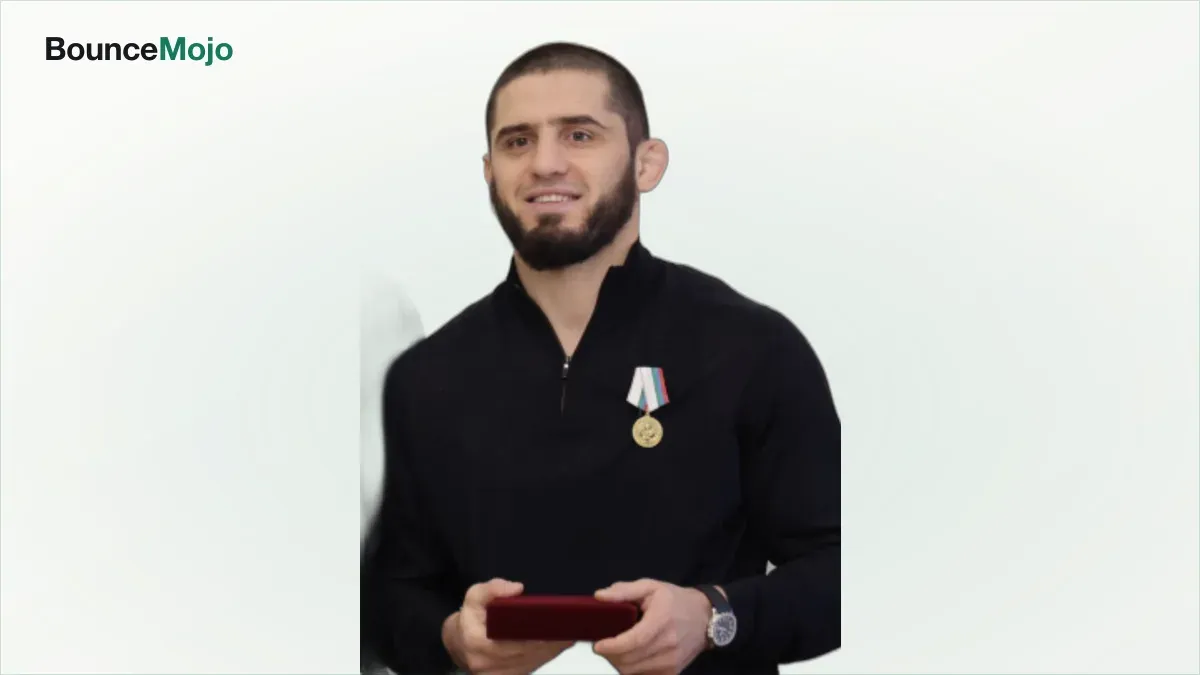
Most people know Islam Makhachev as “the next Khabib.” That label is both the truest and the laziest thing anyone says about him.
Here’s what most people miss: the calm, almost bored expression Islam wears in the cage was forged in a fight system that treats losing as unthinkable and showmanship as a weakness.
The Myth vs. The Reality
The myth is simple. Islam Makhachev: Khabib’s clone, a wrestling machine with no personality, a champion who inherited a throne rather than earned it. Understudy. Placeholder. Roll credits.
The reality is far more stubborn than that.
Here’s the deal: Islam is not a copy of anyone. He shares a camp, a homeland and a mentor with Khabib Nurmagomedov, but his skill set is genuinely his own, a smoother striker, a more patient hunter, a fighter who added tools Khabib never needed. Reducing him to “the next Khabib” flattens a decade of separate, grinding work into a nickname.
And the “he inherited the throne” line misses the part that matters: Islam won the belt years after Khabib walked away, against a field that had every reason to expose him. Inheritance doesn’t survive a five-round title fight. Skill does.
You might be wondering: how does a quiet kid from a Russian mountain republic end up as the best fighter in a sport built for loud personalities? To understand that, you have to understand where he comes from.
The World That Made Islam Makhachev
Islam was born in 1991, in the final months of the Soviet Union, into a republic that runs on a very particular idea of manhood.
He grew up in Dagestan, a rugged corner of southern Russia where wrestling isn’t a hobby, it’s a civic religion. Boys learn to grapple the way kids elsewhere learn to ride bikes. The mountains are dotted with villages that have produced Olympic and world champions in freestyle wrestling, sambo and judo for generations. Toughness there is assumed, not advertised.
Now: this is a world that prizes control over flash. The ideal fighter doesn’t trash-talk, doesn’t celebrate wildly, doesn’t beg for attention. He wins, shakes hands, and goes home. That code is stamped into everything Islam does, the flat expression, the economical movement, the refusal to be baited into brawls.
That collision, a self-effacing warrior culture meeting a loud, American-style entertainment business, is the backdrop for Islam’s whole career. He wasn’t built to sell a fight. He was built to end one.
But before any of that, there was a boy on a mat in Makhachkala, learning that discipline is the only thing you can fully control.
The Crucible: Early Life and the Climb
The Environment That Shaped Him
Islam started combat sports young, in the same regional pipeline that produces so many Dagestani standouts. Wrestling came first, then combat sambo, the Russian grappling-and-striking hybrid that has become the region’s calling card.
The defining relationship of his life formed early. He and Khabib Nurmagomedov trained together as young men under the guidance of Khabib’s father, Abdulmanap Nurmagomedov, a legendary coach and patriarch of the camp. That environment was relentless. Long sessions, hard sparring, and a standard that treated anything short of dominance as failure.
Think about it: while other prospects were learning to fight, Islam was learning inside a system that had already cracked the code of turning Dagestani wrestlers into world-beaters.
He turned professional in 2010 as a teenager and built a record on the regional circuit before the UFC came calling in 2014. He was a prospect with pedigree. But pedigree guarantees nothing in a cage.
The Catalyst
Here’s the truth: Islam’s career nearly ended almost before it began.
In just his second UFC fight, in 2015, he was knocked out cold in the first round. For a young grappler carrying the weight of a famous camp’s expectations, it was a nightmare. Doubters wrote him off instantly, a wrestler with a suspect chin, another prospect who couldn’t hang once the striking started.
It gets better, and stranger. Instead of collapsing, Islam went back to the mountains and rebuilt. He tightened his defense, sharpened his striking, and started stacking wins, one disciplined performance at a time. The loss that was supposed to break him became the foundation of one of the longest win streaks in the promotion.
That’s where the climb truly began. But he didn’t do it alone, and the man in his corner would become the single most important figure in his story.
The Key Players
No fighter rises alone, and Islam’s rise is inseparable from a small, fiercely loyal circle.
Khabib Nurmagomedov. More than a friend, Khabib became Islam’s mentor, cornerman and shield. When Khabib retired undefeated as one of the greatest lightweights ever, he anointed Islam as his successor and stood in his corner for the biggest nights of Islam’s life. Their bond is the emotional spine of the whole story. Khabib’s presence gave Islam both a blueprint and a buffer against the doubt that shadows any heir.
Abdulmanap Nurmagomedov. Khabib’s father and the architect of the camp, he shaped Islam’s foundation as a young athlete. His death in 2020 was a heavy blow to the entire team, and the camp carried his standards forward as a form of tribute.
The Dagestani team. Islam is one node in a dense network of training partners and coaches who push each other in brutal sessions. That collective is why the region keeps producing champions, and why Islam rarely looks surprised by anything an opponent brings.
Dana White and the UFC. On the business side, the promotion turned Islam from a respected contender into a headline pay-per-view attraction the moment he won gold, the mechanics of which live in his net worth breakdown.
Think about it: every one of these relationships reinforced the same message, control what you can, ignore the noise, and let the results speak. That mindset carried him to the mountaintop.
The Turning Point
The Pinnacle
October 2022 was Islam’s coronation.
He captured the vacant UFC lightweight title, the same belt Khabib had held and never lost, then set about proving the win was no fluke. He defended the championship against the division’s best, including a marquee clash with one of the sport’s most beloved and durable stars, a fight that announced Islam as a genuine pound-for-pound force rather than a caretaker champion.
By his peak, Islam had built a win streak that ranked among the longest active runs in the UFC. Analysts and rankings placed him at or near the top of the pound-for-pound lists, the rare fighter whose dominance was so complete it almost read as monotony.
As his own net worth story lays out, that title run rewired his earning power, turning modest undercard purses into championship pay-per-view paydays.
The Price
Here’s the kicker: the very thing that made him a champion made him hard to love for casual fans.
Islam’s game is built on control, positional dominance, and grinding decisions rather than highlight-reel violence. It’s beautiful to a purist and dull to a thrill-seeker. He wins the way a chess grandmaster wins, methodically, inevitably, without drama. That style earned him respect but not always the roaring adoration that flashier stars command.
And the shadow of comparison never lifts. Every win is measured against Khabib’s legend. The pinnacle brought a belt and a spotlight, and with them a question no other champion answers: is he his own man, or an echo? Which brings us to the parts of Islam that complicate the clean-champion image.
The Unvarnished Truth
Islam is not a cartoon of perfection, even if he plays one on fight night.
He can be prickly with the media, dismissive of promotion, and openly uninterested in the trash-talk theater that sells tickets. To a fan raised on Conor McGregor’s showmanship, Islam’s flat affect can read as arrogance or boredom. He has feuded verbally with rivals, held grudges, and let his frustration with a fickle audience show.
Now: none of this makes him a villain. It’s the residue of a culture that taught him self-promotion is a form of weakness. When you grow up believing your job is to win and go home, the circus of modern MMA feels beneath you.
But that same disregard for the show has a cost. The biggest fortunes in the sport belong to fighters who mastered the spectacle, not just the fight. Islam’s refusal to play that game keeps him respected and, relative to his skill, underpaid.
The most honest thing anyone can say about Islam is this: his greatest strength and his blind spot are the same trait. Detachment. It makes him unshakable in the cage and unmarketable on the microphone.
Controversies and Criticisms
Islam has largely avoided the scandals that follow flashier stars, but he hasn’t fought controversy-free.
The Khabib comparison fatigue. Critics argue he’s been carried by association, that his rankings and headline slots owe as much to Khabib’s shadow as to his own résumé. Supporters counter that no one grinds through a title reign on borrowed credibility.
The style debate. A recurring criticism is that his dominance is so controlling it borders on unwatchable, that he neutralizes opponents rather than finishing them. It’s a purist-versus-entertainment argument that has trailed grapplers for decades.
Weigh-in and matchmaking disputes. Like many elite fighters, Islam has been involved in the usual friction over opponents, timing and terms, the ordinary politics of a sport where the biggest paydays are never guaranteed.
The nationality and camp politics. As a Russian Dagestani star in a global promotion, Islam has occasionally been pulled into the broader debates and geopolitics that surround fighters from the region, most of it far outside his control.
Compared with the tabloid chaos that follows some champions, Islam’s controversies are almost quaint, arguments about style and lineage rather than conduct.
What We Can Learn From Islam Makhachev
Navigating Hard Times
The first lesson is about resilience: a single catastrophe doesn’t have to define you. Islam got knocked out cold on a big stage early in his UFC run, the kind of loss that ends careers and confidence at once.
But here’s the truth his rise makes plain: he treated the disaster as data, not identity. He went back, fixed the holes, and rebuilt into a champion. The setback that was supposed to be his ceiling became his foundation. Real toughness wasn’t never getting hurt. It was refusing to let the hurt write the ending.
The Success Blueprint
If you want the replicable part, it’s this: master the fundamentals so completely that flash becomes unnecessary. Islam wins by controlling every position, closing every escape, and removing luck from the equation. He doesn’t gamble. He suffocates.
That’s transferable far beyond the cage. The lesson isn’t “be boring.” It’s “build a system so sound that you don’t need a miracle to win.” His discipline put him on the same pound-for-pound shelf as the greats, and it echoes in every athlete who chooses process over spectacle. His placement among the sport’s best-paid names on our richest MMA fighters ranking tells the financial half; his win streak tells the other.
Becoming Better
The deepest lesson is about self-command. Islam’s edge isn’t just physical, it’s emotional. He refuses to be baited, refuses to panic, refuses to let an opponent or a crowd dictate his temperature.
In other words, control of self precedes control of anyone else. Master your own reactions and the fight, in the cage or in life, tilts your way before it even starts. It’s a quieter kind of greatness, and it leads directly to the question that will define his legacy.
Final Verdict
Islam Makhachev is one of the finest fighters of his generation, and the word “fighter” undersells him. He’s a technician, a strategist, and the standard-bearer for a fight culture that values substance over noise. In an era that rewards the loudest voice, he built a case for the quietest discipline.
And here’s the twist that reframes everything: the label that follows him everywhere, “the next Khabib,” is exactly the thing he has spent his career quietly dismantling. Every title defense, every dominant round, chips away at the idea that he’s anyone’s sequel. His full earning story, and how the belt transformed it, lives in his net worth breakdown, and it points to a fighter whose biggest chapters may still be unwritten.
If you want to understand modern MMA, watch how Islam wins. Not the finishes, the control. The way he removes chaos from a chaotic sport. He may never be the most beloved champion of his time, but he might be the most complete, and completeness, in a cage, is the rarest thing of all.
Shop Islam Makhachev on Amazon
Books, audiobooks, merch and more, handpicked for fans.
As an Amazon Associate we earn from qualifying purchases.
Frequently Asked Questions
Where is Islam Makhachev from?+
Islam Makhachev was born in Makhachkala, the capital of Dagestan, a mountainous republic in southern Russia known for producing world-class wrestlers and grapplers.
How are Islam Makhachev and Khabib Nurmagomedov connected?+
They are lifelong friends and training partners who grew up in the same Dagestani fight system. Khabib became Islam's mentor and cornerman, and Islam is widely seen as the heir to Khabib's legacy.
When did Islam Makhachev become UFC champion?+
Islam won the UFC lightweight title in October 2022, capturing the belt his mentor Khabib had vacated in retirement, then defended it against the division's top contenders.
What style does Islam Makhachev fight in?+
Islam is a sambo and wrestling-based grappler with a suffocating top game, sharpened by years in the Dagestani system and a striking arsenal he added later in his career.
Did Islam Makhachev ever lose a fight?+
Yes. Early in his UFC run he suffered a first-round knockout loss that many thought would derail him. He rebuilt from it into one of the longest active win streaks in the promotion.
Want the money side of the story?
Read Islam Makhachev's Full Net Worth Breakdown →Shop Islam Makhachev on Amazon
Books, audiobooks, merch and more, handpicked for fans.
As an Amazon Associate we earn from qualifying purchases.