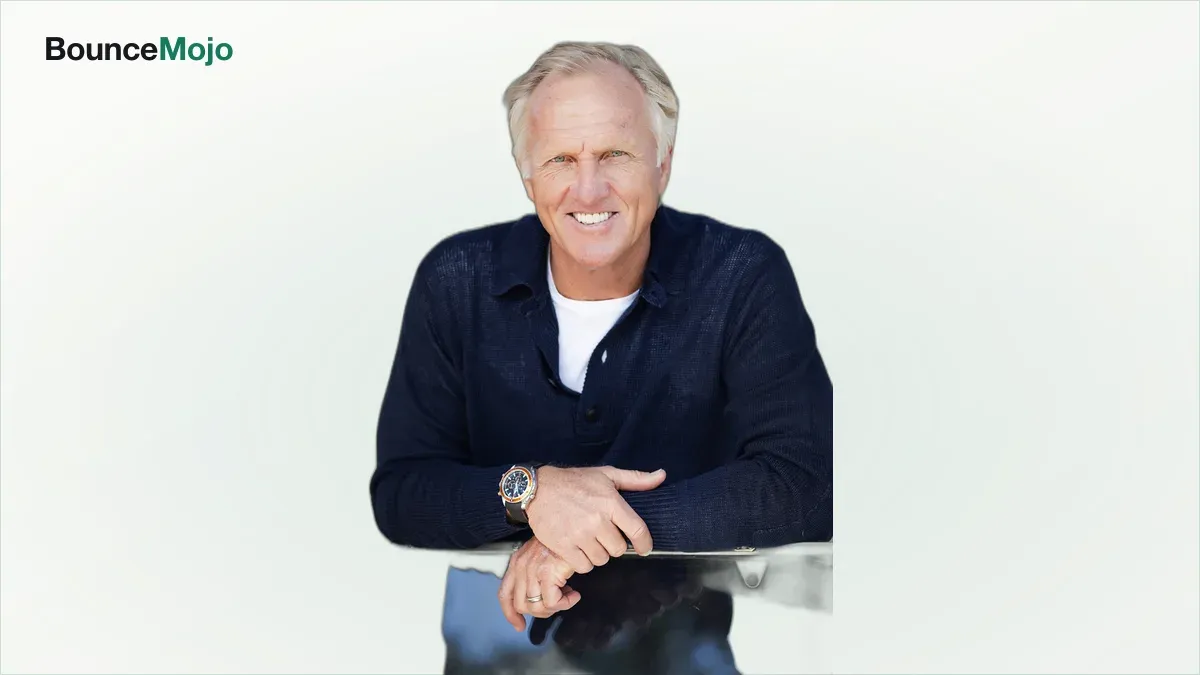
Greg Norman Biography: The Great White Shark Who Missed the Majors
Sunday at Augusta, 1996: Six Shots, Gone
He led the Masters by six strokes with eighteen holes to play. He shot 78 and lost to Nick Faldo.
That is the sentence that follows Greg Norman everywhere, and it remains one of the most painful collapses in sports history. What made it unbearable to watch was not the arithmetic but the slowness of it, a lead bleeding away hole by hole in front of a global audience. When it was over, Faldo embraced a devastated Norman on the 18th green, and the photograph of that moment became an icon of sportsmanship, filed forever under someone else’s victory.
It was not an isolated disaster. Norman lost all four majors in playoffs or on the final hole at various points in his career. He was on the wrong end of miracle shots. He converted only two of his years at the top of the game into major titles.
And yet the man in that photograph would spend the following decades almost never losing anything again. To understand how a career defined by Sunday heartbreak produced one of the richest men in golf, start with a boy who did not pick up a club until he was fifteen.
A Queensland Kid Who Would Rather Have Been Surfing
Norman was born in 1955 in Mount Isa, Queensland, and grew up largely around Townsville and the Queensland coast, a world of beaches, surf and sun. As a teenager he was more interested in surfing and rugby than the country club. His mother, a scratch golfer herself, introduced him to the game around age 15.
Then his raw athleticism took over. Within a couple of years he had cut his handicap to scratch. He turned professional in 1976 and won his first tournament that same year, the West Lakes Classic in Australia, leading wire-to-wire. A young man who was surfing at 15 was beating seasoned pros by his early twenties.
Australian golf in the 1970s was producing tough, self-reliant players who often had to leave home to make their names abroad, a template set by pros like Bruce Devlin. Norman fit it exactly: physically imposing, fearless, built to travel and conquer.
But the late start left its mark on his whole approach. He never had the polished, conservative game drilled into players groomed from toddlerhood. He learned golf as a powerful athlete first, and it showed in the way he attacked courses, all length and aggression. That style thrilled galleries. It also meant he sometimes lacked the grinding patience that closes out the biggest tournaments, and that tension between flair and caution explains both his triumphs and Augusta.
Turnberry, 331 Weeks, and a Nickname Worth Millions
At the 1981 Masters, a journalist dubbed him “The Great White Shark,” a nod to his blond hair, Australian roots and attacking style. Norman grasped its commercial value immediately and made the shark his personal emblem.
The golf caught up to the branding at the 1986 Open Championship at Turnberry, where Norman won his first major and confirmed his place atop the game. He took a second at the 1993 Open. Between and around those wins he held the world No. 1 ranking for 331 weeks, one of the longest reigns ever, and won dozens of tournaments around the globe. For long stretches of the 1980s and ’90s he was the most feared player in golf and one of its biggest draws.
Critically, he did not wait for the career to end before monetizing it. He launched the Greg Norman Company at his competitive peak, turning a nickname and a logo into apparel, wine and course design. That timing is the single most replicable thing he ever did, and it is why his net worth breakdown reads so differently from his major record.
The Rivals, the Marriages, and the Man Who Never Hid
Jack Nicklaus was the benchmark Norman measured himself against, first on the course and later as a rival in the course-architecture business.
Nick Faldo delivered the defining heartbreak at Augusta, then the embrace that softened it.
Laura Andrassy, his first wife and the mother of his children, was with him through the peak years and the founding of the business empire, before a long marriage ended in a costly divorce. He was later briefly married to tennis legend Chris Evert, from 2008 to 2009, a high-profile union of two sporting greats that lasted little more than a year.
Norman’s flaws were his strengths taken too far. The relentless aggression that thrilled crowds sometimes betrayed him at the worst possible moment, and critics argued he lacked the cautious temperament champions like Faldo used to close out titles. He has also been called combative and self-interested, particularly in business, a proud and sometimes prickly man who does not shy from conflict.
What he never did was hide. He talked openly about the 1996 Masters and his other collapses, absorbing the pain publicly rather than pretending it hadn’t scarred him.
Picking Fights With Golf’s Establishment, Twice
In the 1990s, Norman championed a breakaway global golf tour. It collapsed under opposition from the PGA Tour, and it was an early signal of his appetite for challenging the sport’s power structure.
He got a second attempt. As founding CEO of LIV Golf, the Saudi-backed circuit, Norman became a lightning rod, accused by critics of helping “sportswash” a controversial regime and of deepening a bitter rift in professional golf. Supporters countered that he expanded opportunity and pay for players. His blunt, confrontational manner in business and media has won him admirers and enemies in roughly equal measure, and LIV concentrated both.
Alongside all of it sits the older debate that has never quite closed: whether a player with 331 weeks at No. 1 and only two majors underachieved relative to his talent.
What the Shark Actually Proves
Norman is the most compelling figure golf has produced, and “compelling” fits better than “greatest,” though at his peak he was nearly untouchable. Two majors, 331 weeks at world No. 1, dozens of global wins, and a business empire that made him one of the richest men in the sport, ranked alongside players with far more majors on our richest golfers list.
The useful part of his story is not the collapse. It is what he did with it. A public failure did not define his life; he took the competitive fire that betrayed him at Augusta and redirected it into a boardroom where the same aggression paid. He refused to be only a golfer, becoming an apparel mogul, a winemaker, a course designer and a league executive, never letting a single identity or a single Sunday contain him.
The beach kid who came to golf late spent the rest of his life proving he knew exactly how to win. The full accounting of what that was worth lives in his net worth breakdown.
Shop Greg Norman on Amazon
Books, audiobooks, merch and more, handpicked for fans.
As an Amazon Associate we earn from qualifying purchases.
Frequently Asked Questions
Why is Greg Norman called 'The Great White Shark'?+
The nickname came from his aggressive playing style, blond hair, and Australian roots. A journalist coined it at the 1981 Masters, and Norman embraced it, turning the shark into his personal logo and brand.
How many weeks was Greg Norman world No. 1?+
Norman spent 331 weeks ranked as the world's No. 1 golfer, one of the longest reigns in the history of the Official World Golf Ranking.
Why is Greg Norman remembered for losing majors?+
Norman suffered several agonizing near-misses, most famously blowing a six-shot final-round lead at the 1996 Masters. He won two majors but is remembered as much for the ones that slipped away.
What is Greg Norman's role in LIV Golf?+
Norman served as the founding CEO of LIV Golf, the Saudi-backed circuit that split professional golf, a high-profile and heavily criticized position.
Want the money side of the story?
Read Greg Norman's Full Net Worth Breakdown →Shop Greg Norman on Amazon
Books, audiobooks, merch and more, handpicked for fans.
As an Amazon Associate we earn from qualifying purchases.