Gareth Bale Biography: The Welsh Wizard Almost Too Fast to Play
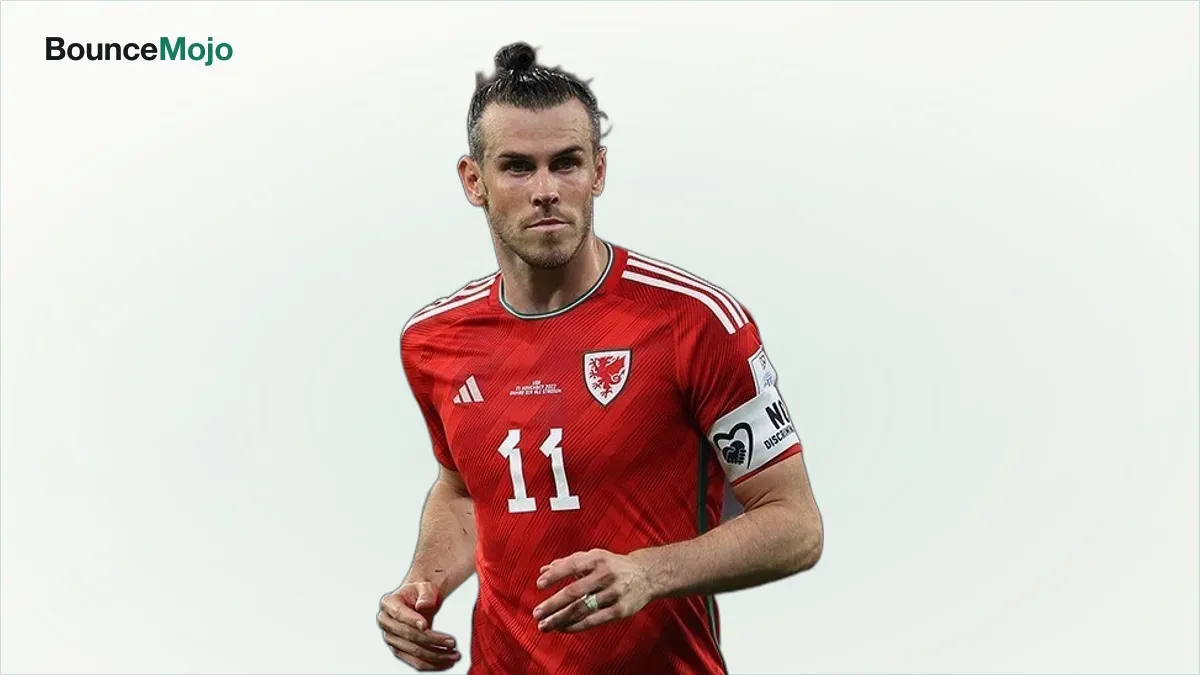
Five Champions League medals, a world-record transfer, and one of the greatest cup final goals ever scored: Gareth Bale is the most successful British footballer of his era.
Here’s what most people miss: the man who became the most expensive player on earth was once a left-back who couldn’t get in his own club’s team.
The Myth vs. The Reality
The myth of Gareth Bale is a moody, injury-prone superstar who cared more about his golf handicap than his football club.
Here’s the truth: that version is lazy and mostly wrong.
Strip away the tabloid noise and you find one of the most explosive athletes the sport has ever produced. A player who ran the 100 metres in 11.4 seconds as a 14-year-old. A left-back who reinvented himself as a match-winning forward. A man who scored in two Champions League finals and delivered on the biggest stages football has to offer.
Now: the golf jokes and the injury frustrations were real. But they buried the actual story, which is about a quiet, driven kid who kept proving people wrong at every level.
To understand why Bale ended up carrying that “difficult” label, you have to go back to a school in Cardiff where he was simply too good.
The World That Made Gareth Bale
Cardiff, Wales, in the 1990s. Football country, but a country whose national team had been an afterthought on the world stage for decades. Wales hadn’t reached a major tournament in a generation, and Welsh footballers grew up knowing the big glory belonged to England.
That’s the world Gareth Frank Bale was born into on July 16, 1989. His father Frank worked as a school caretaker. His mother Debbie was an operations manager. It was an ordinary, hardworking family, not a footballing dynasty, though his uncle Chris Pike had played for Cardiff City.
Think about it: nobody expected a world-record footballer to come out of a comprehensive school in Whitchurch. But the signs were there early.
Bale attended Whitchurch High School, where he played alongside future Wales rugby captain Sam Warburton and excelled at nearly every sport he tried, athletics, hockey, rugby, and football. He was spotted by Southampton at just nine years old during a six-a-side tournament.
Here’s the deal: he was so far ahead of everyone else that his PE teacher had to invent rules to keep games competitive. Bale was restricted to one-touch football and banned from using his dominant left foot. That’s how much of a freak of nature the young Welshman was.
But talent alone wasn’t going to make him. His body was about to test him in ways nobody saw coming.
The Crucible: Early Life and the Climb
The environment that shaped him
Bale grew up quiet, polite, and obsessive about sport. He wasn’t the loudest kid or the flashiest personality. He let his feet talk.
At 16 years and 275 days, he became the second-youngest player ever to appear for Southampton, behind only Theo Walcott. He started as a left-back, a defender, and it took years for anyone to realize his true position was much further up the pitch.
In 2007, Tottenham Hotspur signed him. And that’s where the trouble started.
The catalyst
Bale couldn’t win.
Literally. For a stretch of his early Tottenham career, the team failed to win a single Premier League game he started, a run that stretched past two dozen matches. Fans and pundits began whispering that he was a jinx. He battled injuries too, and there was serious talk of him being loaned out or sold. His confidence took a beating.
You might be wondering: how does a supposed jinx become the most expensive player in the world?
Here’s the kicker: Tottenham manager Harry Redknapp moved him forward, from left-back to left wing, and something clicked. Bale’s blistering pace and thunderous left foot suddenly had a canvas. A hat-trick against Inter Milan in the Champions League announced him to Europe. The jinx label vanished, and the legend began.
The Key Players
Bale’s rise ran through a handful of people who unlocked him.
Harry Redknapp, the Tottenham manager who pushed him up the pitch, deserves enormous credit for seeing the forward inside the failing defender. Without that positional switch, Bale might have drifted out of the top flight entirely.
Then came Real Madrid, and with it the most complicated relationship of his career: sharing a dressing room with Cristiano Ronaldo. Bale arrived as the world’s most expensive player, but he was always the second star at the Bernabeu, playing in the shadow of one of the greatest to ever live. Under manager Zinedine Zidane, Bale won trophy after trophy, yet never quite escaped Ronaldo’s gravity.
And through it all was Emma Rhys-Jones, his childhood sweetheart from Cardiff, whom he married in 2019. She was the constant, the link back to the ordinary Welsh life he came from.
But the biggest moment of his career, and the biggest cost of it, was still to come. And it arrived in a single swing of his leg.
The Turning Point
The pinnacle
The 2018 Champions League final. Real Madrid versus Liverpool in Kyiv.
Bale started on the bench. He came on as a substitute. And within minutes he produced one of the greatest goals the competition has ever seen: an overhead bicycle kick that flew into the top corner, a strike of such audacity and technique that it silenced any argument about whether he belonged at the very top. He added a second goal to seal the trophy. It was Real Madrid’s third straight European crown, and Bale had won them the final.
He collected five Champions League medals in Madrid. Few players in history can say that.
The price
But the glory came with a slow-burning cost.
Injuries piled up. Bale’s explosive style put brutal strain on his body, and he spent long stretches watching from the sidelines. As his playing time shrank, the Real Madrid fanbase and Spanish media turned on him, painting him as disengaged, overpaid, and more interested in his golf swing than his football.
Here’s the truth: some of the criticism was fair, and plenty of it was cruel. Bale had stopped enjoying the circus. He drifted from the club he had joined as a superstar, and the relationship curdled.
That growing distance would produce the single most controversial moment of his career.
The Unvarnished Truth
Let’s be honest about the man. Bale could be prickly, withdrawn, and stubborn.
He never learned to love the Madrid spotlight the way the fans wanted him to. He didn’t master Spanish fluently, he kept his circle small, and he made little effort to court the local press. In a city that worships its Galacticos, that reserve read as arrogance or indifference.
His body betrayed him too. The same explosive pace that made him great tore his hamstrings and calves again and again. For a player defined by speed, the cruelest flaw was fragility.
Now: the honest read is that Bale was a homebody dropped into the most demanding football environment on the planet, and he coped by retreating to what he loved. That’s human. It just didn’t play well in Madrid.
And it all came to a head with one banner.
Controversies and Criticisms
The defining controversy of Bale’s later years wasn’t a scandal or a feud. It was a flag.
After Wales qualified for the Euros in 2020, Bale was photographed celebrating with a banner that read: “Wales. Golf. Madrid. In that order.” To Welsh fans, it was a joke and a badge of pride. To Real Madrid supporters, it was a slap in the face, an admission that the club paying his enormous wages ranked below his hobby.
The backlash was ferocious. Spanish media savaged him. It confirmed every suspicion that Bale had checked out, and it soured the final chapter of his Madrid career for good.
Then there was the golf itself. Critics claimed his obsession with the game distracted him from football and even contributed to injuries. Bale always denied it, and the accusation was never proven, but it stuck to him for years.
Strip away the noise, though, and there are real lessons in how Bale handled a career that made him rich and famous while quietly wearing him down. That’s where this gets useful.
What We Can Learn From Gareth Bale
Navigating hard times
The lesson of Bale’s early Tottenham years is simple: a label is not a verdict.
He was branded a jinx, a failing defender, a bad signing. He didn’t argue. He found a new position, worked at it, and rewrote the story entirely. When circumstances trap you, sometimes the answer isn’t to fight harder in the same spot, it’s to move to a role where your strengths actually matter.
The success blueprint
Now: Bale’s on-pitch blueprint was about weaponizing a single elite trait.
He was faster than almost anyone alive, and he built his game around it. Rather than becoming a well-rounded average player, he leaned all the way into his explosive pace and his rocket of a left foot, and became world-class. The takeaway for anyone: identify your one genuine superpower and organize everything around it.
It gets better: he applied the same clarity to his money. Bale cashed in at his peak, protected his earnings, and is now turning that fortune into investments, the full story of which you can read in his net worth breakdown. The same focus that made him a footballer made him wealthy.
Becoming better
The deepest lesson is about staying yourself under pressure.
Bale never became the flashy, media-friendly Galactico the world wanted. He stayed a quiet Welshman who loved his family, his home, and his golf. It cost him some popularity in Madrid. It also kept him sane and grounded through a decade at the most demanding club on earth. There’s real wisdom in refusing to perform a personality that isn’t yours.
Which leaves one question worth answering plainly.
Final Verdict
Gareth Bale is the greatest Welsh footballer of his generation and one of the most successful British players in history, and it says a lot about the sport’s noise machine that he’s remembered almost as much for a golf banner as for five Champions League titles.
The bicycle kick in Kyiv. The world-record transfer. The night he dragged Wales to their first World Cup in 64 years and then walked away on his own terms. All of it real. The “difficult” reputation was mostly a story told by people who wanted him to be someone he never was.
He sits comfortably among the richest soccer players today, playing the golf he always loved, running his investments, and answering to nobody. For a quiet kid from Cardiff who was once too fast for his own school team, that reads less like a fall from grace and more like a man who got exactly what he wanted.
Shop Gareth Bale on Amazon
Books, audiobooks, merch and more, handpicked for fans.
As an Amazon Associate we earn from qualifying purchases.
Frequently Asked Questions
Why did Gareth Bale's PE teacher ban his left foot?+
At Whitchurch High School in Cardiff, PE teacher Gwyn Morris wrote special rules restricting a teenage Bale to one-touch football and banning him from using his dominant left foot, because he was so far ahead of his classmates that games were no contest otherwise.
How much did Real Madrid pay for Gareth Bale?+
In September 2013, Real Madrid signed Bale from Tottenham in a then world-record transfer reported at around 100 million euros, breaking the record set by Cristiano Ronaldo four years earlier.
What is Gareth Bale famous for at Real Madrid?+
Bale won five Champions League titles at Real Madrid and is best remembered for his stunning overhead bicycle kick in the 2018 final against Liverpool, widely called one of the greatest goals in the competition's history.
Why did fans call Gareth Bale controversial in his final years?+
A banner unfurled by Bale after a Wales match reading 'Wales. Golf. Madrid. In that order.' angered many Real Madrid supporters, who felt it disrespected the club during a period when injuries limited his playing time.
When did Gareth Bale retire?+
Bale retired from professional football in January 2023, shortly after captaining Wales at the 2022 World Cup in Qatar, their first appearance at the tournament in 64 years.
Want the money side of the story?
Read Gareth Bale's Full Net Worth Breakdown →Shop Gareth Bale on Amazon
Books, audiobooks, merch and more, handpicked for fans.
As an Amazon Associate we earn from qualifying purchases.