BounceMojo
Biography

Fernando Alonso Biography: The Relentless Story of Spain's F1 Fighter

Updated Jul 11, 2026
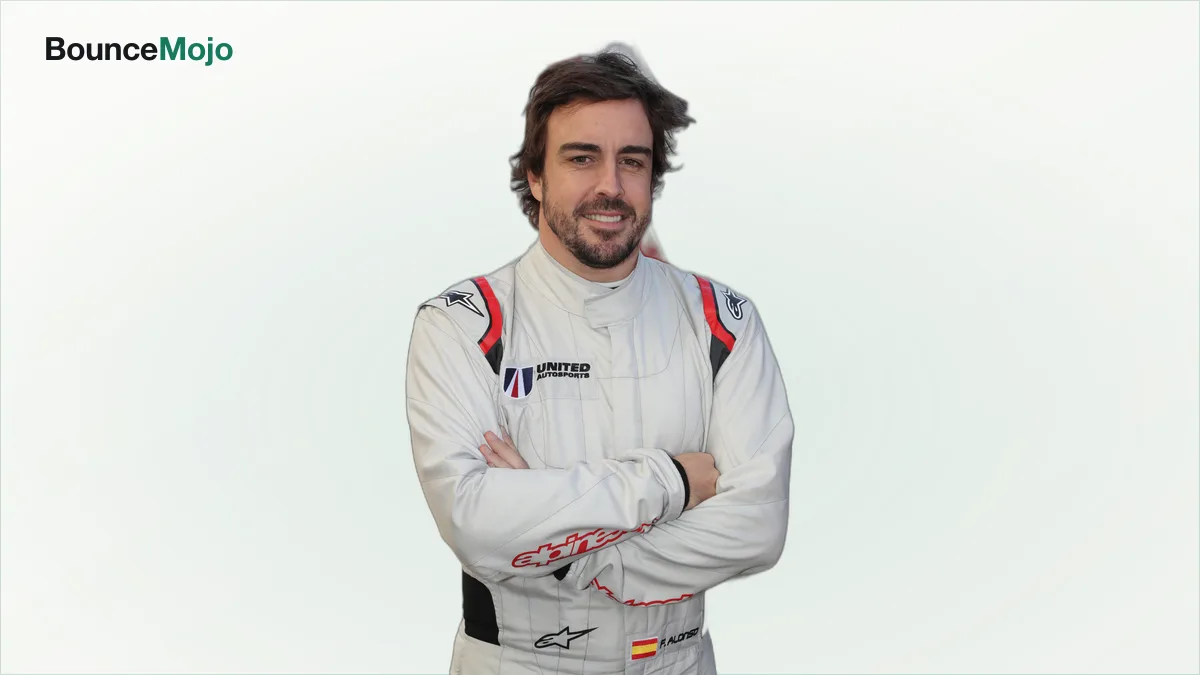
Fernando Alonso
Photo: Wikimedia Commons / CC BY 2.0

Everybody remembers the two world titles that ended Michael Schumacher’s reign. Almost nobody remembers the three-year-old in Asturias, hammering around a homemade kart before he could spell his own name.

Here’s what most people miss: the thing that made Fernando Alonso a two-time champion is the same thing that has kept him fighting, sometimes against his own teams, for more than 20 years.

In this story, you’ll discover:

  • The Asturias childhood where a father’s homemade kart started everything
  • The junior career that made him unbeatable before he could legally drive on the road
  • The Renault years that crowned him the youngest champion in F1 history
  • The career gambles that cost him wins but never his hunger
  • Why a two-time champion kept chasing glory in every series on earth
  • What still drives one of the most relentless competitors motorsport has seen

The titles are the headline. The relentlessness is the real story. Let’s get into it.

The Myth vs. The Reality

The myth is simple. Fernando Alonso, the ruthless racing machine, born with a wheel in his hands, a man who wins anywhere you put him. The complete driver, feared by every teammate, respected by every rival.

That version is real. It’s also only half the picture.

Here’s the truth: the “perfect driver” story skips the part where Alonso’s own choices, his moves between teams, his fallouts, his gambles, cost him seasons and maybe more championships. His career is a story of extraordinary talent tangled up with restless, sometimes self-sabotaging ambition. The machine was actually a fiercely human competitor who could never quite settle for good enough.

Think about it. We love a story of flawless genius because it’s tidy. If Alonso was simply the best, then the near-misses are just bad luck. But that’s not the whole truth. He is a driver whose fire made him great and, at times, made his life harder than it needed to be.

Now, that fire didn’t come from nowhere. It was lit by a specific place, a specific family, and a childhood built entirely around going fast. Which raises the question: what world produces a kid this obsessed with winning?

The World That Made Fernando Alonso

To understand Alonso, you have to understand the Asturias he came up in, a green, industrial corner of northern Spain not exactly famous for producing Formula 1 champions.

He was born on July 29, 1981, in Oviedo. This wasn’t a motorsport dynasty. His father, José Luis, worked at a local mine and explosives factory, and his mother, Ana, worked in a department store. Money was modest, and there was no ready-made path to racing greatness.

But there was a father who loved karts. José Luis built a small kart for Alonso’s older sister; when she lost interest, three-year-old Fernando took it over. The story sounds like legend, but it set the pattern for everything: a working-class family pouring what they had into a boy who simply would not stop racing.

Here’s the deal: Spain had no real F1 culture when Alonso was young. There was no home hero to follow, no obvious ladder to the top. He would have to build the path himself, winning so much in karting that the racing world had no choice but to notice.

But talent alone doesn’t reach Formula 1 from a Spanish mining town. What came next was years of relentless climbing.

The Crucible: Early Life and the Climb

The environment that shaped him

Two things defined young Fernando Alonso: karts and an appetite for winning that bordered on obsession.

From the age of three he raced the kart his father built. By his early teens he was cleaning up Spanish and European junior karting titles, often against better-funded rivals. He wasn’t a rich kid buying his way up. He was a prodigy whose family scraped together what they could while their son simply outdrove everyone.

The environment was demanding. Junior motorsport is brutal and expensive, and every step up required results, sponsors and a little luck. Alonso delivered results with a consistency that made him impossible to ignore.

You might be wondering: how does a kid from a mining town with no racing pedigree reach Formula 1? The answer is that Alonso won so relentlessly, so young, that the sport’s talent-spotters came to him. His karting dominance opened the door to single-seaters, and there he did the same thing again, winning and impressing his way up the ladder.

By his late teens he was tearing through the junior single-seater categories, and the F1 paddock was starting to whisper his name.

The catalyst

The catalyst was a Formula 1 debut with a backmarker, and a manager who saw the future.

Alonso reached Formula 1 in 2001 with Minardi, one of the smallest teams on the grid. He had no chance of winning races, but he used the season to prove he belonged. His raw pace in an uncompetitive car caught the eye of Renault boss Flavio Briatore, who signed him as a test and then race driver.

Here’s the kicker: Briatore’s belief gave Alonso the machinery to match his talent. At Renault he went from promising newcomer to genuine title contender in a matter of seasons, and the partnership would deliver the defining triumphs of his career.

By 2003 he was winning Grands Prix. The kid from Oviedo was no longer a curiosity. He was a threat to the establishment. And the establishment, in those years, meant Michael Schumacher’s Ferrari.

The Key Players

No career this big is a solo act, and Alonso was shaped by the people around him.

Start with José Luis Alonso, his father, the man who built the first kart and drove the family’s early racing dream. Alonso’s whole story runs back to that homemade machine and a dad who believed.

Then there’s Flavio Briatore, the Renault boss and manager who gave Alonso his big break and the car to win two world titles. Their relationship was central to Alonso’s rise from Minardi backmarker to world champion.

And there’s Michael Schumacher, the rival Alonso was measured against. Schumacher’s Ferrari dominance was the mountain Alonso had to climb, and beating it in 2005 and 2006 defined his greatness.

There was also Lewis Hamilton, the young teammate at McLaren in 2007 whose rise triggered one of the most explosive intra-team battles the sport has seen, a rivalry that shaped Alonso’s later career choices.

Now: surround yourself with the right believers and the right rivals, and you can rewrite history. Alonso did exactly that. But his choices along the way came with a cost.

The Turning Point

The pinnacle

The pinnacle came at Renault, across the 2005 and 2006 seasons.

In 2005, Alonso ended Michael Schumacher’s five-year stranglehold on the championship, becoming, at 24, the youngest F1 world champion in history at that point. It was a seismic result, a Spaniard toppling the greatest driver of the era in a sport with no Spanish tradition.

Then he did it again. In 2006 he beat Schumacher once more in a season-long fight, retiring the German (for the first time) as a two-time reigning champion. Back-to-back titles at that age marked him out as one of the very best of his generation.

For a boy from a Spanish mining town who started on a homemade kart, it was a staggering climb.

The price

Because the same fierce ambition that won the titles also complicated everything that came after.

Alonso’s move to McLaren in 2007 turned into a bruising civil war with rookie teammate Lewis Hamilton, and he left after a single season. Over the following years he chased the perfect car and the next title, spending prime seasons at Ferrari and later McLaren without landing the third crown many felt his talent deserved.

The pattern was clear: extraordinary speed, but a career shaped by high-stakes gambles on teams and timing, some of which didn’t pay off. The very hunger that made him great sometimes led him away from the winning machinery.

He had the talent for four or five titles. He finished with two, and a career full of what-ifs that still stings a competitor who hates to lose.

The Unvarnished Truth

Alonso is not a flawless hero, and pretending otherwise misses what makes him compelling.

He could be combustible with teams, and his fallouts, most famously at McLaren, cost him seats and seasons. His pursuit of the ideal car sometimes overrode patience, and he left situations that later turned competitive.

There’s also the loneliness of being, by many measures, the most complete driver of his era without the title tally to prove it. For years Alonso watched less-decorated rivals lift trophies while he sat in cars that couldn’t win, a frustration he rarely hid.

Here’s what’s easy to miss: his greatest strength and his greatest frustration were the same trait. The relentless drive that made him unbeatable on his day also made him restless, unwilling to accept a slow build, always hunting the next winning chance. The gift carried a cost.

None of that dims the two titles or the respect of the paddock. But it explains why his second act, winning Le Mans and chasing motorsport’s Triple Crown, mattered so much to him.

Controversies and Criticisms

Alonso’s career carried real controversy, and it’s worth being honest about it.

The 2007 McLaren season ended in acrimony, with a bitter feud alongside Lewis Hamilton and the fallout from that year’s espionage scandal engulfing the team. Alonso left after just one year of a multi-year deal.

There were tense years at other teams too, where his frank assessments of underperforming cars made headlines and, at times, strained relationships. Critics argued his outspokenness burned bridges.

There’s also a fairer debate about his championship count. Some argue Alonso’s own decisions cost him titles; others counter that he simply kept ending up in the wrong car at the wrong time, a victim of timing as much as choice. Either way, most in the sport rank his raw ability among the very best, title tally or not.

So what does a career like this actually teach the rest of us? Plenty, and not the lessons you’d expect.

What We Can Learn From Fernando Alonso

Alonso’s real lesson isn’t about winning easily. It’s about refusing to quit when the winning stops.

For years he raced cars that couldn’t fight for titles, and the third championship never came. Instead of fading, he reinvented himself, winning the 24 Hours of Le Mans twice, taking the World Endurance Championship, and attempting the Indy 500 and Dakar in pursuit of the sport’s Triple Crown.

In other words: when one door to greatness closed, he went looking for others. He turned frustration into fresh challenges.

The success blueprint

The blueprint here is about relentless self-belief and reinvention.

Alonso came from a place with no racing tradition and reached the very top on talent and work. When his F1 title window narrowed, he built a brand in Kimoa, launched an esports team and a karting circuit, and kept competing at an elite level into his forties.

Want the fuller picture of how that translated into wealth? The full net worth breakdown shows how two titles and two decades at the front became a fortune of an estimated $260 million. And to see how he ranks among motorsport’s biggest earners, the richest race car drivers list puts it in context.

The deeper takeaway is about persistence. Alonso proved that a champion is defined not only by trophies but by the refusal to stop competing. Long after many rivals retired, he was still on the grid, still fighting.

Which brings us to the final reckoning on the man.

Final Verdict

Fernando Alonso is going to be remembered for a number that doesn’t do him justice.

Most people will file him under “two titles,” a fine career but short of the all-time greats by the record books. A smaller, smarter group will remember something harder to measure: a working-class kid from Asturias who reached the summit of a sport with no home tradition, toppled Michael Schumacher, and then spent 20 more years proving he could win anywhere on wheels.

Here’s the bottom line: the titles made him a champion. The relentlessness made him a legend. Few drivers have combined his raw completeness with his sheer, stubborn longevity.

He is a two-time Formula 1 World Champion. He is also living proof that greatness is measured in more than trophies, in the refusal to ever stop fighting. And in the long run, that story, the relentless one, is the version worth remembering.

📖Check out Fernando Alonso's biography on AmazonRead it here →

Shop Fernando Alonso on Amazon

Books, audiobooks, merch and more, handpicked for fans.

As an Amazon Associate we earn from qualifying purchases.

Frequently Asked Questions

Where did Fernando Alonso grow up?+

Alonso grew up in Oviedo, in the Asturias region of northern Spain, where his father built him a kart as a small child and he began racing before he was old enough for school.

How did Fernando Alonso start racing?+

Alonso started in karting as a young boy on a kart his father made, dominating Spanish and European junior categories before graduating to single-seaters and reaching Formula 1 with Minardi in 2001.

How many F1 titles did Fernando Alonso win?+

Alonso won two Formula 1 World Championships, in 2005 and 2006 with Renault, becoming the youngest world champion in the sport's history at the time.

What other races has Fernando Alonso won?+

Beyond F1, Alonso won the 24 Hours of Le Mans twice and the World Endurance Championship, and he attempted the Indianapolis 500 and the Dakar Rally in pursuit of motorsport's unofficial 'Triple Crown'.

Is Fernando Alonso still racing?+

Yes. Alonso continued in Formula 1 into his forties, signing with Aston Martin from 2023, making him one of the most enduring elite drivers the sport has ever seen.

Want the money side of the story?

Read Fernando Alonso's Full Net Worth Breakdown →
📖Check out Fernando Alonso's biography on AmazonRead it here →

Shop Fernando Alonso on Amazon

Books, audiobooks, merch and more, handpicked for fans.

As an Amazon Associate we earn from qualifying purchases.

Sources