Fedor Emelianenko Biography: The Last Emperor Who Never Frowned
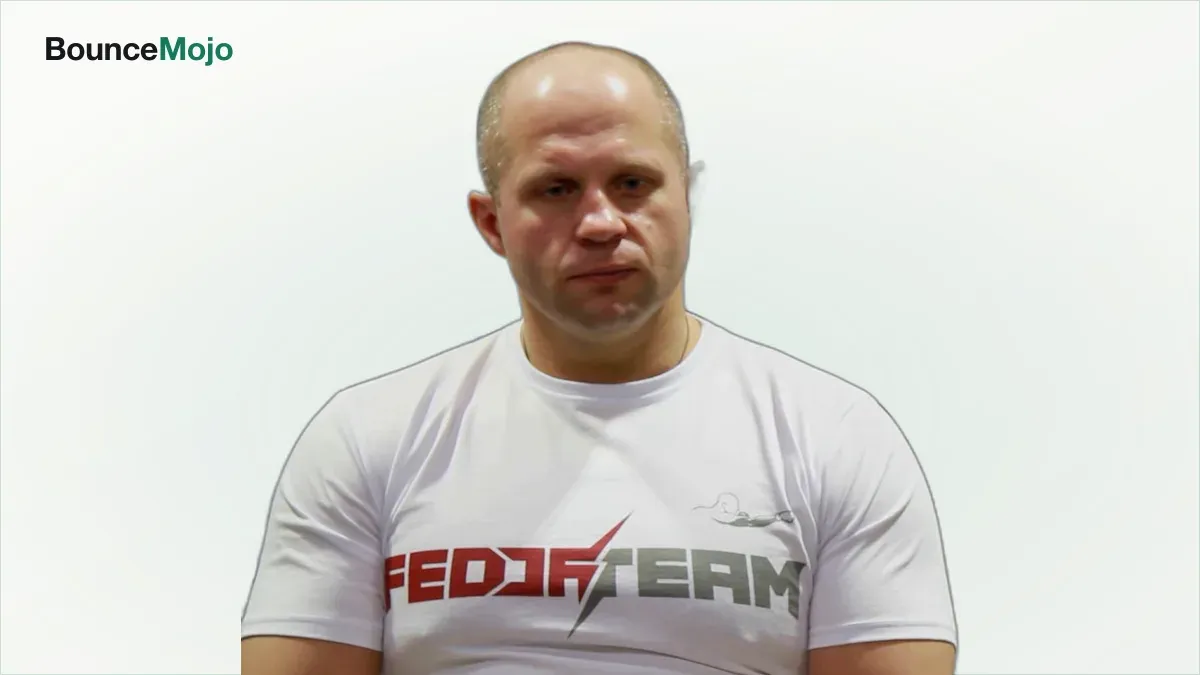
Most people picture the greatest heavyweight in MMA history as a snarling monster. Fedor Emelianenko was the opposite.
Here’s what most people miss: the man who dismantled the biggest, most dangerous fighters on the planet did it with the flat, unbothered expression of a bookkeeper checking a ledger.
The Myth vs. The Reality
The myth is simple. Fedor Emelianenko: the emotionless killing machine, the pudgy Russian who somehow beat giants, the man with dead eyes and a cast-iron chin. Ruthless. Robotic. Untouchable.
The reality is stranger and far more human.
Here’s the deal: Fedor was never robotic. Away from the cameras, teammates and rivals described a soft-spoken, deeply religious man who doted on his daughters, quoted scripture, and seemed almost embarrassed by his own legend. The blank face in the ring wasn’t emptiness. It was a monk-like calm, the composure of a man who had already made peace with whatever happened next.
And the “unbeatable” framing? It flattens the truth. Fedor did lose, and the way his career ended, on a losing skid against younger men, is part of what makes the story real rather than a fairy tale.
You might be wondering: how does a shy kid from a Soviet steel town become the most feared fighter alive? To understand that, you have to understand the world that made him.
The World That Made Fedor Emelianenko
Fedor was born in 1976, in the last years of the Soviet Union, and the collapse of that world shaped everything.
He was born in Rubizhne, in what is now Ukraine, but his family moved when he was two to Stary Oskol, a gritty steel-producing town in Russia’s Belgorod region. His mother taught. His father welded. This was working-class Soviet life, disciplined, austere, with sport offered to boys as a path to structure and, occasionally, escape.
Now: when the USSR fell apart in 1991, the safety nets went with it. A generation of young Russian men came of age in economic chaos, and combat sports, sambo above all, became a proving ground. Sambo, the Soviet grappling art, was woven into the national identity. It rewarded exactly the traits the era demanded: toughness, patience, and the ability to endure.
Fedor arrived as MMA was globalizing but before Russia had produced a true world beater. He would become the first. The steel town that made him also stamped him with the quality everyone remembers: an unshakeable, almost unnatural calm.
But before any of that, there was an ordinary boy nobody expected greatness from.
The Crucible: Early Life and the Climb
The Environment That Shaped Him
Fedor was not a prodigy. By his own accounts and those around him, he was a quiet, unremarkable child, small for his age and far from the obvious future champion.
At age 11, he began training in sambo and judo under coach Vasily Gavrilov, later working with Vladimir Voronov, the man who would guide much of his development. He wasn’t the star of the gym at first. What he had was relentlessness. He simply refused to quit, showing up, absorbing punishment, and grinding his way up.
By 1997 he had earned the title of Master of Sport in both judo and sambo and joined the Russian national team, winning an international judo tournament in Kursk. He served in the Russian military, another crucible of discipline.
Here’s the truth: the ingredients that made Fedor terrifying weren’t gifts of nature. They were built, on cold mats, in a hard country, by a boy with nothing exceptional except an unwillingness to break.
The Catalyst
The turning point came at the dawn of the new century, when Fedor turned to the emerging sport of mixed martial arts.
In 2000 he began his professional MMA career, and by 2002 he had landed in Japan’s PRIDE Fighting Championships, then the richest and most prestigious promotion on Earth. What happened next rewrote the sport’s history.
He beat the reigning legend Antonio Rodrigo Nogueira to claim the PRIDE heavyweight crown, then simply never let go. Fight after fight, giant after giant, Fedor won. His calm never cracked. His aura grew.
It gets stranger, though. The more dominant he became, the more mysterious he seemed, a fighter who ruled the world yet lived like a humble parishioner back home. That contradiction is where the real story lives, and it runs through everyone who shaped him.
The Key Players
No fighter rules alone, and Fedor’s reign was built by a tight, loyal circle.
Vladimir Voronov. His longtime coach helped forge the technical, unflappable style that made Fedor so hard to solve. Where flashier fighters chased knockouts, Fedor’s team drilled a complete, patient game.
Vadim Finkelchtein. His manager and business partner steered his career and later co-founded M-1 Global with him, turning Fedor’s fame into an ownership stake rather than a series of one-off checks.
Aleksander Emelianenko. His younger brother followed him into heavyweight fighting, a talented but far more troubled figure whose turbulent life stood in sharp contrast to Fedor’s discipline.
Antonio Rodrigo Nogueira and Mirko Cro Cop. His great PRIDE rivals pushed him to the performances that built the legend. You don’t become “The Last Emperor” beating nobodies. Fedor beat the best of a golden generation.
Think about it: every one of these figures reflects the same theme, loyalty and restraint over spectacle. That theme carried Fedor to the top, and it also framed how his reign finally ended.
The Turning Point
The Pinnacle
From roughly 2003 to 2009, Fedor was, by consensus, the best fighter alive at any weight.
He held the PRIDE heavyweight title and defended his throne against a murderer’s row of contenders. He fought bigger men and beat them. He was cut, dropped, and pressured, and he always came back, often finishing opponents moments after looking vulnerable. That resilience became his signature. As his own net worth story lays out, the fame he built in Japan turned into paydays across Russia and, eventually, America.
For nearly a decade, he did not lose a real fight. The only blemish on his record from 2000 to 2010 was a controversial doctor’s stoppage after an accidental cut. In the eyes of most fans, he was untouchable.
The Price
Here’s the kicker: nobody stays on top forever, and the fall, when it came, was steep.
In 2010 and 2011, a suddenly older Fedor lost three straight fights against a new generation of heavyweights. The aura cracked in public. Critics who had grumbled that he’d avoided the UFC in his prime grew louder. The Last Emperor looked, at last, mortal.
He rebuilt, retired, returned, and later fought a respectable run in Bellator into his forties. But the invincibility was gone. The price of a reign that long was watching the world finally catch up, on camera, in front of everyone. Which brings us to the parts of the man the legend tends to hide.
The Unvarnished Truth
Fedor was never a saint, and the myth of the flawless warrior does him a disservice.
He fought on well past his physical peak, taking losses that dented the perfect narrative fans had built around him. Critics have long argued he ducked the UFC during his best years, choosing the safer, better-paying Japanese and Russian circuits over testing himself against the American elite. That debate has no clean answer, and it follows him still.
Now: none of that makes him a fraud. Much of what looks like caution was loyalty, to his manager, his promotion, his country, the same loyalty that defined his whole life. He stayed where he was comfortable and where he was paid, and in doing so he left a “what if” that his critics never let go of.
The most honest thing you can say about Fedor is this: his greatest strength, his steady, unshowy consistency, was also the thing that fueled the accusation he never truly tested his ceiling.
Controversies and Criticisms
For a man so widely admired, Fedor attracted real debate.
The UFC question. The loudest criticism, repeated for two decades, is that Fedor never signed with the UFC during his prime. Negotiations collapsed, and fans were left to argue whether he was protecting a perfect record or simply following the money. He always insisted it was a business decision.
The late-career losses. His string of defeats in the early 2010s prompted some to revise their view of his dominance, questioning whether the competition in PRIDE had been as deep as it seemed.
Politics and country. As a proud, publicly patriotic Russian who took on administrative roles at home, Fedor became a lightning rod for some observers, especially as tensions between Russia and the West sharpened. His close association with Russian institutions drew scrutiny from critics abroad.
His brother’s shadow. Aleksander Emelianenko’s legal troubles and turbulent life occasionally spilled onto the family name, a reminder that Fedor’s discipline was his own, not a family guarantee.
What We Can Learn From Fedor Emelianenko
Navigating Hard Times
The first lesson is about composure. Fedor’s entire legend rests on a single trait: he did not panic. Cut, dropped, pressured, he kept the same flat expression and kept working the problem.
Here’s the truth the losses make plain, though: even the most composed champion eventually meets a version of the game that has moved past him. Fedor’s dignity in defeat, fighting on, losing to younger men, and never making excuses, is as instructive as any of his wins. Grace under pressure includes grace in decline.
The Success Blueprint
If you want the replicable part, it’s this: Fedor won by being complete and patient in a sport obsessed with highlights. He wasn’t the biggest, the strongest, or the flashiest. He was the most well-rounded and the hardest to rattle.
That’s transferable far beyond a cage. The lesson isn’t “be violent.” It’s “master every part of your craft and refuse to lose your head.” His steady, ownership-minded approach to money mirrors the same philosophy, as our richest MMA fighters ranking shows, he ended up wealthier than louder stars precisely because he stayed disciplined.
Becoming Better
The deepest lesson is about identity. Fedor never let the sport define him. He was a fighter, but first a father, a believer, a citizen of a small Russian town. That anchor kept him from the excess and self-destruction that swallowed so many peers.
In other words, know who you are before the world tells you who to be. That self-knowledge is why Fedor could rule the most brutal sport on Earth and still walk away recognizably himself.
Final Verdict
Fedor Emelianenko is one of the most important figures in the history of mixed martial arts, and “important” carries as much weight here as “great,” though he was surely that too. He proved a heavyweight could be a technician, that dominance could look calm rather than cruel, and that a fighter from a collapsing empire could become the standard by which all others are measured.
And here’s the twist that reframes everything: the most feared man in the sport was, by every account, its gentlest. He walked away with a modest fortune, a spotless personal reputation, and a legacy that survives even the losses at the end. The full picture of what that dominance was worth lives in his net worth breakdown, but the number was never the point. Fedor’s real achievement was ruling the hardest game there is without ever seeming to need it. That, more than any belt, is why they still call him the Last Emperor.
Shop Fedor Emelianenko on Amazon
Books, audiobooks, merch and more, handpicked for fans.
As an Amazon Associate we earn from qualifying purchases.
Frequently Asked Questions
Where was Fedor Emelianenko born?+
Fedor was born on September 28, 1976, in Rubizhne in the Ukrainian SSR of the Soviet Union. When he was two, his family moved to Stary Oskol, a steel town in Russia's Belgorod region, where he grew up.
How did Fedor Emelianenko start fighting?+
Fedor began training in sambo and judo at age 11 under coach Vasily Gavrilov. He earned Master of Sport certification in both by 1997 and represented Russia internationally before turning to mixed martial arts in 2000.
Why is Fedor called 'The Last Emperor'?+
The nickname reflects his aura of calm, total dominance during MMA's PRIDE era. From 2000 to 2010 he went roughly a decade with only one controversial loss, ruling the heavyweight division with an almost expressionless composure.
Is Fedor Emelianenko religious?+
Yes. Fedor is a devout Russian Orthodox Christian and has often spoken about his faith as central to his life, crediting it above fighting or fame. His humility became a defining part of his public image.
What is Fedor Emelianenko doing now?+
After retiring from active competition following his Bellator run, Fedor turned to sports administration in Russia and business ventures including the M-1 Global promotion, a gym chain, and martial arts equipment.
Want the money side of the story?
Read Fedor Emelianenko's Full Net Worth Breakdown →Shop Fedor Emelianenko on Amazon
Books, audiobooks, merch and more, handpicked for fans.
As an Amazon Associate we earn from qualifying purchases.