Erling Haaland Biography: The Goal Machine Built in a Norwegian Town
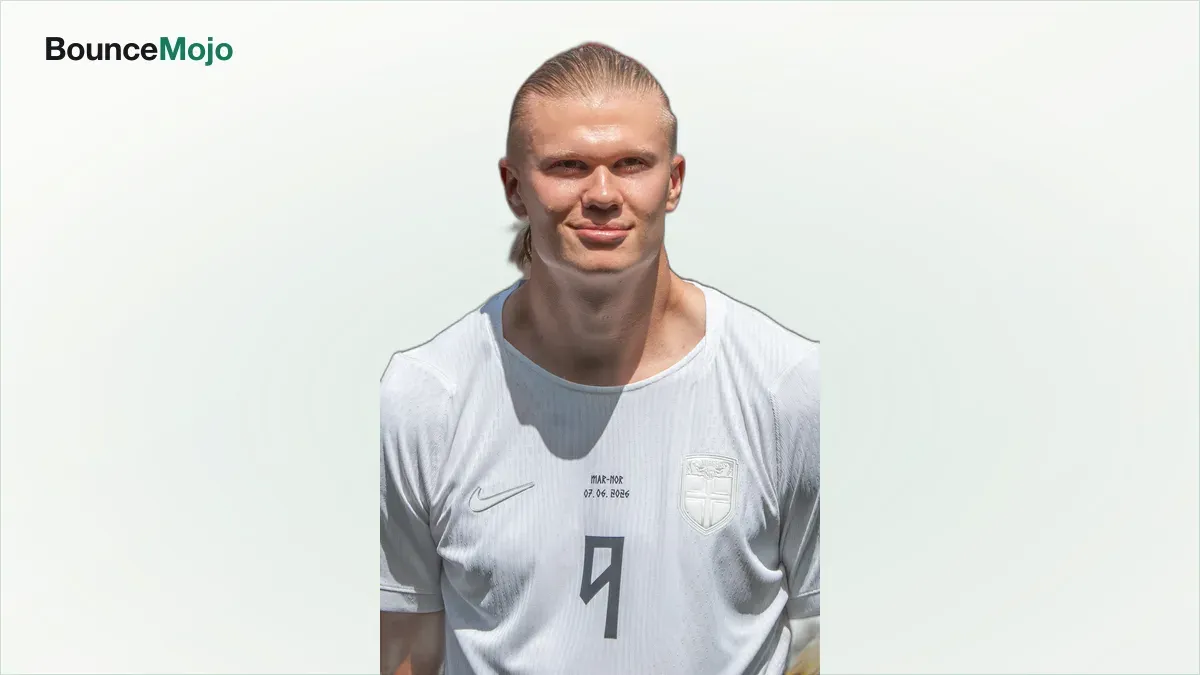
Most people know Erling Haaland as a scoring robot, a 6-foot-5 machine who breaks records like other people break a sweat. That image misses the boy behind it.
Here’s what most people miss: the most fearsome striker on earth was once a skinny kid in a tiny Norwegian town, overlooked by the giant clubs, betting on a plan almost nobody else believed in.
The Myth vs. The Reality
The myth is simple. Erling Haaland: genetic freak, born to score, a plug-and-play goal machine who was always going to be great. Point him at a goal and let physics do the rest.
The reality is more interesting.
Here’s the deal: the physical gifts are real, but plenty of tall, fast kids never make it. What separated Haaland was a plan, and the patience to follow it when flashier options tempted him. He didn’t sprint to a superclub as a teenager. He built himself, rung by rung, in leagues that toughened him up before the spotlight found him.
And the “born great” story ignores how much of Haaland is manufactured on purpose. The blackout blinds. The blue-light glasses. The strict meals. The early bedtimes. This is a man who treats his body like a business asset and his career like a project with a spreadsheet.
You might be wondering: how does a kid from a Norwegian town of 12,000 end up here? To understand that, you have to understand where he came from.
The World That Made Erling Haaland
Haaland was born in 2000 in Leeds, England, into a football family in a football-mad country he’d soon leave behind.
His father, Alfie Haaland, was in the middle of a Premier League career, playing for Leeds United and later Manchester City. So Erling’s first years were spent around elite English football, in dressing rooms and on training grounds most kids only see on television. Then the family moved home to Bryne, Norway, a small town on the country’s southwest coast, and that’s where the striker was really made.
Now: Norway is not a football superpower. It produces good players, occasionally great ones, but it isn’t Brazil or Spain. Growing up there meant Haaland had to be undeniable to get noticed. There was no giant academy conveyor belt to carry him along. He had to force his way onto bigger and bigger stages, one proof point at a time.
That backdrop matters. Haaland’s whole rise is the story of a player from the periphery of the football world refusing to accept the periphery’s ceiling. And the person who first showed him what the ceiling could look like was sitting at his own dinner table.
The Crucible: Early Life and the Climb
The Environment That Shaped Him
Alfie Haaland wasn’t just a dad who liked football. He was a professional who’d competed at the highest level, and he brought that knowledge home.
Erling grew up understanding the demands of the game from the inside, what elite fitness looked like, how professionals ate and trained and recovered. He started at the local club, Bryne, the same club his father had played for, and by his mid-teens it was clear he was different. Not just talented. Relentless.
Here’s the truth: the early Haaland wasn’t the finished monster fans see now. He was tall, a little awkward, still growing into a frame that would eventually become a weapon. Scouts saw potential, but nobody was calling him the next great striker yet.
He made his senior debut for Bryne as a teenager, then moved to Molde, where a coach named Ole Gunnar Solskjaer, a former Manchester United great, began sharpening him into a genuine prospect. The goals started coming. So did the interest.
The Catalyst
The move that changed everything was Red Bull Salzburg in 2019.
At Salzburg, Haaland detonated. He scored a hat-trick on his Champions League debut against Genk, becoming one of the youngest players ever to do so, and finished with an absurd goal tally that made Europe’s biggest clubs sit up. Suddenly the skinny kid from Bryne was the most wanted teenager in football.
It gets better: instead of chasing the biggest name or the biggest wage, Haaland’s camp chose Borussia Dortmund, a club famous for developing young stars and giving them minutes. It was a calculated step, not a leap. The plan again.
That decision set up the climb to Manchester City. But the climb was never a solo effort, and the people around him would prove as important as his own talent.
The Key Players
No striker scores alone, and no career is built without a cast around it. Haaland’s is unusually tight-knit.
Alfie Haaland. His father is the foundation. A former pro who understood the industry, Alfie guided decisions, managed expectations and stayed close to the business side, giving Erling something rare: a family member who actually knew how the machine worked.
Mino Raiola and Rafaela Pimenta. The late super-agent Mino Raiola engineered Haaland’s biggest early moves, extracting favorable terms and release clauses that kept his client’s options open. After Raiola’s death, Rafaela Pimenta took the reins, steering the Manchester City deal and the long extension that secured his fortune.
Ole Gunnar Solskjaer. At Molde, the former United striker helped turn a raw teenager into a finisher, an early mentor who understood exactly what a goalscorer needs.
Pep Guardiola. At Manchester City, the demanding manager gave Haaland the perfect platform, a team built to feed him chances, and the tactical structure to turn his gifts into trophies.
Think about it: every one of these figures added a piece, family trust, sharp representation, expert coaching. Together they turned raw ability into a machine. And the machine reached its peak faster than anyone expected.
The Turning Point
The Pinnacle
The 2022-23 season was Haaland’s coronation.
In his debut campaign at Manchester City, he scored 36 Premier League goals, shattering the single-season record for a 38-game season. He didn’t just fit into Guardiola’s side. He transformed it. City won the Premier League, the FA Cup and, for the first time in the club’s history, the Champions League, completing a treble with Haaland leading the line.
He was 22 years old. Most players spend a decade chasing a single trophy like that. Haaland won the sport’s biggest three in one season, in his first year in England, while breaking a record that had stood for years.
As his own net worth story shows, that debut season didn’t just make him a champion. It made his enormous contract look like a bargain and rocketed him up the ranks of the richest soccer players before his prime had even started.
The Price
Here’s the kicker: scoring at that rate turns you into a target and a talking point.
Every quiet game becomes a story. Every tactical debate about City circles back to whether the team is better with or without him. The scrutiny that comes with being the most expensive, most watched striker in the league is relentless, and Haaland has faced criticism in stretches where the goals slowed, even when his overall numbers stayed absurd.
There’s a personal cost too. The discipline that fuels him, the rigid routines, the near-monastic focus on recovery, leaves little room for the ordinary life a 25-year-old might otherwise have. He’s chosen the machine over the chaos. That choice has flaws, and Haaland is human enough to have them.
The Unvarnished Truth
Haaland isn’t a controversial figure by football’s usual standards, but the perfect-robot image hides real complexity.
He can be prickly and combative on the pitch, jawing with defenders, snapping at officials, letting frustration show when chances dry up. Away from it, his intense, almost clinical approach to his body and career strikes some as cold. He’d rather talk about sleep hygiene and macros than emotion or spectacle.
Now: none of that is a scandal. But it’s a personality, not a highlight reel. Haaland has been open about how single-minded he is, how much he structures his life around one goal. That focus is a strength. It’s also a kind of sacrifice, one that not everyone would trade a normal youth for.
He’s also faced the awkwardness of privilege in a sport that mythologizes hardship. Haaland didn’t rise from poverty. He rose from a stable, well-off football family with insider knowledge. That doesn’t diminish the work. But it’s an honest part of the picture that the fairy-tale version tends to skip.
Controversies and Criticisms
For a player so young, Haaland’s controversies are mostly football arguments rather than off-field drama.
The “flat-track bully” debate. Critics have periodically argued that Haaland feasts on weaker teams and goes quiet in the biggest matches. His backers point to his Champions League record and treble to shut the argument down, but the criticism resurfaces whenever City stumble in a marquee game.
The system question. Some analysts claim Haaland is a product of Guardiola’s brilliant machine, that any elite striker would score in that side. It’s a debate about how much credit belongs to the man and how much to the platform, and it will follow him until he proves it elsewhere or wins enough to end it.
The money noise. His enormous wages and the release clauses baked into his contracts have drawn ongoing speculation about whether and when he’ll leave for Real Madrid or another giant. That constant transfer chatter, fueled by the structure his agents built, keeps him in headlines even in quiet weeks.
None of it has dented his standing much. If anything, the arguments prove the point: you only debate players who matter this much.
What We Can Learn From Erling Haaland
Navigating Hard Times
The lesson from Haaland’s climb is patience with a plan. He had offers to jump faster and higher, and he chose the steps that would actually develop him, Salzburg, then Dortmund, then City.
Here’s the truth: the fastest route isn’t always the best one. Haaland treated his career like a project with stages, refusing to skip the parts that made him ready. When the big moment came, he wasn’t overwhelmed by it. He was built for it.
The Success Blueprint
If you want the replicable part, it’s the discipline. Haaland’s talent is rare, but his routine is copyable, sleep, nutrition, recovery, obsessive attention to the boring fundamentals that most people ignore.
That mindset put a kid from a Norwegian town in the same conversation as generational forwards like Kylian Mbappe and the goal-scoring giants he’s chasing, from Cristiano Ronaldo to the legends of the past. The takeaway isn’t “be seven feet tall and fast.” It’s “control the controllables so ruthlessly that your talent has nothing standing in its way.”
Becoming Better
The deepest lesson is about self-knowledge. Haaland figured out exactly what kind of player and person he is, a finisher, a machine, a project, and he built his entire life around maximizing that instead of pretending to be something else.
In other words, he didn’t chase being well-rounded. He chased being unstoppable at one thing. That clarity, knowing your edge and sharpening it obsessively, is a lesson that reaches far beyond football.
Final Verdict
Erling Haaland is the rarest thing in modern football: a young superstar who might genuinely rewrite the record books before he’s done. He arrived fully formed at Manchester City, won everything in his first season, and shows no sign of slowing down.
And here’s the twist that reframes the fairy tale: the “born great” striker is actually the most engineered player of his generation. The goals look effortless. The life behind them is anything but. Every blackout blind, every early night, every measured meal is a choice most players wouldn’t make, and it’s the real reason the numbers keep climbing.
The full financial side of that machine, the record contract, the Nike deal, the fortune he’s built before 26, lives in his net worth breakdown. Read it if you want to see what happens when rare talent meets relentless discipline, and a plan almost nobody believed in pays off in full.
Shop Erling Haaland on Amazon
Books, audiobooks, merch and more, handpicked for fans.
As an Amazon Associate we earn from qualifying purchases.
Frequently Asked Questions
Where is Erling Haaland from?+
Erling Haaland was born in Leeds, England in 2000 while his father Alfie played for Leeds United, but he grew up in Bryne, Norway, a small town where he began his football career.
Who is Erling Haaland's father?+
His father is Alfie Haaland, a former Norwegian international who played in the Premier League for Nottingham Forest, Leeds United and Manchester City, the same club his son now stars for.
How did Erling Haaland become so good?+
Haaland combined rare physical gifts with obsessive discipline. He broke through at Molde and Red Bull Salzburg, exploded at Borussia Dortmund, and is famous for a strict routine around sleep, diet and recovery.
What records has Erling Haaland broken?+
Haaland set the Premier League single-season scoring record with 36 goals in his debut 2022-23 campaign for Manchester City, part of a treble-winning season, and has repeatedly broken Champions League age and scoring records.
Is Erling Haaland one of the best players in the world?+
Yes. Since arriving at Manchester City, Haaland has been widely regarded as one of the best strikers in the world, a serial trophy winner and a leading contender for individual honors alongside players like Kylian Mbappe.
Want the money side of the story?
Read Erling Haaland's Full Net Worth Breakdown →Shop Erling Haaland on Amazon
Books, audiobooks, merch and more, handpicked for fans.
As an Amazon Associate we earn from qualifying purchases.