Eileen Gu Biography: The Raw Truth Behind the Two-Nation Prodigy
Everybody remembers the gold medals in Beijing. Almost nobody remembers the single mother who made all of it possible.
Here’s what most people miss: the story of the world’s most marketable young athlete is really the story of the woman who raised her alone in San Francisco.
The Myth vs. The Reality
The myth is perfection. Eileen Gu, the flawless prodigy who wins Olympic gold, walks fashion runways, aces her exams and glides between two cultures like it’s effortless. A young woman who seems to have every gift at once.
That version is real. It’s also incomplete in an important way.
Here’s the truth: the “perfect” story hides how much of it was built by one determined parent, and how much pressure comes with being a symbol for two countries at once. Gu isn’t a magic natural who floated to the top. She’s the product of a specific, relentless upbringing, and she carries a weight most young athletes never have to.
Think about it. We look at someone who’s a champion, a model and a scholar and assume the ease is real. But being all of those things simultaneously, in the glare of two national spotlights, is not effortless. It’s a high-wire act, and the person walking it is still very young.
Now, that act didn’t come from nowhere. It came from a household headed by a woman who had already crossed an ocean to build a new life. Which raises the question: what kind of mother produces a daughter like this?
The World That Made Eileen Gu
To understand Gu, you have to understand her mother, and the two worlds she straddles.
Eileen was born on September 3, 2003, in San Francisco. Her mother, Yan Gu, is a first-generation Chinese immigrant with a remarkable resume of her own: a former short-track speed skater at Peking University, later the holder of graduate degrees in the United States, including an MBA from Stanford’s Graduate School of Business. Yan raised Eileen largely as a single mother in Sea Cliff, one of San Francisco’s most exclusive neighborhoods.
The era mattered too. Gu grew up as social media and global branding were reshaping what an athlete could be. A young competitor could now be a model, an influencer and a champion at once, monetizing a personal brand across continents in ways that were impossible a generation earlier. Gu came of age perfectly positioned to exploit that shift.
Here’s the deal: she was raised at the intersection of two enormous cultures, American and Chinese, fluent in both languages and comfortable in both worlds. That dual fluency, instilled by her mother, would become the single most valuable thing about her.
But first, she had to become a skier. And that started absurdly early.
The Crucible: Early Life and the Climb
The environment that shaped her
Two forces shaped young Eileen Gu: an extraordinary mother and an early start on snow.
Yan Gu once worked part-time as a ski instructor at Lake Tahoe, and she put her daughter on skis at just three years old. Eileen took to it immediately. But skiing was only part of a much broader upbringing. Yan raised her daughter to excel at everything, academics, sport, music, presentation, with the high standards common in families that have sacrificed to build a new life.
You might be wondering: how does a kid become elite at a dangerous sport and a top student at the same time? Through structure and expectation. Gu grew up in a household where being exceptional wasn’t optional, and where her mother’s own achievements set an intimidating bar. The result was a young person with a rare capacity to compete at the highest level in multiple arenas at once.
By her early teens, Gu was dominating junior freestyle skiing, throwing tricks that put her among the best in the world while still keeping near-perfect grades. The raw material was undeniable.
The catalyst
The catalyst was a decision that changed everything: in 2019, Gu chose to compete for China.
Born and raised in the United States, Gu announced she would represent China, her mother’s home country, at international competitions. She framed it as a way to honor her heritage and inspire young people, especially girls, in China. Commercially and competitively, it was a seismic move.
Here’s the kicker: that single choice transformed her from a talented American skier into a national icon in the world’s most populous country. Chinese brands and audiences embraced her instantly. It positioned her to become the face of the 2022 Beijing Winter Olympics, held in her adopted nation, in front of the largest possible home crowd and market.
The prodigy had picked her stage. Now she had to deliver on it, and the whole world was watching.
The Key Players
No life this big is a solo act, and Gu’s is anchored by a few essential figures.
Start with Yan Gu, her mother, who is inseparable from the story. Immigrant, academic, former skater, single parent, Yan built the environment, the standards and the dual-culture fluency that made Eileen who she is. Nearly every advantage Gu has traces back to her mother’s choices and sacrifices.
Then there’s her extended family in China, including a grandmother Gu has spoken about warmly, who deepened her connection to the country she chose to represent. That family bond gave the 2019 decision an emotional core, not just a strategic one.
There’s also IMG, the agency that turned her athletic fame into a global modeling and endorsement career, and the constellation of coaches and trainers who developed her into a multi-discipline skier capable of winning across events.
And there’s the public itself, two publics, really: a Chinese audience that adopted her as a hero, and an American one that watched a homegrown talent choose another flag.
Now: with a formidable mother, a global agency and a chosen home stage, Gu had everything lined up. And in Beijing, she delivered a performance that made her a superstar. But the triumph came wrapped in a difficult cost.
The Turning Point
The pinnacle
The pinnacle came at the 2022 Beijing Winter Olympics.
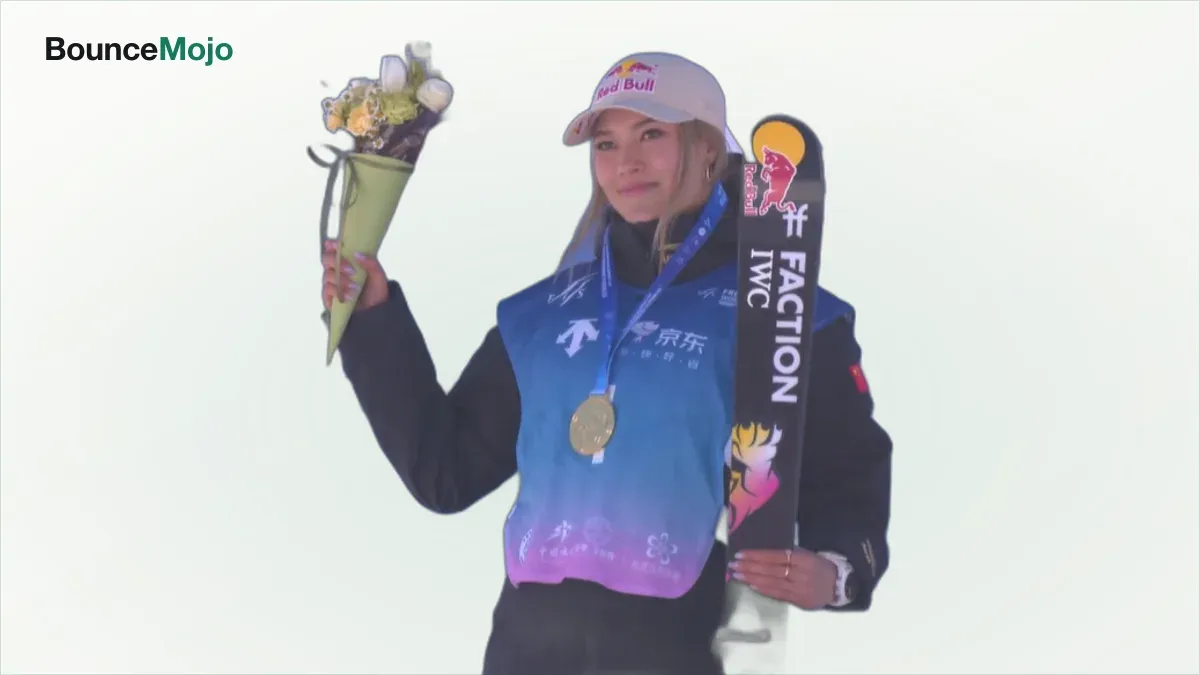
Competing on home snow for China, and still just 18 years old, Gu won gold in big air and gold in the halfpipe, plus a silver in slopestyle. Her big air victory in particular, landing a trick she’d never done in competition to snatch gold, became one of the defining images of the Games. She was the youngest Olympic freestyle skiing champion, and she’d done it under the most intense pressure imaginable, in front of a home nation that had adopted her as its star.
Overnight, she went from elite athlete to global phenomenon. The endorsements, already substantial, exploded. Luxury houses, consumer giants and Chinese brands all wanted her. At 18, she had become one of the most marketable people in sport.
Here’s the truth: she didn’t just win. She became a symbol, which is a far heavier thing to carry.
The price
Because being a symbol for two countries meant belonging fully to neither.
Gu’s choice to compete for China made her a hero there and a source of controversy in the United States. She faced pointed questions about citizenship, loyalty and whether she was navigating politically sensitive issues honestly. Standing between two nations that were increasingly at odds, she absorbed criticism from both sides no matter what she said. That’s a brutal place for anyone, let alone a teenager, to live.
There was also the ordinary but real pressure of doing everything at once. Elite skiing is dangerous and time-consuming. Modeling and endorsements demand constant availability. Stanford demands serious academic work. Gu chose to carry all of it, and the schedule and scrutiny that come with that are relentless.
The gold medals were dazzling. The position she now occupies, admired and interrogated by millions, is far more complicated.
The Unvarnished Truth
Gu is widely admired, but her story isn’t a simple fairy tale, and honesty serves it better.
The most persistent criticism concerns her handling of the politics around her China decision. When pressed on sensitive questions, Gu often deflected with polished, carefully neutral answers, and critics argued she wanted the enormous commercial benefits of representing China without engaging honestly with the harder questions that came with it. Supporters saw a young athlete refusing to be dragged into geopolitics. Both readings have merit.
There’s also the reality of extraordinary privilege. Gu’s rise was fueled by advantages most young athletes never have: an accomplished, resourceful mother, an elite San Francisco upbringing, and access to two of the world’s biggest markets. That doesn’t diminish her genuine talent or work ethic, but it’s an honest part of the picture. Not everyone starts with a Stanford MBA parent and Lake Tahoe on the doorstep.
Here’s what’s easy to miss: the same dual identity that made her rich also made her a target. The thing that opened every door also drew every critic. Gu’s greatest asset and her heaviest burden are the same.
None of that erases what she accomplished on the snow. It just makes the phenomenon more human.
Controversies and Criticisms
Gu’s public life has drawn real controversy, and it’s worth naming clearly.
The central one is her decision to compete for China rather than the United States. In the US, it drew accusations that she’d chosen commercial opportunity over her birth country. In China, it made her a celebrated patriot. The murkiness around her citizenship status, which she has declined to fully clarify, kept the debate alive.
Then there are the deflections. Asked about politically sensitive topics during and after Beijing, Gu repeatedly gave smooth non-answers, which critics read as evasive and defenders read as prudent. Either way, it became a recurring knock: a global figure choosing marketability over candor.
And there’s the broader debate about what she represents. Is Gu a barrier-breaking symbol of cross-cultural achievement, or a carefully managed brand that carefully avoids anything that might cost a sponsor? The honest answer is that she’s some of both, and reasonable people disagree on the balance.
So what does a life like this actually teach the rest of us? A surprising amount.
What We Can Learn From Eileen Gu
Navigating hard times
Gu’s real lesson is about carrying pressure without cracking.
Being a teenage symbol for two rival nations, expected to win gold, model, study and stay perfectly composed, is a level of scrutiny most people can’t imagine. Gu has largely managed it by staying relentlessly focused on her performance and controlling what she can control: her training, her grades, her craft.
In other words: when the noise around you is overwhelming, the anchor is the work. Gu keeps returning to the things she can actually master.
The success blueprint
The blueprint here is about the power of being more than one thing.
Gu isn’t the best pure skier who ever lived. What made her a phenomenon is the combination, champion plus model plus scholar plus bicultural bridge. She leaned into every one of those identities instead of picking a lane, and the market rewarded the rare stack enormously.
Want the fuller picture of how that translated into wealth? The full net worth breakdown shows how a college-aged skier built a $50 million brand off luxury and consumer deals. And to see where she ranks among the biggest fortunes in Olympic sport, the richest Olympians list puts it in context.
The deeper takeaway is about leverage. In the modern world, the most valuable people are often the ones who can credibly be several things at once. Gu is proof that range, cultivated deliberately, can be worth more than singular excellence. If you can be excellent at more than one thing, the combination can become your greatest asset.
Which brings us to the final reckoning on the young star.
Final Verdict
Eileen Gu is going to be remembered as effortless, and that’s the one thing her life hasn’t been.
Most people will file her under “the perfect prodigy,” the girl who has everything and makes it look easy. A smaller, smarter group will see the fuller story: a daughter raised by a driven single mother, put on skis at three, taught to excel at everything, who made a high-stakes choice about which country to represent and then had to carry the consequences in front of the entire world.
Here’s the bottom line: the gold medals made her famous, but the combination of talents and the weight she carries are what make her genuinely remarkable. She turned a bicultural upbringing into one of the most valuable young brands in sport, and she’s done it while still barely out of her teens.
She is one of the richest and most marketable young athletes alive. She is also a reminder that even the most polished success story is built by someone, in her case, a mother who crossed an ocean. And in the long run, that partnership, between an immigrant parent and her extraordinary daughter, is the version worth remembering.
Shop Eileen Gu on Amazon
Books, audiobooks, merch and more, handpicked for fans.
As an Amazon Associate we earn from qualifying purchases.
Frequently Asked Questions
Where did Eileen Gu grow up?+
Gu grew up in the Sea Cliff neighborhood of San Francisco, raised largely by her mother, Yan Gu, a Chinese immigrant and Stanford MBA. She began skiing at Lake Tahoe at age three.
Who is Eileen Gu's mother?+
Her mother is Yan Gu, a Chinese immigrant who was a short-track speed skater at Peking University, later earned degrees in the United States including a Stanford MBA, and raised Eileen as a single mother.
Why does Eileen Gu compete for China?+
In 2019, Gu chose to compete for China, her mother's home country, rather than the United States where she was born. The decision was celebrated in China and drew controversy in the US.
What did Eileen Gu win at the 2022 Olympics?+
At the 2022 Beijing Winter Olympics, Gu won two gold medals and one silver in freestyle skiing, becoming, at 18, the youngest Olympic freestyle skiing champion.
Is Eileen Gu a student?+
Yes. Gu is an academic high achiever who enrolled at Stanford University, balancing elite skiing and a global modeling and endorsement career with her studies.
Want the money side of the story?
Read Eileen Gu's Full Net Worth Breakdown →Shop Eileen Gu on Amazon
Books, audiobooks, merch and more, handpicked for fans.
As an Amazon Associate we earn from qualifying purchases.