Eddy Merckx Biography: The Raw Truth Behind Cycling's Cannibal
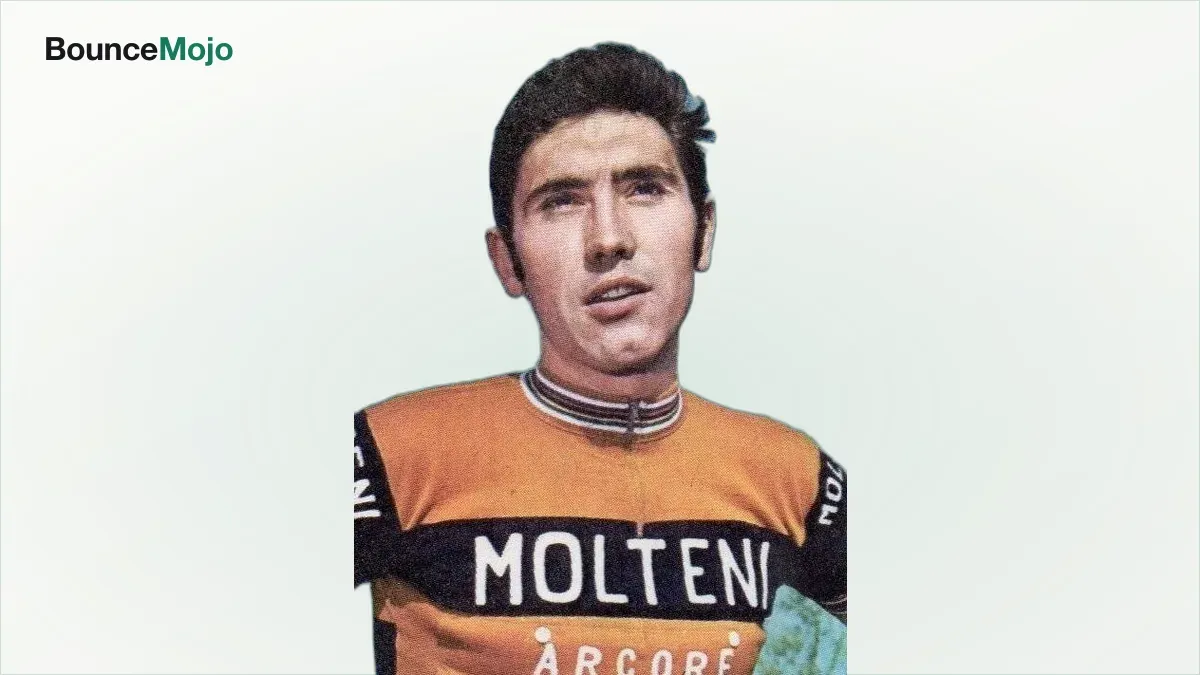
The rainbow jersey, the endless victories, the aura of a man who simply could not be beaten. That’s the Eddy Merckx most fans picture.
Here’s what most people miss: the greatest cyclist who ever lived was driven by a hunger so ferocious that even his own teammates found it hard to understand. His whole story turns on that hunger, and what it cost him.
The Myth vs. The Reality
The myth is simple. Eddy Merckx was invincible, a machine who won everything and never seemed to struggle.
The reality is far more human.
Here’s the truth: Merckx suffered, doubted, and bled like anyone else. He was disqualified in a doping scandal he furiously denied. He was physically assaulted mid-race. He rode through injuries that would have ended lesser careers, and he pushed himself so hard that many believe he burned out years before he had to.
Now think about what that hunger really was. It wasn’t arrogance. It was a fear of losing so deep that he could not stop chasing wins, even when there was nothing left to prove.
That fear made him the greatest. It also nearly consumed him. To understand it, you have to start behind the counter of a small shop in Brussels.
The World That Made Eddy Merckx
Édouard Louis Joseph Merckx was born on June 17, 1945, in the village of Meensel-Kiezegem, Belgium, just weeks after the end of the war in Europe. His family soon moved to Woluwe-Saint-Pierre, a suburb of Brussels, where his parents ran a grocery store.
This was postwar Belgium, a country rebuilding itself, and cycling was its national obsession. In a nation without mountains of its own to boast about, the great riders were folk heroes. Kids raced through the streets dreaming of the Tour de France and the spring classics that crossed their own cobbled roads.
Young Eddy was one of them. He was restless, competitive, and far more interested in racing than in school or the family shop. By his mid-teens he was winning amateur races, and it was clear the grocer’s son had a gift that could not be contained behind a counter.
But here’s the kicker: raw talent alone rarely makes a legend. What set Merckx apart was already forming, and it was closer to an obsession than a hobby.
The Crucible: Early Life and the Climb
The environment that shaped him
Merckx grew up in a household of hard work and modest means. His parents valued effort, and the grocery shop ran on long hours and discipline. That work ethic seeped into him.
He turned professional in 1965 at age twenty. Within two years he had won the World Championship, announcing himself as the sport’s next great force. He didn’t ease in. He attacked from the front, in race after race, as if losing were a personal insult.
The talent was obvious. The hunger behind it was something else entirely.
The catalyst
The moment that revealed who Merckx truly was came at the 1969 Giro d’Italia.
Merckx was leading the race, dominating, when he was disqualified after a failed doping test. He was devastated and always insisted he was innocent, suggesting he had been set up. The Belgian public rallied around him, and the episode left a permanent mark.
Here’s the deal: instead of breaking him, the injustice hardened him. Weeks later he entered his first Tour de France and destroyed the field, winning the overall title, the points classification, and the mountains classification all at once.
Want to know what that fury turned into? The most dominant single season cycling had ever seen, and it was only the beginning.
The Key Players
You cannot tell the Merckx story without the people around him.
His rivals came first. Riders like Luis Ocaña, Felice Gimondi, and Raymond Poulidor spent years trying to crack him. Ocaña in particular pushed Merckx to his limits, and their duels in the mountains are still cycling folklore. Merckx respected them, but he refused to give them an inch.
His wife, Claudine, was the anchor. She married him early in his career and gave him a stable home life away from the relentless pressure of the road. The couple raised two children, including a son who would carry the family name back into the peloton.
That son, Axel Merckx, is the third key figure. Axel became a professional cyclist in his own right and later a respected team manager, ensuring the Merckx name stayed in the sport into a new century.
Here’s the truth: all of it, the rivals, the family, the fame, was about to collide with a moment of triumph that also planted the seeds of his decline.
The Turning Point: Triumph and Its Hidden Cost
The pinnacle
Start with the triumph, because the numbers barely seem real.
Between 1969 and 1974, Merckx won the Tour de France five times. He won the Giro d’Italia five times and the Vuelta a España once, completing all three Grand Tours. He captured the World Championship three times and swept nearly every one-day classic, from Milan–San Remo to Paris–Roubaix to the Tour of Flanders.
In total he won a staggering 525 professional races. In 1972, he set the Hour Record, riding farther in sixty minutes than any human before him. No cyclist had ever combined stage-race dominance, classics mastery, and time-trial power the way he did.
He earned the nickname “The Cannibal” because he devoured everything. Teammates reportedly begged him to let others win the occasional minor race. He rarely did.
The price
Now the cost, which was hidden inside all that winning.
At the 1975 Tour de France, while leading, Merckx was punched in the stomach by a spectator on a climb. Around the same period he suffered a serious crash that fractured his cheekbone and forced him to keep racing in pain. He was never quite the same rider afterward.
Many observers believe the deeper price was self-inflicted. By trying to win everything, every year, Merckx wore himself down. The obsession that built his legend may also have shortened his prime. He retired in 1978, aged just thirty-three, his body spent by more than a decade of total effort.
You might be wondering how a man so dominant handled the fading of his powers. The answer reveals the flaws behind the legend.
The Unvarnished Truth
Let’s not pretend it was all glory.
Merckx could be single-minded to the point of coldness on the bike. His refusal to share victories frustrated peers and even teammates, and some accused him of a ruthlessness that bordered on selfish. He wanted it all, and he made no apologies for it.
The 1969 Giro disqualification also left a shadow he never fully escaped. Merckx always maintained his innocence, and the case remains disputed, but it was part of an era in cycling when doping controls were primitive and controversy was common across the sport.
Here’s the truth: his greatest strength, that bottomless hunger, was also his flaw. It made him unbeatable and, in the end, it may have burned him out faster than he needed to burn.
Even so, that same hunger is why no rider since has matched his complete command of the sport.
Controversies and Criticisms
For a national hero, Merckx carried his share of controversy.
The 1969 doping disqualification is the biggest. It happened at the height of his powers, it was hotly disputed, and it colored how some critics viewed his era. Merckx defended himself fiercely and pointed to the primitive testing of the time.
He was also criticized for his relentlessness. In a sport with unwritten codes about letting rivals have their moments, Merckx’s refusal to ease off struck some as excessive. Others called it exactly what made him great.
Beyond that, the criticisms are minor. In a career of extraordinary scrutiny, Merckx’s biggest sins were wanting to win too much and racing through an era when the sport’s rules were still catching up.
Here’s the thing though: none of it dents the legacy. Because the record speaks for itself, and no one has come close to it.
What We Can Learn From Eddy Merckx
Navigating the darkness
When the 1969 Giro was ripped away from him, Merckx had two choices. He could sulk, or he could ride angrier.
He rode angrier. The very next Tour de France he won by a landslide. The lesson isn’t to bury injustice, it’s to convert it into fuel. Merckx turned the worst moment of his career into the launchpad for his most dominant run.
The success blueprint
Now the part that outlasted the racing.
Merckx never coasted on talent. He trained obsessively, raced constantly, and treated every event as worth winning. When he retired, he did the same thing with his name, founding Eddy Merckx Cycles and building a brand on the reputation he had earned. That discipline is why he ranks among the wealthiest and most respected figures in cycling. The full money breakdown lives in our Eddy Merckx net worth analysis, and you can see where he sits among the richest athletes overall, alongside fellow Grand Tour giant Miguel Indurain.
In other words, the man who devoured races also knew how to build something that lasted.
Becoming better
The deepest lesson is about the double edge of ambition. Merckx’s hunger made him the greatest cyclist ever, but it also cost him. The takeaway is balance: relentless drive is a superpower, yet knowing when to ease off might have extended his prime. Greatness and sustainability are not always the same thing.
So what’s the final word on cycling’s Cannibal?
Final Verdict
Eddy Merckx is the rare athlete whose dominance is measured not in titles but in totality.
He won everything: five Tours, five Giri, a Vuelta, three World Championships, the Hour Record, and 525 races in all. He devoured the sport so completely that the debate over the greatest cyclist ever tends to end at his name.
Here’s the bottom line: the winning was never the whole story. Behind it was a grocer’s son from Brussels whose fear of losing drove him to a peak no one has reached since, and whose obsession may have cost him as much as it gave.
Anyone who remembers only the invincible machine has missed the man. Merckx’s real story is the hunger, and it built a legend that still sets the standard for the entire sport.
Shop Eddy Merckx on Amazon
Books, audiobooks, merch and more, handpicked for fans.
As an Amazon Associate we earn from qualifying purchases.
Frequently Asked Questions
Where did Eddy Merckx grow up?+
Eddy Merckx was born on June 17, 1945, in Meensel-Kiezegem, Belgium, and grew up in Woluwe-Saint-Pierre, a suburb of Brussels, where his parents ran a grocery shop.
Why was Eddy Merckx nicknamed 'The Cannibal'?+
He earned the nickname because of his insatiable hunger to win. Merckx tried to take every race, every stage, and every classic, refusing to leave victories for anyone else.
What made Eddy Merckx the greatest cyclist ever?+
Merckx won a record 525 professional races, including all three Grand Tours, the World Championship, and nearly every prestigious one-day classic, a range of dominance no rider has matched.
What was Eddy Merckx's darkest moment?+
In 1969 he was disqualified from the Giro d'Italia after a failed doping test he always disputed, and in 1975 a spectator punched him during the Tour de France, injuries that marked the decline of his peak.
What did Eddy Merckx do after retiring?+
He founded Eddy Merckx Cycles in 1980, a premium bicycle brand, and became a lifelong ambassador for the sport he had dominated.
Want the money side of the story?
Read Eddy Merckx's Full Net Worth Breakdown →Shop Eddy Merckx on Amazon
Books, audiobooks, merch and more, handpicked for fans.
As an Amazon Associate we earn from qualifying purchases.