Denny Hamlin Biography: Trailer-Park Racer Turned NASCAR Owner
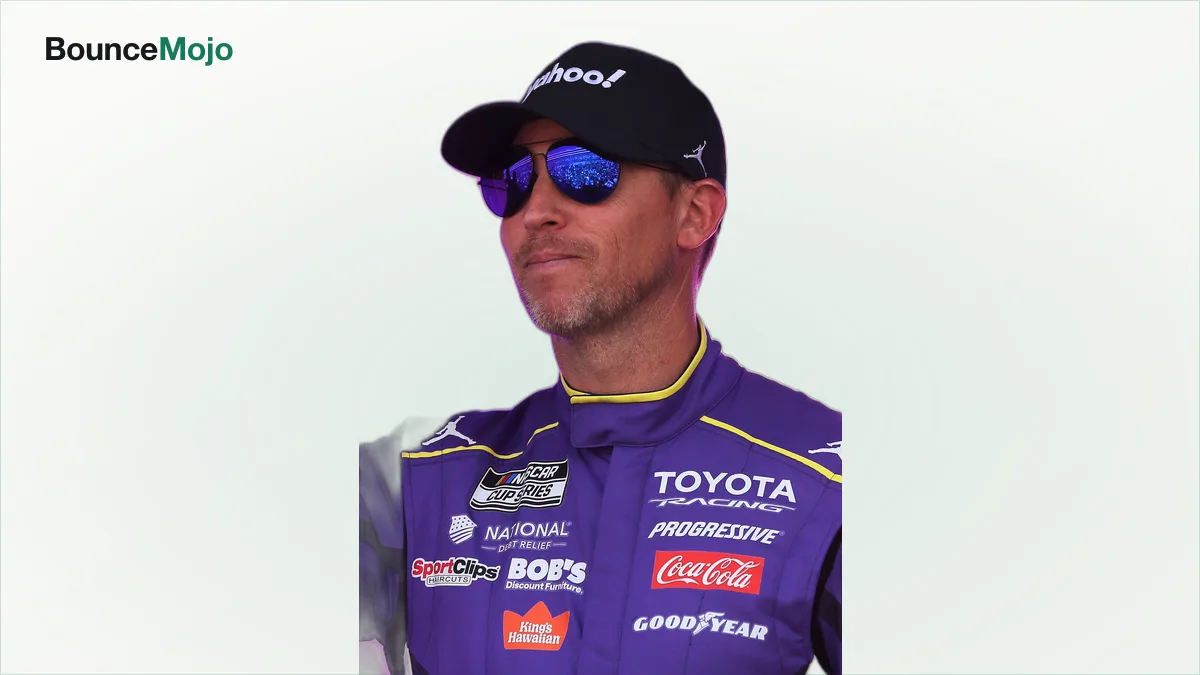
Everybody remembers the Daytona 500 wins and the podcast hot takes. Almost nobody remembers the Virginia kid whose family bet everything they had on a go-kart.
Here’s what most people miss: the same relentless, chip-on-the-shoulder drive that made Denny Hamlin a target for critics is the exact thing that turned him from a short-track hopeful into a NASCAR team owner.
The Myth vs. The Reality
The myth is a familiar one in NASCAR. Denny Hamlin, the polished Joe Gibbs Racing star, blessed with a top ride, a signature sponsor and every advantage a driver could want.
That version has some truth to it. It’s also missing the part that matters.
Here’s the reality: Hamlin came from modest means in Chesterfield, Virginia, and his path to the Cup Series ran through a family that sacrificed to fund his short-track career long before any big team came calling. The ride at JGR wasn’t handed to him. He earned it by being fast enough to make a legendary owner take a chance.
Think about it. We like to assume the drivers at the front were always destined for it. But Hamlin’s rise depended on parents willing to spend what they didn’t have, on years of grinding through late-model races, and on catching one break at exactly the right moment. Strip away the polish and you find a self-made competitor who never forgot where he started.
Now, that starting point shaped everything about him. Which raises the question: what kind of upbringing produces a driver this hungry and this stubborn?
The World That Made Denny Hamlin
To understand Hamlin, you have to understand the short-track world of central Virginia that raised him.
He was born on November 18, 1980, and grew up in Chesterfield, near Richmond. This wasn’t a wealthy racing dynasty. It was a working family that decided early their son had a gift and organized their lives around it. His parents backed his racing from childhood, funneling money and weekends into karts and then cars.
The era mattered too. Hamlin came up as NASCAR was booming in popularity through the late 1990s and early 2000s, when a talented kid from a short track could realistically dream of reaching the Cup Series, and when big teams were building development programs to find the next star.
Here’s the deal: Virginia has a deep short-track tradition, and Hamlin cut his teeth in the late-model ranks, racing against grown men while still young. The pavement bullrings of the Southeast were his classroom, and they taught him a hard-nosed, aggressive style that would define his career.
But talent alone doesn’t get you to the top. He needed someone with resources to notice. And that’s where the story turns.
The Crucible: Early Life and the Climb
The environment that shaped him
Two things defined young Denny Hamlin: a supportive family and a lot of pressure.
His parents invested heavily in his racing, and that kind of sacrifice cuts both ways. It gave him opportunity, but it also loaded every race with meaning. When a family spends what it can’t easily afford, the kid in the car feels it. Hamlin has spoken about racing with the weight of his family’s investment on his shoulders.
He climbed the Virginia short-track ladder, winning enough to get noticed in a crowded field of hopefuls. There was no guarantee any of it would pay off. For every short-track prodigy who reaches NASCAR’s top series, hundreds never make it out of the regional ranks.
You might be wondering: how does a kid from Chesterfield leap from local tracks to the sport’s biggest stage? The answer is a tryout that went right. Joe Gibbs Racing, the powerhouse team founded by NFL Hall of Fame coach Joe Gibbs, was scouting for young talent. Hamlin’s speed in a test earned him a development deal, the break that changes everything.
The short-track kid was suddenly in the pipeline of one of NASCAR’s best organizations. But he still had to prove he belonged.
The catalyst
The catalyst was Joe Gibbs Racing itself.
Landing with JGR gave Hamlin elite equipment, sharp engineering and the kind of platform most drivers only dream about. The team believed in him enough to move him up quickly, and Hamlin rewarded that faith almost immediately.
Here’s the kicker: in his very first full Cup season in 2006, Hamlin won the spring race at Pocono, then won there again in the fall, and put himself in playoff contention as a rookie. He announced himself as a serious talent from the jump, and JGR knew it had found a long-term cornerstone.
That partnership, formed when Hamlin was a young unknown, would anchor his entire premier-series career. He never drove full-time for anyone else in Cup competition.
The kid who came up on Virginia short tracks was now a Cup Series winner. But the biggest prize would prove maddeningly hard to grasp.
The Key Players
No career this big is a solo act, and Hamlin was shaped by a handful of pivotal figures.
Start with his parents, who bankrolled his early racing and instilled the drive that carried him. Their sacrifice is the foundation the whole story rests on.
Then there’s Joe Gibbs, the Super Bowl-winning coach turned NASCAR owner who signed Hamlin, gave him a top ride and kept faith in him across two decades. The Gibbs organization gave Hamlin the tools to win.
There’s Kyle Busch, his longtime JGR teammate and sometime rival, a relationship that pushed both drivers and defined an era at the team. Competing alongside a driver that talented sharpened Hamlin’s edge.
And there’s Michael Jordan, who arrived later as a business partner rather than a racing mentor. Their alliance would take Hamlin somewhere no driving contract could.
Now: surround yourself with the right backers and the right platform, and you can build a remarkable career. Hamlin did exactly that. But one storyline would follow him everywhere.
The Turning Point
The pinnacle
The pinnacle, at least in single-race terms, came at Daytona.
Hamlin won the Daytona 500, NASCAR’s biggest event, multiple times across his career, including a stunning victory that ranks among the sport’s most dramatic finishes. Winning the 500 even once secures a driver’s legacy. Hamlin did it three times, a mark that puts him in rare company.
Across his career, the totals became elite: more than 50 Cup Series wins, hundreds of top-ten finishes and a spot among the winningest drivers of his generation. He became a perennial championship contender, a fixture at the front of the field for the better part of twenty years.
Here’s the truth: he built one of the great careers of his era, and there was still one thing missing.
The price
Because for all the wins, the Cup championship kept slipping away.
Hamlin came close more than once, contending deep into the playoffs, only to fall short of the title. Over time, “the best driver never to win a championship” became a label attached to his name, a frustrating shadow over an otherwise stellar record. The very consistency that made him a threat every week also made the near-misses sting harder.
That storyline shaped how the public saw him, and it clearly fueled him. Rather than let the missing trophy define him, Hamlin channeled that hunger into a different kind of legacy, one built on ownership rather than a single Sunday’s result.
He’d spent his whole life chasing a championship. When it kept eluding him, he found another way to leave a mark on the sport.
The Unvarnished Truth
Hamlin is not a universally beloved figure, and pretending otherwise misses what makes him compelling.
He races aggressively and talks bluntly, which has made him a lightning rod for fans and rivals alike. His candor on his podcast and in interviews has drawn both praise and criticism. He is, by design, not everyone’s favorite.
There’s also the weight of the championship that never came. For a driver of his talent and win total, the absence of a Cup title is the defining tension of his career, and he has been honest about how much it matters to him.
Here’s what’s easy to miss: the same combative, self-promoting edge that irritates his critics is exactly what made him a successful team owner. The willingness to bet on himself, to speak his mind, to build his own platform, translated directly into business ambition.
None of that erases the near-misses. But it does explain why his second act, as an owner, may end up being just as significant as his driving.
Controversies and Criticisms
Hamlin’s career has carried its share of friction, and it’s worth being honest about it.
He has been involved in on-track feuds and hard racing that drew boos and criticism, the natural byproduct of an aggressive, uncompromising style. He has never shied from confrontation with rivals.
His outspokenness off the track, especially through his media ventures, has generated headlines and occasional backlash. Being candid in a sport that often prizes diplomacy comes with a cost.
There’s also a fairer debate about his legacy itself. Some argue that a career this decorated without a championship is a story of unfulfilled potential; others counter that longevity, win totals and multiple Daytona 500s make him a certain future Hall of Famer regardless. Both takes have merit, and the debate itself keeps Hamlin at the center of the conversation.
So what does a career like this actually teach the rest of us? More than the trophy count suggests.
What We Can Learn From Denny Hamlin
Navigating hard times
Hamlin’s real lesson isn’t about winning the biggest race. It’s about what to do when the one thing you want most keeps slipping away.
Instead of letting the missing championship consume him, Hamlin widened his definition of success. He turned his standing in the sport into an ownership stake, building something that would outlast any single season’s disappointment.
In other words: when the front door stays locked, build a second door. Hamlin refused to let one absent trophy write his whole story.
The success blueprint
The blueprint here is about turning influence into ownership.
Most drivers spend their careers as highly paid employees. Hamlin used his stature to become an owner, co-founding 23XI Racing with Michael Jordan and giving himself equity in the sport itself.
Want the fuller picture of how that translated into wealth? The full net worth breakdown shows how 50-plus wins and a team stake built a fortune estimated around $65 million. And to see how he ranks among the sport’s biggest earners, the richest race car drivers list puts it in context.
The deeper takeaway is about legacy. Hamlin proved that greatness isn’t only measured in championships. By building a business and a media platform on top of his driving, he created a footprint in NASCAR far larger than any one trophy could provide.
Which brings us to the final reckoning on the man.
Final Verdict
Denny Hamlin may be remembered for a trophy he didn’t win.
Some will always file him under “best driver never to win a Cup title,” the talented star who fell just short of the sport’s ultimate prize. A smarter group will remember something bigger: a kid from a Virginia short track whose family sacrificed to get him racing, who won three Daytona 500s and more than 50 Cup races, and who then reinvented himself as a team owner in business with Michael Jordan.
Here’s the bottom line: the wins made him a star, but the ownership made him a builder. Hamlin turned a driving career into a stake in the sport’s future, the kind of move most racers never even attempt.
He is one of the most accomplished drivers of his generation. He is also proof that when the trophy you chase won’t come, the right answer is to build something the trophy could never give you. And in the long run, that second story, the entrepreneur’s, may be the one that matters most.
Shop Denny Hamlin on Amazon
Books, audiobooks, merch and more, handpicked for fans.
As an Amazon Associate we earn from qualifying purchases.
Frequently Asked Questions
Where did Denny Hamlin grow up?+
Hamlin grew up in Chesterfield, Virginia, near Richmond, where his parents poured their resources into his short-track racing from the time he was a young child.
How did Denny Hamlin get into NASCAR?+
Hamlin came up through Virginia's short tracks and late-model ranks, then earned a development deal with Joe Gibbs Racing, which fast-tracked him into the Cup Series in the mid-2000s.
How many Daytona 500s has Denny Hamlin won?+
Hamlin has won the Daytona 500 three times, including in his rookie season, making him one of the most successful drivers in the history of NASCAR's biggest race.
Does Denny Hamlin own a race team?+
Yes. In 2020 Hamlin co-founded 23XI Racing with NBA legend Michael Jordan, becoming an owner in the Cup Series while continuing to drive full-time for Joe Gibbs Racing.
Has Denny Hamlin won a NASCAR Cup championship?+
As of early 2026 Hamlin had not won a Cup Series title despite more than 50 wins, making him one of the winningest drivers never to claim the championship, a storyline that has defined much of his career.
Want the money side of the story?
Read Denny Hamlin's Full Net Worth Breakdown →Shop Denny Hamlin on Amazon
Books, audiobooks, merch and more, handpicked for fans.
As an Amazon Associate we earn from qualifying purchases.