Daniel Alfredsson Biography: The Late Pick Who Won a City's Heart
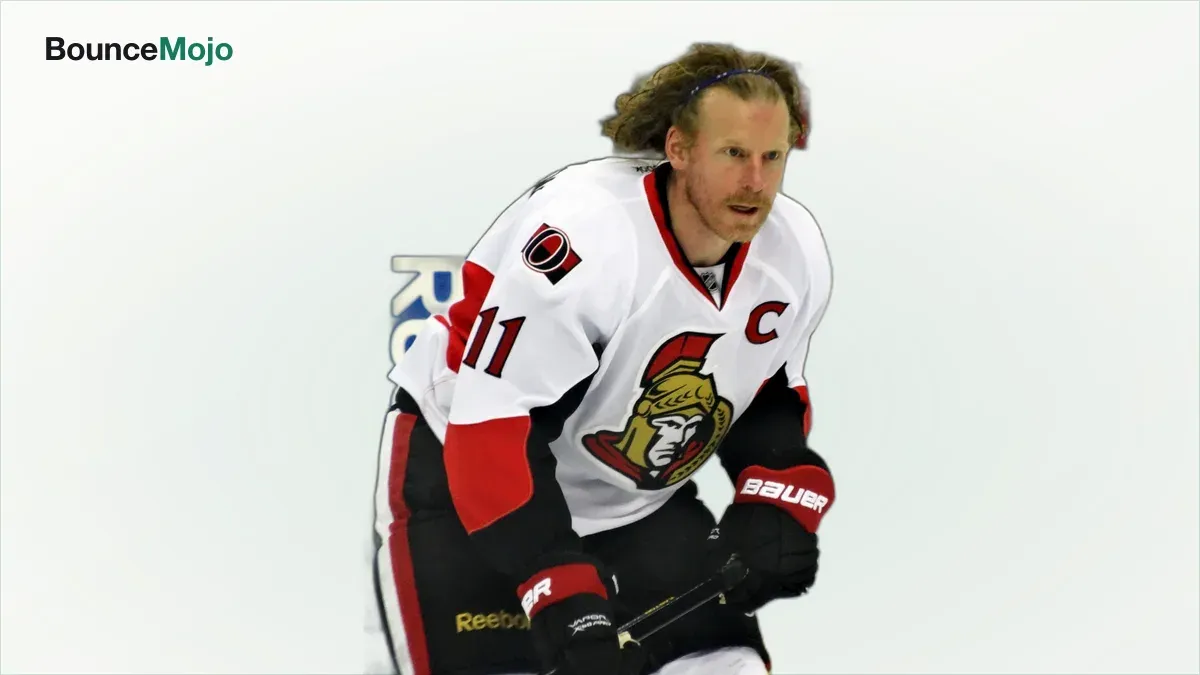
Everybody in Ottawa knows his name. Almost nobody, back in 1994, thought he’d ever make the NHL at all.
Here’s what most people miss: the greatest player in a franchise’s history was a sixth-round afterthought that most teams didn’t bother to scout.
The Myth vs. The Reality
The myth is that great players announce themselves early. Blue-chip prospects, high draft picks, obvious talent. Daniel Alfredsson was none of that.
The reality is a slow-burn story that makes his eventual greatness even more remarkable.
Here’s the truth: Alfredsson wasn’t a can’t-miss prodigy. He was a small, late-developing winger from Sweden who wasn’t drafted until his early twenties, and even then only in the sixth round. Nearly every team in the league decided he wasn’t worth an early pick. He proved all of them wrong, becoming a Hall of Famer and the greatest player one of the NHL’s youngest franchises has ever had.
Think about it: the entire scouting apparatus of professional hockey looked at this player and shrugged. And he turned that shrug into a career worth studying.
Now, that kind of overlooked greatness doesn’t emerge from nowhere. It’s forged by being underestimated, again and again, until you learn to feed on it. Which raises the question. What kind of upbringing produces a player patient and driven enough to outlast everyone’s doubt?
The World That Made Daniel Alfredsson
To understand Alfredsson, you have to understand where and how he came up.
He was born on December 11, 1972, in Gothenburg, Sweden, the country’s second-largest city and a genuine hockey hotbed. He developed through the Frolunda program, one of Sweden’s storied clubs, but he did so slowly. He wasn’t a phenom the way some of his contemporaries were. He was a good player who kept getting a little better, year after year, without the fanfare.
Sweden in that era was exporting skilled players to the NHL in growing numbers, and North American teams were increasingly willing to bet on them. But the scouting focus fell on the obvious talents. A modestly sized, late-blooming winger like Alfredsson slipped through the cracks of that attention.
But here’s the kicker: being overlooked turned out to be the making of him. He never coasted on hype because he never had any. Every step forward was earned.
Which is where the story really starts.
The Crucible: Early Life and the Climb
The environment that shaped him
Alfredsson’s path was built on patience and steady improvement, not early stardom.
In the Frolunda system, he honed a complete, intelligent game. He wasn’t the biggest or the fastest, so he learned to think the game, to be in the right place, to contribute at both ends of the ice. That well-rounded foundation would later define his NHL career and separate him from flashier but less complete players.
Crucially, he developed the mentality of someone who expected nothing to be handed to him. When you spend your youth as a good-not-great prospect that scouts ignore, you build a certain resilience. You learn to prove yourself continuously.
You might be wondering: how does a player nobody drafts early become a superstar? For Alfredsson, the answer was maturity. He arrived in North America later than most, but as a more finished, more mentally prepared player. He didn’t need to survive the growing pains of a teenager in the pros. He was ready.
The catalyst
Then came the moment that changed everything: the 1994 NHL Draft, and what he did after it.
The Ottawa Senators, then a young and struggling expansion team, selected Alfredsson in the sixth round, the 133rd pick overall. It was the kind of selection nobody notices. But when he arrived in Ottawa for the 1995-96 season, he was instantly one of the team’s best players.
Here’s the deal: he won the Calder Trophy as the NHL’s rookie of the year, an astonishing outcome for a sixth-round pick. Overnight, the afterthought had become the face of a franchise still desperate for an identity. The Senators had stumbled into their cornerstone.
It gets better, though. That rookie season was just the beginning of a bond between a player and a city that would last nearly two decades, shaped by the people around him.
The Key Players
No franchise legend rises alone, and Alfredsson’s story is populated by the teammates who defined an era of Ottawa hockey.
Start with Jason Spezza and Dany Heatley, the young stars who joined Alfredsson to form the “CASH line” and later the “Pizza Line,” one of the most productive forward units in the league during the mid-2000s. Alongside those linemates, Alfredsson’s game reached its peak, and the Senators became a genuine Stanley Cup contender.
Then there’s Chris Phillips, the steady defenseman and fellow long-serving Senator who shared the trenches with Alfredsson through the franchise’s best years. The two of them represented the loyal, homegrown core of that era.
Later came Erik Karlsson, the young, dazzling defenseman who arrived near the end of Alfredsson’s Ottawa run and would become a superstar in his own right. Alfredsson mentored the next generation even as his own career wound down.
And behind it all stood the city of Ottawa itself, which adopted the quiet Swede as its own and made him the emotional center of its hockey identity.
Now: leading a team is one thing. Carrying its hopes to the brink of glory, and falling just short, is another. And Alfredsson’s greatest triumph came wrapped in heartbreak.
The Turning Point
The pinnacle
The pinnacle came in the spring of 2007.
That year, Captain Alfredsson led the Ottawa Senators on the deepest playoff run in franchise history, all the way to the Stanley Cup Final. He was electric throughout the postseason, driving the team with clutch scoring and steady leadership. For a franchise that had never reached the sport’s biggest stage, it was a defining moment, and Alfredsson was its unquestioned leader.
He piled up individual honors too, becoming Ottawa’s all-time leader in goals, assists, and points, categories he still tops. He represented Sweden with distinction internationally, including winning Olympic gold in 2006. He was, without argument, the greatest player his franchise had ever produced.
Here’s the truth: the sixth-round afterthought had climbed all the way to the doorstep of a championship, carrying a whole city with him.
The price
But the Senators lost that 2007 Final, and the Cup would forever elude him.
That absence is the one gap in an otherwise storybook career. Alfredsson gave everything for that trophy and never won it, a fate shared by many great players but no less painful for it. He came agonizingly close and never got another chance quite like it.
The deeper price came at the end. In 2013, after 17 seasons and years as the beloved captain, a contract dispute with Senators management led Alfredsson to do the unthinkable: he signed with the Detroit Red Wings for what became his final NHL season. For a fan base that saw him as family, the split was wrenching. The perfect one-city legacy had a crack in it.
It gets deeper, though. Because even that bitter chapter revealed something human and complicated beneath the beloved captain’s calm exterior.
The Unvarnished Truth
Alfredsson was not a flawless figure, and honesty requires acknowledging the harder edges.
The Detroit departure exposed real tension. The saintly, loyal captain had legitimate grievances with how the organization operated, and he was willing to leave over them. Some fans felt betrayed. Others understood a proud veteran wanting to be valued properly. The clean narrative of unbroken loyalty was, in truth, messier than the highlight reels suggest.
There was also frustration baked into his career. Being repeatedly overlooked, first by scouts, then by voters and pundits who sometimes underrated him, took a toll. He played much of his career slightly beneath the national spotlight, in a smaller Canadian market, and never received the full acclaim his talent warranted until late.
Here’s what’s easy to miss: the same quiet pride that fueled his greatness is what made the Detroit split possible. The trait wasn’t a flaw exactly. It was the human core of a competitor who knew his worth.
None of that diminished the reconciliation that followed, or the love the city still holds for him. But it does complicate the too-perfect story.
Controversies and Criticisms
Alfredsson’s career is remarkably clean, which itself speaks to his character. But criticism found him.
The loudest chapter is the Detroit departure. For a player who built his entire identity on loyalty to Ottawa, leaving for a rival to chase a Cup felt, to some, like a contradiction of everything he stood for. The wound eventually healed, and Alfredsson returned to retire as a Senator and rejoin the organization, but the episode remains a genuine complication in his legacy.
There’s also the perennial debate about whether he was underrated or, in some corners, slightly overrated by a devoted fan base. Playing in a smaller market, he was sometimes overlooked nationally, yet his most loyal supporters occasionally pushed his case beyond what his stats strictly supported. The truth sits comfortably in between: a genuinely great, genuinely underappreciated player.
And there’s the eternal “no Cup” asterisk that follows every great player who never won one. Critics use it. Defenders point to the 2007 run and everything he gave. Both have a point.
So what does a career like this teach the rest of us? A great deal.
What We Can Learn From Daniel Alfredsson
Navigating hard times
Alfredsson’s story is a lesson in outlasting doubt through patience.
He was overlooked, undersized, and drafted late. The lesson isn’t that talent always wins. It’s that steady, relentless improvement, combined with the resilience of the perpetually underestimated, can carry you further than early hype ever could. He never had a hype train to ride, so he built something more durable instead.
In other words: being counted out early is not a verdict. For Alfredsson, it was a starting line.
The success blueprint
The blueprint here is loyalty, completeness, and leadership.
Alfredsson succeeded by being great at everything rather than spectacular at one thing, and by committing himself to a single place until he became irreplaceable. That combination built both his legacy and his fortune. Being the complete, dependable leader who elevates everyone around you is worth more over a career than raw individual brilliance.
Want to see how that translated into wealth? The full net worth breakdown shows how a loyal, two-decade career built an eight-figure fortune. And to see where he ranks among the sport’s biggest earners, the richest hockey players list puts it in context.
The deeper lesson is about giving back. Alfredsson poured himself into Ottawa, especially through his advocacy for mental health, and that generosity deepened a bond that endures. He didn’t just take from a city. He became part of it.
Which brings us to the final reckoning on the man.
Final Verdict
Daniel Alfredsson is going to be remembered as Ottawa’s beating heart, and that’s exactly right.
The late-round pick that nobody wanted became a Hall of Famer, a franchise’s all-time leader, an Olympic gold medalist, and the captain who carried a young team to within two wins of a championship. He did it all quietly, without ego, without the spotlight that flashier stars demanded.
Here’s the bottom line: greatness isn’t only about draft position or trophies. It’s about what you build, where you build it, and who you become to the people who watch. By that measure, Alfredsson built something few players ever will.
He never won the Cup, and his exit had a bitter chapter. But he gave one city a face, a leader, and a legend, and that city loves him for it still. In the end, that’s the version worth remembering.
Shop Daniel Alfredsson on Amazon
Books, audiobooks, merch and more, handpicked for fans.
As an Amazon Associate we earn from qualifying purchases.
Frequently Asked Questions
Where did Daniel Alfredsson grow up?+
Alfredsson grew up in Gothenburg, Sweden, and came up through the Frolunda hockey program. He was a late bloomer who wasn't drafted until his early twenties.
Why was Daniel Alfredsson drafted so late?+
Alfredsson was considered small and undersized, and he developed later than most prospects. The Ottawa Senators took him in the sixth round in 1994, making his rise to stardom one of the great draft steals in NHL history.
What is Daniel Alfredsson most famous for?+
Alfredsson is best known as the greatest player in Ottawa Senators history, their longtime captain, and the man who led the franchise to its only Stanley Cup Final appearance in 2007.
Did Daniel Alfredsson leave Ottawa?+
Yes, but only at the very end. After 17 seasons, a contract dispute led him to sign with the Detroit Red Wings for his final season in 2013-14. He later reconciled with Ottawa and retired as a Senator.
Is Daniel Alfredsson in the Hockey Hall of Fame?+
Yes. Alfredsson was inducted into the Hockey Hall of Fame in 2022, honored as one of the premier two-way wingers of his era and Ottawa's franchise cornerstone.
Want the money side of the story?
Read Daniel Alfredsson's Full Net Worth Breakdown →Shop Daniel Alfredsson on Amazon
Books, audiobooks, merch and more, handpicked for fans.
As an Amazon Associate we earn from qualifying purchases.