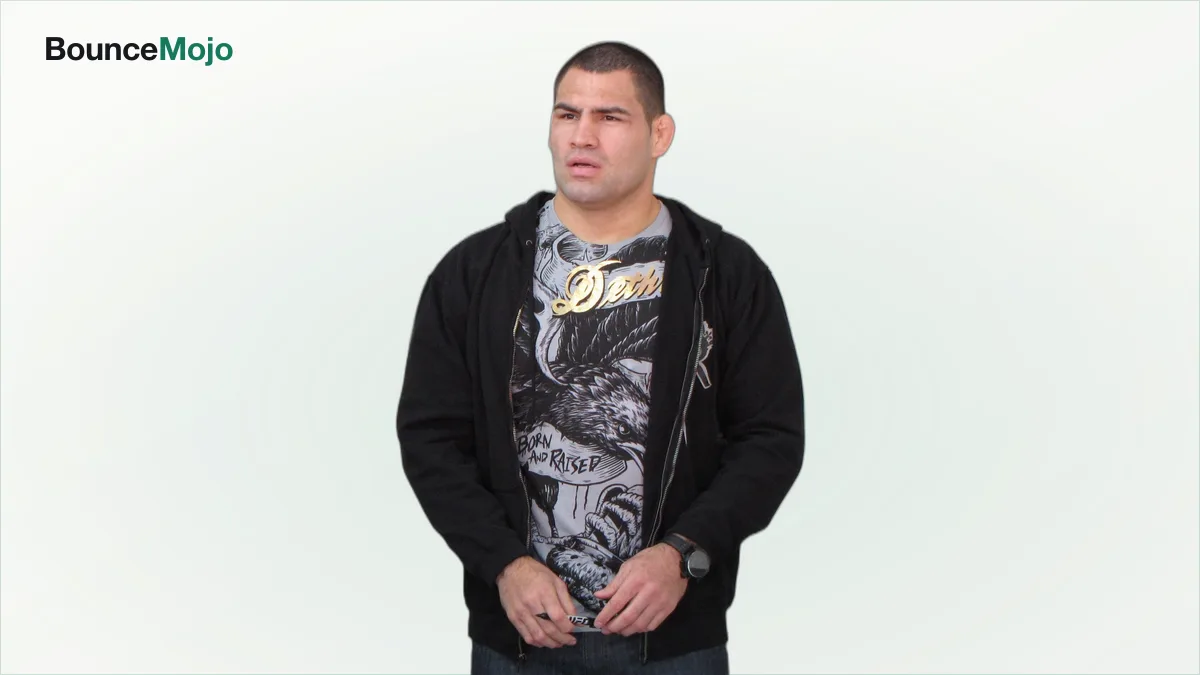
Cain Velasquez Biography: The Wrestler Who Became a Cautionary Tale
Most people remember Cain Velasquez as the man who mauled heavyweights nobody thought could be mauled. That picture is only half true.
Here’s what most people miss: the most dominant heavyweight of his era spent more of his prime injured on a table than fighting in a cage.
The Myth vs. The Reality
The myth of Cain Velasquez is simple. He was the perfect heavyweight: a huge man with the cardio of a lightweight, a wrestler who could drown opponents in pace and punish them for standing. When he was healthy, that myth was completely real. He beat Brock Lesnar. He avenged himself on Junior dos Santos, twice. He looked, for stretches, unbeatable.
Here’s the truth: the healthy version of Cain barely existed.
His prime was a series of comebacks from surgery, each one shorter than the last. The fighter fans imagine, the one who might have gone down as the greatest heavyweight ever, only appeared a handful of times. The rest was rehab, rescheduled fights, and a body that kept betraying a man whose will never did.
You might be wondering: how does a champion that good end up with so few fights? To answer that, you have to go back to where his toughness was forged.
The World That Made Cain Velasquez
Cain came from a world of hard labor and border crossings. He was born in Salinas, California, in 1982, into a Mexican-American family that knew exactly what work cost.
His father, Efrain, crossed the border repeatedly to find farm work, deported and returning again and again before finally building a stable life in the United States. That story sat at the center of Cain’s identity. He grew up understanding that nothing came free and that endurance was a family trait long before it became a fighting style.
The family eventually settled in Yuma, Arizona, farm country, where Cain found the sport that would define him: wrestling. In other words, before he ever threw a punch, he learned the grind of a discipline where there are no shortcuts and no hiding your conditioning.
There’s a detail that captures the whole thing. Cain’s father worked the fields, and Cain grew up understanding exactly what that labor demanded. He carried that awareness into everything, later saying he fought partly to honor the sacrifices his parents made. His “Brown Pride” tattoo and his sombrero-and-serape walkouts weren’t marketing. They were a genuine tribute to a family that had crossed borders and broken their backs so he could chase something better.
That upbringing gave him something no gym could teach. It also set up the collision between talent and fragility that would shape everything. Let’s look at where the fighter was actually built.
The Crucible: Early Life and the Climb
The Environment That Shaped Them
Wrestling was Cain’s first love and his first proving ground. He starred at Kofa High School in Yuma, then earned his way to Arizona State University, one of the best wrestling programs in the country.
There he became a two-time NCAA Division I All-American, competing against the toughest amateur wrestlers in America. That’s the detail people forget: Cain was elite in a brutal, unforgiving sport long before mixed martial arts. The gas tank that terrified UFC heavyweights was built on the mats of the Pac-10, in a discipline where being tired is a choice you can’t afford.
Here’s the deal: college wrestling doesn’t pay. When Cain graduated, he had world-class skills and no obvious way to earn from them. Mixed martial arts offered an answer.
The Catalyst for Breakout
Cain moved to San Jose and joined the American Kickboxing Academy, one of the sport’s great fight teams. Under coach Javier Mendez, he added striking to his wrestling base and turned pro in 2006.
The rise was fast. He won his early fights, signed with the UFC, and started running through the heavyweight division with a relentless, high-output style no big man could match. The pressure was suffocating. Opponents who planned to pace themselves found Cain in their chest for fifteen minutes, and most of them broke.
Now: the climb had a summit, and the summit had a name. Reaching it would make him a champion. It would also introduce the two men who defined his career.
The Key Players
Two rivals shaped Cain’s legacy more than any others.
The first was Brock Lesnar, the former WWE superstar and NCAA champion who had become the UFC’s biggest heavyweight draw. In 2010, Cain took Lesnar’s title, weathering the bigger man’s opening surge before overwhelming him. That win announced Cain as the sport’s premier heavyweight and proved his pressure could break even a physical freak.
The second was Junior dos Santos. Their trilogy became the defining story of the division. Dos Santos knocked Cain out in 2011 to take the belt, the most painful loss of Cain’s career and the only real blemish on his prime. Cain answered with two dominant, punishing wins to reclaim and defend the title. That rivalry was the heart of his championship years.
Behind them stood his coach, Javier Mendez, and his AKA teammates, including future champion Daniel Cormier, who became one of his closest friends and training partners.
But here’s the kicker: the belt Cain fought so hard to win, he could barely hold onto, and the reason had nothing to do with any opponent.
The Turning Point
The Pinnacle of Achievement
At his peak, Cain was as feared as any heavyweight the sport had seen. His revenge wins over dos Santos cemented a reputation for relentless dominance, and many observers called him the best heavyweight in UFC history when healthy.
He fought in a sombrero and serape, walking out to celebrate his Mexican-American roots, “Brown Pride” tattooed across his chest. For a generation of Latino fans, he was a hero who carried their story into the biggest arenas in the sport. That mattered as much as any belt.
The Price of Admission
Then the body gave out.
Cain’s career became a cruel loop of injury and rehab: back surgery, shoulder problems, knee trouble. He fought only once in some entire years. The reign that should have run for a decade instead flickered, with long absences that let the division move on. In 2015 he lost the title to Fabricio Werdum in a fight where his cardio, undone by altitude and inactivity, failed him. He never won it back.
That Werdum loss stung in a particular way. Cain’s whole identity was his conditioning, the bottomless gas tank that let him drown bigger men. In Mexico City’s thin air, after another long injury layoff, that engine sputtered, and he gassed and got submitted. The one attribute nobody thought could fail him failed at the worst possible moment. It was a cruel summary of his whole career: the tools were still there, but his body could no longer keep them sharp enough often enough.
Think about it: the most dominant heavyweight of his time is remembered as much for what was taken from him as for what he achieved.
That’s the athletic tragedy. The personal one cut even deeper.
The Unvarnished Truth
Cain was never a trash-talker or a controversy magnet in his fighting days. He was quiet, humble, and devoted to his family, the opposite of the loud pay-per-view archetype the sport increasingly rewarded.
That humility may have cost him mainstream fame and money. He didn’t chase the spotlight the way some rivals did, and his frequent injuries kept him out of the promotional machine. But it made him beloved by hardcore fans who valued his authenticity.
Here’s the truth: his greatest vulnerability wasn’t ego or discipline. It was flesh and bone. A fighter whose entire identity was built on toughness and endurance was undone by the one thing toughness can’t fix, a body that simply couldn’t hold up to what his will demanded of it.
And then came the chapter no one saw coming.
Controversies and Criticisms
In 2022, Cain Velasquez’s life changed in a way that had nothing to do with fighting. He was arrested and charged in connection with a shooting incident tied to a family matter involving allegations against a man in his community. He spent months in custody before being granted bail.
The case drew enormous attention precisely because it clashed so completely with the image of the quiet, family-first champion fans knew. It became the defining story of his post-fighting life and a somber turn no highlight reel could soften.
This biography does not relitigate the legal details or pass judgment on an ongoing matter. What’s clear is that a man defined for years by discipline and restraint found himself at the center of a painful, complicated situation, and that the story of Cain Velasquez can no longer be told only through his fights.
You might be wondering what a fan can actually take from a life this complicated. There’s plenty.
What We Can Learn From Cain Velasquez
Navigating the Darkness
Cain’s fighting career is a lesson in a hard reality: talent and will are not enough when the body won’t cooperate. He responded to setback after setback by grinding back, again and again, refusing to accept that the injuries defined him. That resolve is worth admiring even in a career that fell short of its ceiling.
The wider lesson is about protecting your one irreplaceable asset. For an athlete, that’s the body. Cain’s story is a warning about the cost of a style built entirely on volume and pressure, and about how quickly a dominant run can end when health disappears.
The Success Blueprint
Cain’s rise shows the value of a deep, non-negotiable foundation. His elite college wrestling wasn’t flashy, but it was the bedrock that made everything else possible. He didn’t cut corners building his base, and it carried him to two world titles.
Here’s the blueprint: master the unglamorous fundamentals so completely that they become your advantage. Cain out-conditioned and out-wrestled the entire heavyweight division because he’d done the boring work no one else wanted to do.
Becoming Better
Above all, Cain carried where he came from with pride. He never hid his roots; he wore them into the cage and made a generation of fans feel seen. That’s a kind of success no belt measures.
Here’s the deeper lesson in that. Representation and authenticity have real power. For countless Mexican-American fans, Cain was proof that the son of a farmworker could stand at the very top of a global sport without ever pretending to be something he wasn’t. He didn’t dilute his identity to fit the mainstream. He brought his whole self, his family’s story, his heritage, his humility, into the biggest arenas in the world. Long after the fights are forgotten, that pride is what many will remember most.
Final Verdict
Cain Velasquez is one of the great “what ifs” in combat sports. On talent alone, he belongs in the conversation for the greatest heavyweight ever. On availability, injuries reduced a potential decade of dominance to a handful of unforgettable nights.
His fortune, an estimated $4 million, reflects that arc: elite peak earning power capped by a body that couldn’t stay in the fight. For the full breakdown of how those title purses and his WWE crossover added up, read his complete net-worth story.
Remember him for the pressure that broke Brock Lesnar and the two wins that avenged his only real defeat. Remember the sombrero, the serape, and the pride he carried for the people he came from. And remember, too, that even the toughest man in the room is human, on the mat and off it.
Shop Cain Velasquez on Amazon
Books, audiobooks, merch and more, handpicked for fans.
As an Amazon Associate we earn from qualifying purchases.
Frequently Asked Questions
Where did Cain Velasquez grow up?+
Cain Velasquez was born on July 28, 1982, in Salinas, California, and spent part of his childhood in Yuma, Arizona. He grew up in a hardworking Mexican-American family; his father crossed the border repeatedly to find farm work before settling in the United States.
Was Cain Velasquez a college wrestler?+
Yes. Cain was a two-time NCAA Division I All-American wrestler at Arizona State University, a background that became the foundation of his mixed martial arts style.
How many times was Cain Velasquez UFC champion?+
Cain was a two-time UFC Heavyweight Champion. He won the title from Brock Lesnar in 2010, lost it to Junior dos Santos in 2011, then reclaimed it in 2012 and defended it before injuries derailed his reign.
Why did Cain Velasquez fight so rarely?+
A long series of injuries, especially to his back, shoulder, and knees, repeatedly kept Cain out of competition. Despite his dominance, he fought only a handful of times across his prime years.
What is the meaning of Cain Velasquez's chest tattoo?+
Cain has 'Brown Pride' tattooed across his chest, a tribute to his Mexican-American heritage and the farmworking family he came from. He often fought in a sombrero-and-serape walkout that celebrated that background.
Want the money side of the story?
Read Cain Velasquez's Full Net Worth Breakdown →Shop Cain Velasquez on Amazon
Books, audiobooks, merch and more, handpicked for fans.
As an Amazon Associate we earn from qualifying purchases.