Arnold Palmer Biography: The Steelworker's Son Who Became 'The King'
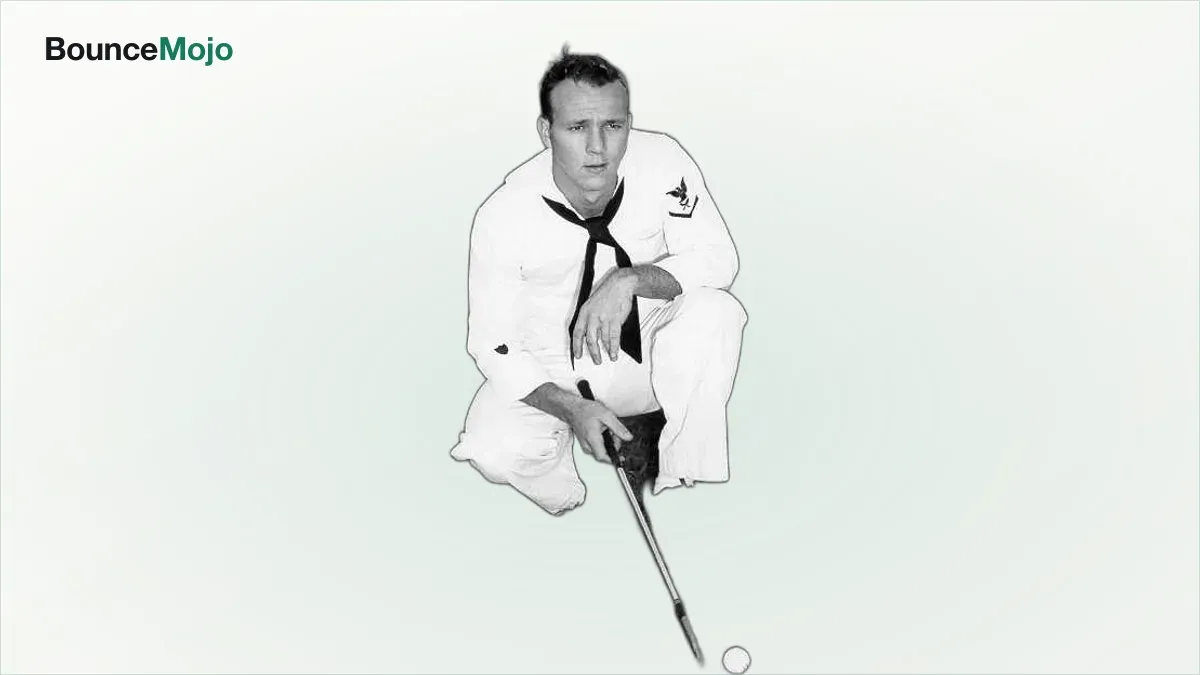
The man who invented the modern sports celebrity started life beside a golf course he was not allowed to belong to. Everything Arnold Palmer became traces back to that one arrangement in Latrobe, Pennsylvania.
The Cottage He Grew Up In, and the Clubhouse He Couldn’t Enter
Palmer was born in 1929 in Latrobe, a steel-and-coal town in the Allegheny foothills, just as the Great Depression took hold. His father, Milfred “Deacon” Palmer, was the greenskeeper and later the head professional at Latrobe Country Club, and the family lived modestly near the course.
Young Arnold could practice there. He was not to use the pool or the clubhouse like the paying members. The message was quiet and unmistakable: you serve here, you don’t belong here.
Deacon taught him the fundamentals early and demanded toughness, giving his son a powerful, self-taught, aggressive swing and an unshakeable work ethic with very little coddling. The grip that became one of the most famous in sport was shaped by a working man who expected his boy to earn everything.
Palmer starred in junior and amateur golf and went to Wake Forest on a scholarship. After the death of a close college friend shook him deeply, he served a stint in the U.S. Coast Guard. He came back, sharpened his game, and won the 1954 U.S. Amateur, the victory that convinced him to turn professional.
He was never the most polished player in the field. His edge was nerve, charisma, and a refusal to play it safe, which turned out to be precisely the right set of qualities for what happened next.
Cherry Hills, 1960: Seven Shots Back on Sunday
American golf in the 1930s and ’40s had been a game of privilege, played by the wealthy in genteel silence and watched in person by a select few. Then television arrived in American living rooms just as Palmer reached his prime, and his bold, emotional style turned out to be tailor-made for the small screen.
The proof was the 1960 U.S. Open at Cherry Hills. Palmer entered the final round seven shots back, drove the first green, and stormed to a comeback victory that stunned the sport. Broadcast to a growing television audience, that charge made him a national sensation.
Combined with his Masters titles in 1958, 1960, 1962, and 1964, it made him golf’s first true TV celebrity, and “Arnie’s Army” swelled into the largest and loudest galleries the game had seen. His decision to travel to Britain in 1960 helped revive The Open as a marquee event for American players. Seven major championships in total, two of them Open Championships, and a decade at the summit of a sport he was steadily dragging into the mainstream.
He became the sport’s first millionaire. He was also, still, a laborer’s son who had been kept off the course he grew up beside, and he never stopped sounding like one. The working-class fans discovering golf on Sunday afternoons saw one of their own leading the charge, because that is exactly what he was.
A Handshake With a Young Lawyer in 1960
The most consequential deal of Palmer’s life was not a tournament. In 1960 he shook hands with a young attorney named Mark McCormack, and that agreement created IMG and, with it, the entire sports-marketing industry.
McCormack saw something nobody in golf had priced correctly: Palmer’s likability was worth more than his scorecard. He turned Palmer into the first athlete brand, and the licensing empire built on that warmth dwarfed the prize money and kept earning long after the competitive career ended. His estate still earns tens of millions a year, and that partnership sits at the heart of his net worth story. It is also why he ranks near the very top of our richest golfers list.
Not everyone admired the machine. Critics of golf’s growing corporatization have traced it back to Palmer and McCormack, whose endorsement operation, for better or worse, turned athletes into brands and galleries into marketing audiences. A few skeptics went further and questioned whether the accessible everyman image was itself a product McCormack packaged and sold.
Most people who knew him insisted the man and the marketing were the same thing. Palmer gave every autograph, made the eye contact, and stayed genuinely reachable, and history records remarkably little scandal attached to his name. The image and the man matched, and that authenticity was the actual asset.
The 1966 Collapse, and Handing the Era to Nicklaus
The go-for-broke style fans adored also cost him. At the 1966 U.S. Open he squandered a seven-shot final-round lead and lost in a playoff, one of the most famous collapses in the sport’s history and the flip side of everything that made him thrilling to watch. His recklessness and his charisma were never separable.
His window at the very top was also brief. Jack Nicklaus, younger and more powerful, arrived in the early 1960s and by the middle of the decade had begun to overtake him. The rivalry was more respectful than bitter, and it grew the game enormously; alongside Gary Player, whose global travels helped make golf an international sport, the three of them became the “Big Three.”
As Nicklaus surpassed him, some argued Palmer had been more showman than sustained champion, and that seven majors, however great, fell short of the all-time dominance his fame implied. He spent the back half of his career as golf’s beloved elder statesman rather than its dominant player, and by every account he handled it with more grace than the loss of a throne usually invites. The affection people felt for him deepened rather than faded.
He was human in the ordinary ways too, a workaholic with a punishing schedule and a fierce need to win that never fully cooled even as the trophies slowed.
What Latrobe Got Back
Palmer gave endlessly: his time to fans, his money to charity, his name to the Arnold Palmer Hospital for Children, and a hand up to the players who followed him into the wealth he had helped create. He grew the pie rather than guarding his slice of it.
He died on September 25, 2016, at 87, in Pittsburgh, less than fifty miles from the course where his father cut the greens.
“Important” fits his career better than “greatest,” though he was undeniably great. Seven majors, a decade at the top, and a charisma that pulled an elitist game into the television age and the American mainstream. The boy told he did not belong at the country club came to be called the king of the whole sport, and he managed it not by acting like royalty but by never once forgetting where he came from. The full accounting of the fortune built on that warmth lives in his net worth breakdown.
Shop Arnold Palmer on Amazon
Books, audiobooks, merch and more, handpicked for fans.
As an Amazon Associate we earn from qualifying purchases.
Frequently Asked Questions
Why was Arnold Palmer called 'The King'?+
Palmer earned the nickname because he transformed golf into a mainstream television sport in the 1950s and '60s. His charisma and go-for-broke style built a massive fan following known as 'Arnie's Army.'
Where did Arnold Palmer grow up?+
He grew up in Latrobe, Pennsylvania, the son of a greenskeeper and course professional at Latrobe Country Club, where he learned the game as a young boy.
How many majors did Arnold Palmer win?+
Palmer won seven major championships, including four Masters titles (1958, 1960, 1962, 1964), the 1960 U.S. Open, and two Open Championships.
What was Arnie's Army?+
'Arnie's Army' was the nickname for Palmer's devoted galleries of fans, an enormous, loyal following that helped turn golf into a popular spectator sport.
When did Arnold Palmer die?+
Arnold Palmer died on September 25, 2016, at age 87, in Pittsburgh, Pennsylvania. He was mourned as one of the most beloved figures in the history of sport.
Want the money side of the story?
Read Arnold Palmer's Full Net Worth Breakdown →Shop Arnold Palmer on Amazon
Books, audiobooks, merch and more, handpicked for fans.
As an Amazon Associate we earn from qualifying purchases.