Albert Pujols Biography: The Raw Truth Behind The Machine
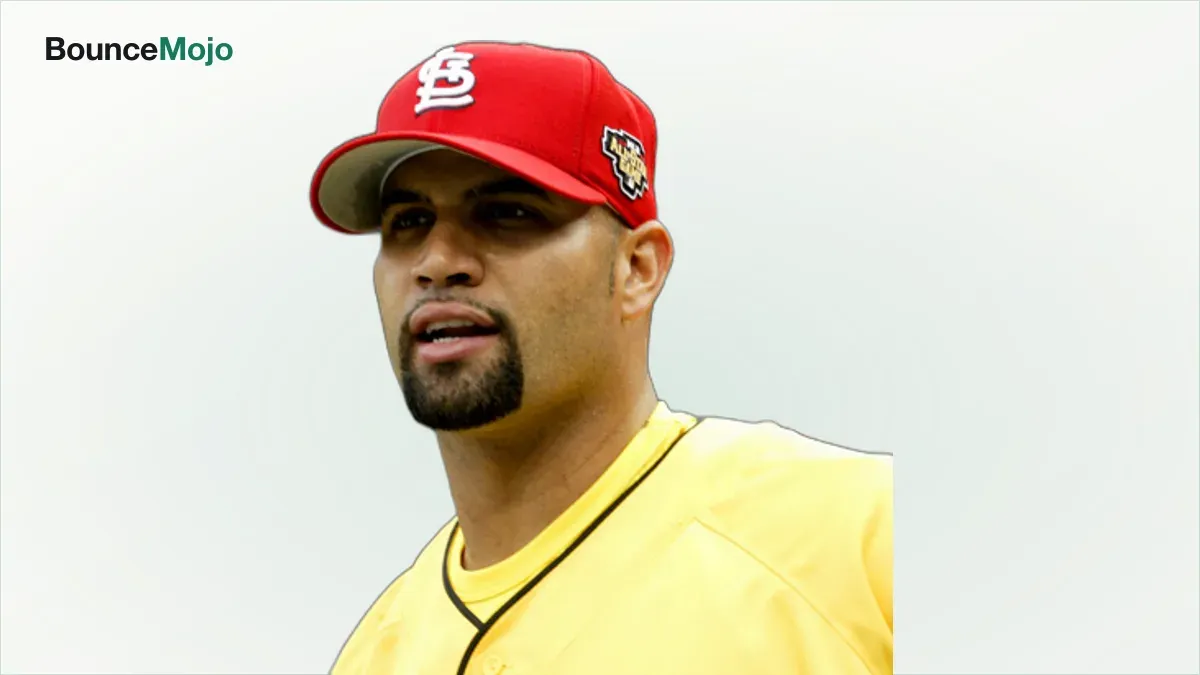
The perfect swing, the calm eyes, the nickname that said it all. That’s the Albert Pujols most fans picture: The Machine, built to hit.
Here’s what most people miss: baseball nearly missed him entirely. Twelve rounds of the draft passed before a single team took a chance.
The Myth vs. The Reality
The myth is that Albert Pujols was born great. The Machine, they called him, as if he arrived fully formed, incapable of a slump or a doubt.
The reality has more struggle in it.
Here’s the truth: Pujols was a late-round afterthought, a teenager who barely spoke English when he arrived in Missouri, dismissed by scouts who couldn’t agree on his real age or his best position. Nothing about his path was guaranteed.
Now think about how easily his story could have ended in the minor leagues, one of thousands of Dominican prospects who never break through.
Instead, he became one of the greatest right-handed hitters in the history of the game. And to understand how, you have to start in Santo Domingo.
The World That Made Albert Pujols
José Alberto Pujols Alcántara was born on January 16, 1980, in Santo Domingo, the capital of the Dominican Republic. Baseball was everywhere in his world. It was the national obsession, the sport kids played in the streets with makeshift gloves and taped balls, the clearest path off the island.
He was raised largely by his grandmother and a large extended family. Money was tight. Opportunity was tighter.
This was the Dominican Republic of the 1980s and early 1990s, a country that had already sent waves of talent to the major leagues and hungered to send more. For a poor kid with a gift for hitting, baseball wasn’t just a game. It was a lottery ticket most people never cashed.
But here’s the kicker: before Pujols could chase that dream, his family had to leave the island entirely.
The Crucible: Early Life and the Climb
The environment that shaped him
As a teenager, Pujols moved with his family to the United States, eventually settling in Independence, Missouri. He barely spoke English and had to adjust to a new country, a new school, and a new level of baseball all at once.
He starred at Fort Osage High School, then at Maple Woods Community College, where he hit well enough to draw scouts. Yet the doubts lingered. Was he really the age he claimed? Was he a third baseman, a shortstop, or a designated hitter with no defensive home?
Those questions cost him. Badly.
The catalyst
In the 1999 MLB draft, 402 players came off the board before the St. Louis Cardinals finally selected Pujols in the 13th round.
Think about that number. Twelve full rounds of other prospects, and one of the best hitters the sport would ever see was still available.
Here’s the deal: that slight became rocket fuel. Pujols tore through the minor leagues in a single season and forced his way onto the Cardinals’ major-league roster in the spring of 2001, a virtual unknown who wasn’t supposed to be there.
Want to know what he did with that chance? He never let the job go.
The Key Players
You cannot tell the Pujols story without a few names.
Tony La Russa is the first. The Hall of Fame manager guided the Cardinals through the entire first decade of Pujols’ career, won two World Series titles with him, and helped shape a raw talent into a disciplined professional.
His faith and family are the second thread. Pujols is openly devout, and his marriage to Deidre and the founding of the Pujols Family Foundation gave his life a structure beyond baseball. Their work supporting people with Down syndrome, including their own daughter, became central to who he is.
Yadier Molina is the third. The catcher was Pujols’ teammate and close friend through the Cardinals’ championship years, part of a core that defined an era in St. Louis.
Here’s the truth: everything Pujols built in St. Louis was about to be tested by the biggest decision of his career.
The Turning Point
The pinnacle
Start with the greatness, because it was staggering.
Pujols won National League Rookie of the Year in 2001, then reeled off one of the finest decades any hitter has ever produced. Three MVP awards. Two World Series titles, in 2006 and 2011. A .300-plus batting average paired with power year after year. By the time he left St. Louis, he was already in the conversation for greatest right-handed hitter ever.
Later, chasing history, he joined the exclusive club of players with 700 career home runs, a milestone reached by only a handful of legends in the sport’s long history.
The price
Now the cost, which was real.
After the 2011 title, Pujols hit free agency, and the Cardinals hesitated to commit long-term. The Los Angeles Angels did not. They signed him to a ten-year, $240 million deal, and Pujols left the city that had adored him.
The move split St. Louis. Some fans felt betrayed. And in California, the back half of that contract coincided with age and injury, so the numbers never fully matched the price tag. Pujols spent years being measured against the impossible standard his own prime had set.
You might be wondering how a proud competitor handles a decade of “he’s not what he was.” The answer shows the character underneath the swing.
The Unvarnished Truth
Let’s not pretend it was all triumph.
The Angels years were, statistically, a decline. Pujols was paid like a superstar while producing like a good-but-aging veteran, and that gap drew constant criticism. Fair or not, it followed him.
There was also the age controversy that trailed him from his earliest days, whispers that he might be older than his listed birthdate, though nothing was ever proven and Pujols firmly denied it.
Here’s the truth: Pujols was human, and the second half of his career forced fans to reconcile the god-like early years with an ordinary mortal grinding through the twilight. Some couldn’t do it. He kept showing up anyway.
Even so, that same stubbornness is what carried him to 700 home runs when it would have been easier to walk away.
Controversies and Criticisms
For a clean-cut figure, Pujols’ controversies were mostly about contracts and expectations, not scandal.
The Angels deal is the biggest. Critics called it one of the worst contracts in sports, a cautionary tale about paying for past performance. Pujols wore that criticism for the better part of a decade.
The St. Louis departure lingered too. To some Cardinals fans, leaving felt like a betrayal of the city that raised his career, even as others understood a player chasing generational security.
Beyond that, the knocks are minor. In a sport with its share of villains, Pujols’ biggest sins amount to aging on a very expensive contract.
Here’s the thing though: none of it dents the legacy. Because the milestones answered the only question that mattered.
What We Can Learn From Albert Pujols
Navigating the darkness
When the world overlooks you, you can accept the verdict or rewrite it.
Pujols was the 402nd pick. He turned that snub into a Rookie of the Year award within two years and a Hall of Fame career within a decade. The lesson isn’t “believe in yourself.” It’s that being underestimated can become the sharpest motivation there is, if you channel it into work instead of grievance.
The success blueprint
Now the part that built the career and the fortune.
Pujols was relentlessly consistent. He didn’t chase one huge season. He stacked good years on top of good years for two decades, and that durability is what pushed his career earnings past $330 million. He signed the long deal, protected his money, and built a business and a foundation around his name. That patient approach is why he ranks among the richest baseball players in the world. The full money breakdown lives in our Albert Pujols net worth analysis, and you can see where he sits among the richest athletes overall, alongside fellow star Mike Trout.
Becoming better
The deepest lesson is about anchoring. Pujols leaned on faith and family through triumph and decline alike, and that steadiness kept him grounded when the criticism came. He proved you can weather a very public second act without losing yourself.
So what’s the final word on The Machine?
Final Verdict
Albert Pujols is the rare player whose greatness is inseparable from how badly he was doubted at the start.
On the field, he’s a three-time MVP, a two-time champion, a member of the 700 home run club, and a certain Hall of Famer. Off it, he’s a devout family man who built a foundation and a business around a name the draft nearly ignored.
Here’s the bottom line: the nickname was never the whole story. Behind The Machine was a Dominican kid who took the 402nd pick in the draft and turned it into one of the greatest careers baseball has ever seen.
Anyone who remembers only the expensive Angels years has missed the grit underneath. Pujols’ real story is the climb, and it’s better than the highlight reel.
Shop Albert Pujols on Amazon
Books, audiobooks, merch and more, handpicked for fans.
As an Amazon Associate we earn from qualifying purchases.
Frequently Asked Questions
Where did Albert Pujols grow up?+
Pujols was born on January 16, 1980, in Santo Domingo, Dominican Republic, and moved as a teenager to Independence, Missouri, where he played high school and junior college baseball.
Why was Albert Pujols drafted so late?+
Scouts doubted his position and age, so he fell to the 13th round of the 1999 draft, a slight that fueled one of the great overlooked-prospect stories in the sport.
What are Albert Pujols' biggest achievements?+
Pujols won three MVP awards, two World Series titles, and joined the exclusive 700 home run club, cementing his case as a first-ballot Hall of Famer.
Is Albert Pujols religious?+
Yes. His Christian faith is central to his identity and the founding of the Pujols Family Foundation, which supports people with Down syndrome.
Why did Albert Pujols leave the Cardinals?+
After the 2011 season the Cardinals hesitated on a long-term deal, and the Los Angeles Angels signed him to a ten-year, $240 million contract in free agency.
Want the money side of the story?
Read Albert Pujols's Full Net Worth Breakdown →Shop Albert Pujols on Amazon
Books, audiobooks, merch and more, handpicked for fans.
As an Amazon Associate we earn from qualifying purchases.