Adam Scott Biography: The Raw Truth Behind Golf's Smoothest Swing
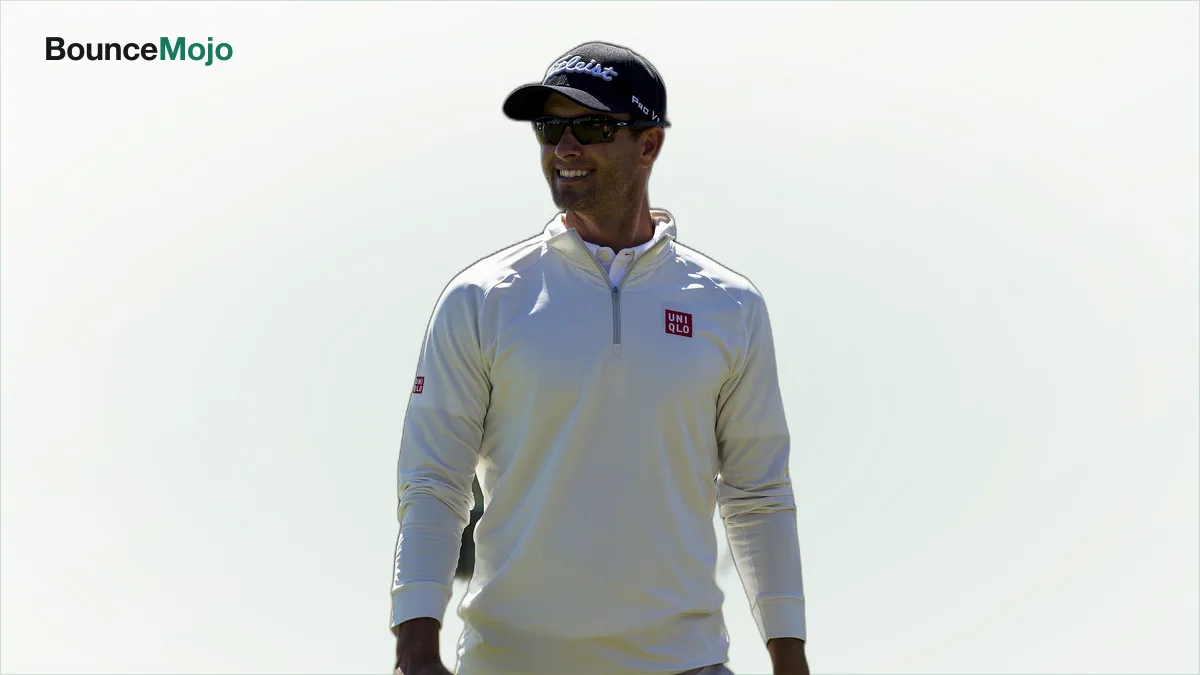
The flowing swing, the movie-star looks, the calm Australian cool. That’s the Adam Scott most fans picture.
Here’s what most people miss: the smoothest player of his generation nearly became famous for the worst collapse of it instead. His story turns on how he answered that.
The Myth vs. The Reality
The myth is smooth. Adam Scott is the effortless one, blessed with the prettiest swing in golf and a temperament that never seems to fray.
The reality has more scar tissue.
Here’s the truth: Scott spent years labeled the most talented player without a major, and in 2012 he came within four holes of a first Claret Jug before throwing it away in agonizing fashion. The cool exterior hid a competitor who had to rebuild his confidence from the wreckage of a very public heartbreak.
Now think about how his story could have ended. One more collapse and Scott becomes a cautionary tale, the gifted Australian who never got over the line.
Instead, he did something almost no one saw coming. And to understand how, you have to start on a par-3 course near Adelaide.
The World That Made Adam Scott
Adam Derek Scott was born on July 16, 1980, in Adelaide, South Australia. Golf was in the house from the start. His father, Phil, was a golf professional who put a plastic set of clubs in his son’s hands and took him to the North Adelaide par-3 course as a toddler.
When Adam was nine, the family moved to the Sunshine Coast in Queensland, and later settled on the Gold Coast. He grew up on golf courses, coached by a father who understood the game inside out.
This was Australian golf in the shadow of a giant. Greg Norman, the Great White Shark, had made Australians believe they belonged at the very top of the sport, yet no Aussie had ever won the Masters. That unfinished business hung over every promising young player from Down Under, Scott included.
But here’s the kicker: before Scott could chase Norman’s dream, he had to survive a nightmare of his own making on the back nine of a major.
The Crucible: Early Life and the Climb
The environment that shaped him
Scott’s talent was obvious early. Coached by his father and later mentored within Tiger Woods’s own swing-coaching circle under Butch Harmon, he developed a technique so pure that instructors used it as a teaching model.
He turned professional in 2000 and won quickly, collecting titles across the European and PGA Tours. By his mid-twenties he was a fixture in the world’s top rankings, tall, elegant, and marketable, with luxury sponsors lining up.
The talent was never in question. What was in question, for a long time, was whether he could win the biggest events when it mattered most.
The catalyst
That question reached its cruelest point at the 2012 Open Championship at Royal Lytham.
Scott led with four holes to play. Then it fell apart. He bogeyed all four, handing the Claret Jug to Ernie Els in one of the most painful finishes in major history. For a player already tagged as too talented to be trophy-light, it was the kind of loss that ends careers.
Here’s the deal: how Scott responded to that afternoon would define everything that came next.
Want to know what he did with all that pain? He turned it into a green jacket eight months later.
The Key Players
You cannot tell the Adam Scott story without a few names.
Greg Norman is the first, more inspiration than mentor. Norman proved Australians could dominate golf, yet famously never won the Masters despite heartbreaking near-misses at Augusta. Scott grew up carrying the weight of that unfinished national dream, and his eventual Masters win felt like completing Norman’s story as much as his own.
His father, Phil Scott, is the second, the golf professional who built the swing and set his son on the path from the earliest age.
Marie Kojzar is the third. The Swedish architect first met Scott in the early 2000s, and after an on-and-off relationship across many years, the two married in the Bahamas in 2014. She became the private anchor of a life he deliberately keeps out of the headlines, and together they have raised three children largely away from the public eye.
Here’s the truth: everything Scott went through was about to converge on one Sunday at Augusta National.
The Turning Point: Triumph and Its Hidden Cost
The pinnacle
Start with the triumph, because it rewrote his story.
In April 2013, Scott arrived at the Masters still carrying the sting of Lytham. This time he held his nerve. He birdied the 72nd hole to take the lead, then birdied the second playoff hole in near darkness and driving rain to beat Angel Cabrera.
Scott became the first Australian ever to win the Masters. The green jacket that had eluded Norman for a generation finally belonged to an Australian, and the man who wore it had done so months after the most public collapse of his life.
A year later, in 2014, Scott climbed to world No. 1, overtaking Tiger Woods and holding the top ranking for 11 weeks. The redemption was complete.
The price
Now the cost, which was subtler than a single bad day.
Scott’s peak coincided with the controversy over the long, anchored putter he used to steady his stroke. The method was later banned, forcing him to adapt his game at the height of his powers and answer constant questions about whether his major was somehow tainted, which it was not.
He also paid the price of expectation. After 2013, the golf world assumed more majors would follow. They didn’t come as often as predicted, and Scott spent years being measured against a standard that his one green jacket had set impossibly high.
You might be wondering how a man handles that kind of scrutiny while guarding his privacy so fiercely. The answer shows a side of Scott few ever see.
The Unvarnished Truth
Let’s not pretend it was all elegance.
Scott has been criticized at times for seeming too laid-back, for lacking the killer instinct that his talent demanded. The 2012 Open collapse fed a narrative that he couldn’t close, and even after Augusta, doubters pointed to majors he might have won but didn’t.
The anchored-putter saga also put him at the center of a rules controversy he never asked for. Scott defended his choice firmly, but it dogged him and forced a difficult transition back to a conventional putter.
Here’s the truth: Scott’s greatest strength, his even-keeled calm, has sometimes read as detachment. In a sport that rewards ruthless focus, his coolness occasionally looked like a lack of urgency, and critics used it against him during his leaner years.
Even so, that same temperament is what let him bounce back from Lytham instead of breaking.
Controversies and Criticisms
For such a clean-cut figure, Scott’s controversies are mostly about golf, not scandal.
The anchored putter is the biggest. Scott was among the highest-profile players using the method when golf’s governing bodies moved to ban it, and he was outspoken in his opposition, arguing the change was unfair to players who had used it legally for years.
He also drew criticism for occasionally prioritizing his schedule and family life over chasing every ranking point, skipping certain events and speaking candidly about wanting balance. Some saw that as admirable; others saw a player not squeezing every drop from his talent.
Beyond that, the knocks are minor. In a sport with its share of villains, Scott’s biggest sins amount to being too calm and too private.
Here’s the thing though: none of it dents the legacy. Because the green jacket answered the only question that mattered.
What We Can Learn From Adam Scott
Navigating the darkness
When your worst moment happens in front of the world, you can hide from it or walk back into the fire.
Scott walked back in. Eight months after the Lytham collapse, he stood on the same kind of stage at Augusta and won. He didn’t let one catastrophic afternoon become his whole identity. The lesson isn’t “shake it off.” It’s that the fastest way past a public failure is to earn a public triumph.
The success blueprint
Now the part that built the fortune and the career.
Scott never chased short-term hype. He signed with premium, loyal partners like Rolex and Uniqlo, competed consistently for two decades, and protected both his health and his privacy. He treated his career as a long game and his money as something to preserve, not flaunt. That patient approach is why he ranks among the richest golfers in the world. The full money breakdown lives in our Adam Scott net worth analysis, and you can see where he sits among the richest athletes overall, alongside fellow Australian Jason Day.
In other words, the man with the smoothest swing built the smoothest career too.
Becoming better
The deepest lesson is about resilience without noise. Scott absorbed a devastating loss, adapted through a rules ban, and kept competing at the top into his forties, all while keeping his private life genuinely private. He proved you can be relentless without being loud.
So what’s the final word on golf’s smoothest operator?
Final Verdict
Adam Scott is the rare player whose defining triumph is inseparable from his defining heartbreak.
On the course, he’s a Masters champion, a former world No. 1, and the owner of a swing that coaches still hold up as perfection. Off it, he’s a fiercely private family man who guarded his wealth and his peace as carefully as he guarded a lead.
Here’s the bottom line: the easy elegance was never the whole story. Behind it was a competitor who took the worst defeat of his life and answered it with the biggest win in Australian golf history.
Anyone who remembers only the smooth swing has missed the grit underneath. Scott’s real story is the comeback, and it’s better than the highlight reel.
Shop Adam Scott on Amazon
Books, audiobooks, merch and more, handpicked for fans.
As an Amazon Associate we earn from qualifying purchases.
Frequently Asked Questions
Where did Adam Scott grow up?+
Adam Scott was born on July 16, 1980, in Adelaide, South Australia, and moved with his family to Queensland's Sunshine Coast and later the Gold Coast, where his golf-teaching father nurtured his game.
What is Adam Scott's biggest win?+
His defining triumph was the 2013 Masters, where he became the first Australian to win the green jacket, beating Angel Cabrera in a playoff at Augusta.
Did Adam Scott ever reach world number one?+
Yes. Scott rose to world No. 1 in 2014, overtaking Tiger Woods and holding the top ranking for 11 weeks.
What was Adam Scott's toughest defeat?+
The 2012 Open Championship, where he bogeyed the final four holes to hand the Claret Jug to Ernie Els, a collapse that could have defined a lesser player.
Who is Adam Scott's wife?+
Scott married Marie Kojzar, a Swedish architect, in 2014 in the Bahamas. The couple have three children and live privately in Switzerland.
Want the money side of the story?
Read Adam Scott's Full Net Worth Breakdown →Shop Adam Scott on Amazon
Books, audiobooks, merch and more, handpicked for fans.
As an Amazon Associate we earn from qualifying purchases.