Rick Pitino Biography: The Comeback King of College Basketball
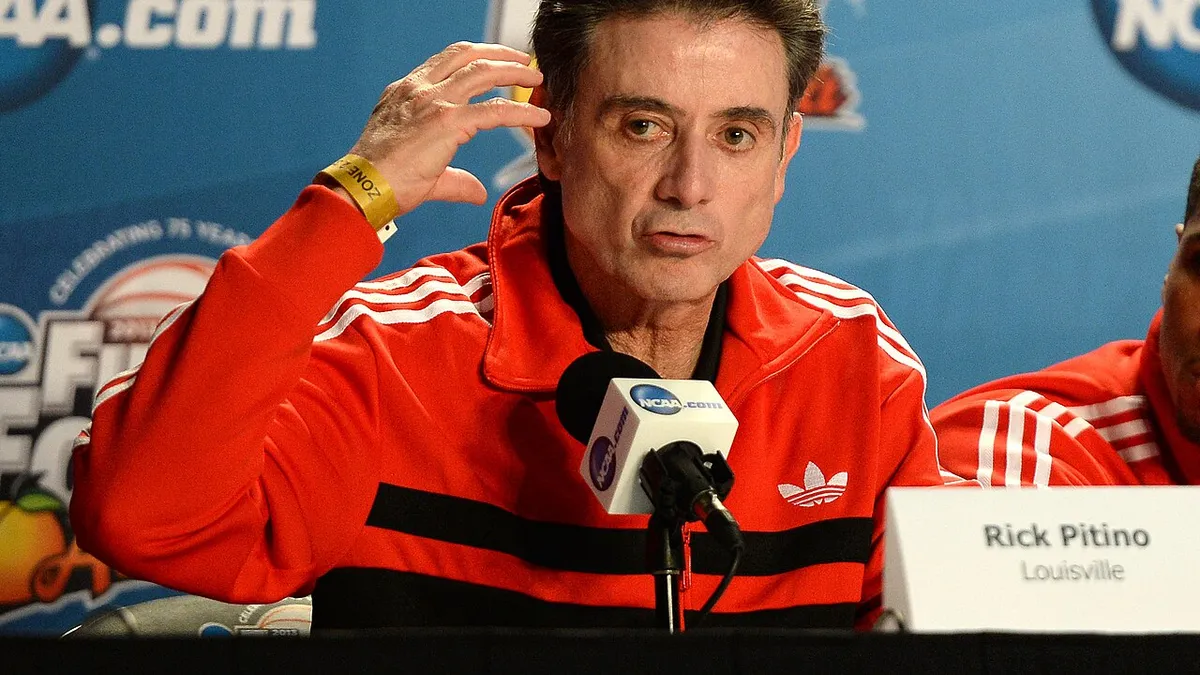
Everybody remembers the two title banners. Almost nobody remembers how many times this man had to start over from nothing.
Here’s what most people miss: the same relentless drive that won Rick Pitino two national championships is the exact drive that kept dragging him back to the sideline after each fall, including the one that should have ended him for good.
The Myth vs. The Reality
The myth is a machine of ambition. Rick Pitino, the fast-talking New Yorker who fixes any program, wins everywhere he goes, and never stops climbing. A coach with an answer for everything and a motor that never idles.
That version is real. It’s also wildly incomplete.
Here’s the truth: the “unstoppable winner” story erases how much this man has lost. Pitino buried an infant son, lost family members to tragedy, watched his signature national title get erased from the record, and was fired in disgrace from the best job in college basketball. The machine was actually a human being who kept getting knocked flat and kept getting up.
Think about it. We love a story of relentless ascent because it’s clean and inspiring. If Pitino just wins everywhere, then his career is a straight line up. But that’s not what happened. His life is a series of peaks and craters, and the real character shows in what he did after each crater.
Now, that restlessness didn’t come from nowhere. It was forged in a specific place and a specific striving family. Which raises the question: what makes a man this unable to ever stop?
The World That Made Rick Pitino
To understand Pitino, you have to understand the New York he came up in.
He was born on September 18, 1952, into an Italian-American family, and spent part of his youth on Long Island. This was striving, working-and-middle-class New York, a world where hustle was a virtue and standing still was failure. That environment shaped a personality that would become famous for its speed, its intensity, and its refusal to coast.
The era mattered too. Pitino came of age as college basketball was exploding into a national television spectacle, and as the coaching profession was becoming a path to real money and fame. A sharp, ambitious young man who understood how to motivate players and sell a vision could rise fast, and Pitino was built for exactly that moment.
Here’s the deal: he was a good college player at the University of Massachusetts, a guard, but not a future pro. Like many great coaches, he learned early that his real gift was for teaching and leading the game rather than starring in it, and he pivoted toward the sideline while still young.
But before the titles, before the fame, there were years of grinding as an assistant and a young head coach. And that climb is where the real story starts.
The Crucible: Early Life and the Climb
The environment that shaped him
Two things defined the young Rick Pitino: relentless energy and a hunger to prove himself fast.
He broke in as an assistant, including a formative stint at Syracuse under Jim Boeheim, absorbing the profession at high speed. Then came his first head-coaching job at Boston University, where his intensity and his signature full-court pressure style immediately turned heads. He was a young man in a hurry, and it showed in everything he did.
So he made his name by taking jobs and winning at them faster than anyone expected. That pattern, arrive, energize, win, would repeat for the rest of his career.
You might be wondering: how does a non-star player become one of the great coaches of his era? The answer is that Pitino turned his intensity into a system. His pressing, up-tempo style demanded total commitment, and his gift for motivation got players to give it. He didn’t out-talent his rivals as a player, so he out-worked and out-motivated them as a coach.
By his early thirties, he was ready for a stage big enough to make him famous.
The catalyst
The catalyst was a Cinderella run at Providence.
Taking over a struggling Providence program in the mid-1980s, Pitino installed his frantic, three-point-heavy style and, in 1987, led the Friars on a shocking run to the Final Four. It was the kind of overachievement that announces a coach to the entire country, and it made Pitino a rising star overnight.
Here’s the kicker: that run proved his method could work anywhere, with almost anyone. It earned him the New York Knicks job, then the chance to rebuild a Kentucky program buried under NCAA probation, a reclamation that would define the next chapter of his life.
The kid from New York was now a national name. But the higher he climbed, the harder the personal blows would land.
The Key Players
No life this big is a solo act, and Pitino was surrounded by people who shaped his path, and by loss that shaped him just as deeply.
Start with Joanne, his wife, the steady partner through a career of constant motion and repeated upheaval. Through every job change, triumph and scandal, the marriage and family remained his anchor.
Then there’s the coaching family. Mentors like Jim Boeheim helped launch him, and his own son, Richard Pitino, followed him into the profession and became a Division I head coach in his own right, extending the family name across the sport.
And there’s the grief that can’t be separated from his story. Pitino and Joanne lost an infant son, Daniel, in the 1980s, a loss memorialized in the family’s charitable foundation. Years later, Joanne’s brother, Billy Minardi, was killed in the September 11 attacks, a wound Pitino has carried publicly and honored ever since.
Now: surround yourself with a loyal family and pour your grief into work, and you can achieve staggering things. Pitino did. But the winning and the losing were always tangled together.
The Turning Point
The pinnacle
The pinnacle came twice, seventeen years apart.
The first title came at Kentucky in 1996, when Pitino completed a stunning rebuild of a program that had been on its knees, turning it into a national champion with a roster stacked with future pros. It was validation that his high-octane system could win it all, not just overachieve.
The second came at Louisville in 2013, when he cut down the nets again with a different school, cementing a place in history as one of the great program-builders the game has known. Along the way he became the only coach ever to take three different programs to the Final Four.
Here’s the truth: he’d reached a mountaintop almost no one else had, twice, and the ground was already shifting beneath him.
The price
Because the same restless drive that built empires also operated in a world of enormous temptation and scrutiny, and Pitino’s later years were consumed by scandal.
His 2013 Louisville title was later vacated by the NCAA after an escort scandal involving the program’s recruiting. Then, in 2017, Louisville was swept up in a sprawling federal investigation into bribery in college basketball, and Pitino was placed on leave and effectively fired. The best job in the sport was gone, and his reputation was in ruins.
He had also endured earlier personal and public storms, including an extortion case years before that dragged his private life into the headlines. For a man who had spent decades as one of the sport’s most admired figures, the fall was total and very public.
He’d spent his life proving he could win anywhere. Now he had to prove he could survive losing everything.
The Unvarnished Truth
Pitino is not a flawless hero, and pretending otherwise does his story a disservice.
He presided over programs where serious violations occurred, and whatever his personal role in the details, the buck stopped at the head coach. His signature national title was erased. He lost a marquee job amid a federal corruption case. These are not footnotes; they are central to how his career will be judged.
There’s also the human cost of his kind of ambition. A life spent chasing the next win, the next rebuild, the next stage can crowd out everything else, and Pitino’s story carries both extraordinary grief and self-inflicted damage side by side.
Here’s what’s easy to miss: his greatest strength and his greatest vulnerability were the same trait. The relentless drive that made him a two-time champion also kept him operating at the highest-pressure edge of a scandal-prone sport, where the fall, when it came, was catastrophic. The engine of his success was tied to the engine of his undoing.
None of that erases the banners or the Hall of Fame plaque. But it does explain why his second act, the improbable comeback, may be the most revealing chapter of all.
Controversies and Criticisms
Pitino’s career carried real controversy, and it’s worth being honest about it.
The vacated 2013 Louisville title is the starkest example. An escort scandal tied to recruiting led the NCAA to strip the championship, an almost unprecedented penalty for a program of that stature.
More damaging still was the 2017 federal investigation into bribery in college basketball, which cost Pitino the Louisville job. He has consistently denied personal knowledge of wrongdoing, but the association ended his time at the school and cast a long shadow.
There was also an earlier extortion case that spilled his private life into public view. Pitino has never hidden from the fact that these episodes defined a difficult stretch of his life, even as he insisted on his innocence in the recruiting scandals.
So what does a life like this actually teach the rest of us? A surprising amount, and not only cautionary lessons.
What We Can Learn From Rick Pitino
Navigating hard times
Pitino’s real lesson isn’t about winning titles. It’s about what you do after you’ve lost almost everything.
Fired in disgrace and written off by much of the sport, Pitino did not disappear. He went to Greece and coached overseas. He took a job at little Iona and won there. Then, against the odds, he landed back at St. John’s, on one of the biggest stages in the game. He treated a career-ending scandal as a setback to be worked through, not an ending to accept.
In other words: the comebacks, not the titles, are what set him apart. Anyone can win when everything is going right. Pitino kept building after it all fell apart.
The success blueprint
The blueprint here is about reinvention as a survival skill.
Pitino has been a head coach across six decades and multiple levels, college, the NBA, overseas, because he was always willing to start over with a new team, a new city, a new challenge. He never let a single job, or a single failure, become his whole identity.
Want the fuller picture of how that translated into wealth? The full net worth breakdown shows how two titles and decades of top contracts became a $40 million fortune, rebuilt after scandal. And to see how he ranks among the sport’s biggest earners, the richest coaches list puts it in context.
The deeper takeaway is about resilience. Pitino proved that a fall, even a public and humiliating one, does not have to be final. If you’re willing to start again at the bottom and out-work the doubt, you can climb back to the top. Few people ever test that idea as thoroughly as he did.
Which brings us to the final reckoning on the man.
Final Verdict
Rick Pitino is going to be remembered as a contradiction.
Most people will file him under “scandal” or under “two titles,” depending on which headline they read last. A smaller, smarter group will remember something more complete: a relentless New Yorker who rebuilt broken programs, won championships seventeen years apart, endured private grief that would have flattened most people, fell about as far as a coach can fall, and then clawed his way back to the sport’s biggest stage in his seventies.
Here’s the bottom line: the titles made him famous. The comebacks made him singular. Whatever you conclude about the controversies, no one in his profession has demonstrated a more stubborn refusal to stay down.
He is a two-time national champion and a Hall of Famer. He is also living proof that a career, like a full-court press, is defined less by any single possession than by the refusal to ever stop coming. And in the long run, that second story, the resilience, is the version worth remembering.
Shop Rick Pitino on Amazon
Books, audiobooks, merch and more, handpicked for fans.
As an Amazon Associate we earn from qualifying purchases.
Frequently Asked Questions
Where did Rick Pitino grow up?+
Pitino was born in New York City in 1952 and raised in an Italian-American family, spending part of his youth on Long Island. He played college basketball as a guard at the University of Massachusetts.
How many national championships has Rick Pitino won?+
Pitino won two NCAA championships, with Kentucky in 1996 and Louisville in 2013. He is also the only coach to lead three different programs to the Final Four, adding Providence to that list.
Why was Rick Pitino fired from Louisville?+
Pitino was let go in 2017 after Louisville was linked to a federal bribery investigation into college basketball recruiting. It followed an earlier escort scandal, and the NCAA had already vacated the program's 2013 national title.
Did Rick Pitino coach in the NBA?+
Yes. Pitino was head coach of the New York Knicks in the late 1980s and later ran the Boston Celtics as coach and president of basketball operations from 1997 to 2001.
Is Rick Pitino in the Hall of Fame?+
Yes. Pitino was inducted into the Naismith Memorial Basketball Hall of Fame in 2013, honoring a coaching career that spans more than four decades and multiple programs.
Want the money side of the story?
Read Rick Pitino's Full Net Worth Breakdown →Shop Rick Pitino on Amazon
Books, audiobooks, merch and more, handpicked for fans.
As an Amazon Associate we earn from qualifying purchases.