Pete Carroll Biography: The Late Bloomer Who Coached Forever
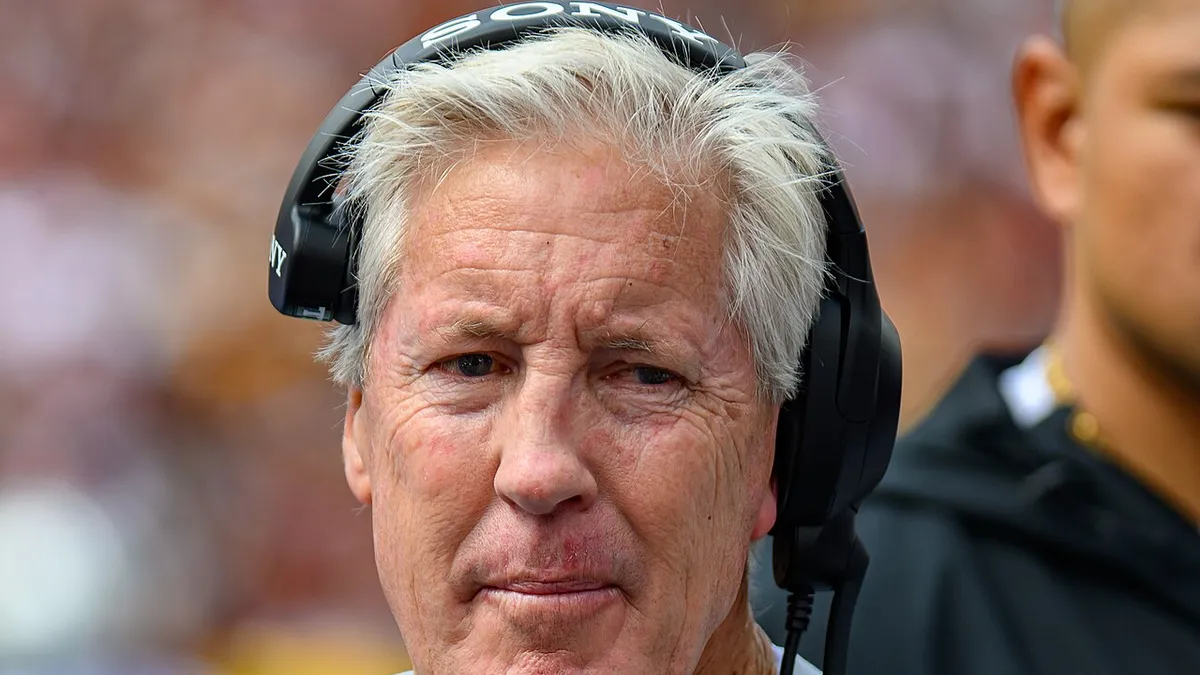
Everybody remembers the sideline energy and the Super Bowl trophy. Almost nobody remembers that two NFL teams gave up on him first.
Here’s what most people miss: the thing that got Pete Carroll fired in his 40s is the exact thing that made him unbeatable in his 50s and 60s.
The Myth vs. The Reality
The myth is pure sunshine. Pete Carroll, the eternally young coach bouncing on the sideline, chewing gum, high-fiving rookies, a man who seems to have been winning forever. Two national titles. A Super Bowl. One of the longest careers in the sport.
That version is real. It’s also wildly incomplete.
Here’s the truth: for the first half of his coaching life, Carroll was seen as a nice guy who couldn’t finish the job. He was fired by the Jets after one season and by the Patriots after three, tagged with the reputation that his players loved him a little too much and feared him not at all. The relentlessly upbeat champion the world knows today was, for years, a cautionary tale about a coach who peaked as a coordinator.
Think about it. We love a story of effortless positivity because it looks like a personality, not a struggle. But Carroll’s optimism wasn’t a gift he was born cashing in. It was a philosophy he had to build after failure forced him to figure out who he actually was.
Now, that reinvention didn’t happen in a vacuum. It came out of a specific place, a specific era of football, and a specific stretch of unemployment. Which raises the question: what makes a twice-fired coach believe he can still be great?
The World That Made Pete Carroll
To understand Carroll, you have to understand the Northern California he came up in, and the long apprenticeship that shaped him.
He was born on September 15, 1951, and raised in Greenbrae, in Marin County, just across the bridge from San Francisco. He was a gifted, undersized athlete, always competing against bigger kids, which forced him to win with energy, instinct and preparation instead of raw size. He starred as a defensive back at Redwood High School and later played safety in college, but he was never big enough or fast enough to reach the pros.
But the era mattered too. Carroll came up through the grinding, nomadic world of the coaching profession in the 1970s and 80s, when a young assistant paid his dues by moving from school to school and job to job. He worked his way through college programs and into the NFL as a defensive backs coach and coordinator, absorbing the trade one stop at a time.
Here’s the deal: that long climb built a coach who understood defense deeply and connected with players naturally. What it hadn’t yet built was a man who knew how to lead an entire organization on his own terms.
But before he’d figure that out, he’d have to fail at the highest level. Twice. And that failure is where the real story starts.
The Crucible: Early Life and the Climb
The environment that shaped him
Two things defined the young coach Carroll: a knack for connecting with players, and a hard ceiling he kept hitting.
He got his first NFL head-coaching shot with the New York Jets in 1994 and lasted a single season. A few years later he took over the New England Patriots from the legendary Bill Parcells, coached them from 1997 to 1999, made the playoffs, then watched the team slide, and got fired. The book on him hardened: great with players, warm in the locker room, but too soft to sustain a winner in the brutal NFL.
For a lot of coaches, that’s the end. A second firing at that level usually means a permanent slide back into a coordinator’s chair. Carroll faced the very real possibility that his shot as a leader was over.
You might be wondering how a man written off at the pro level became one of the great coaches of his generation. The answer is that the wilderness gave him time to think. Out of the NFL, Carroll stopped trying to coach like everyone else and started defining what he actually believed: relentless competition, positivity as a strategy, and a culture where players played free. He wasn’t going to out-grump the hard-nosed coaches. He was going to out-energize them.
He just needed somewhere to prove it.
The catalyst
The catalyst was a job nobody thought he wanted: USC.
In 2001, Carroll took over a stumbling USC program that wasn’t even his first choice, a hire that was widely mocked at the time. And it became the platform that changed everything. Freed from the NFL’s cynicism and turned loose on a talent-rich college campus, Carroll built a juggernaut. His Trojans won national championships in the 2003 and 2004 seasons, produced Heisman Trophy winners, and reeled off a 34-game winning streak that made USC the coolest, most dominant program in the country.
Here’s the kicker: the thing that got him fired in the NFL, that infectious, players-first energy, was exactly what made him magnetic in college recruiting and locker rooms. He hadn’t changed who he was. He’d finally found the arena where it worked.
The late bloomer had become the biggest name in football. And the NFL, the league that had twice shown him the door, was about to come back for him.
The Key Players
No career this long is a solo act, and Carroll was surrounded by people who shaped his path.
Start with Glena Carroll, his wife of nearly half a century. She was the constant through every move, every firing, and every reinvention, the stability that let a coach chase jobs across the country and reset after being let go. Their family became a coaching family, with sons who followed him into the profession.
Then there’s John Schneider, the general manager who partnered with Carroll in Seattle. Together they built the roster that won a Super Bowl, drafting and developing the core of the Legion of Boom. A head coach at that level is only as good as the front office beside him, and their partnership defined the Seahawks era.
And there’s Russell Wilson, the quarterback Carroll’s Seattle teams rode to their peak. A late-round pick who became a franchise star, Wilson was the on-field engine of Carroll’s greatest success, and the eventual fraying of that relationship marked the later chapters in Seattle.
There were rivals too, none sharper than Jim Harbaugh, whose teams battled Carroll’s in college and then again in the NFC West. Their combative, competitive edge became one of the best rivalries in football.
Now: surround yourself with the right partners and the right talent, and a reinvention can turn into a dynasty. Carroll was about to prove it on the biggest stage. But even his crowning moment would come with a scar.
The Turning Point
The pinnacle
The pinnacle came in February 2014, in the Super Bowl.
Carroll’s Seattle Seahawks, built around a ferocious defense and a young quarterback, ran into the Denver Broncos and simply demolished them, 43-8. It was the franchise’s first NFL championship, and it was validation on the grandest possible stage. The coach the NFL had twice discarded was now a Super Bowl winner, and he’d done it his way, with energy, culture and a roster that played fearless.
Across his career, the wins piled into something historic: two national titles, a Super Bowl, and more than a decade of contention in Seattle. Very few coaches in history win at the very top of both college and the pros.
Here’s the truth: he’d reached the summit, and then, one year later, the summit nearly broke his heart.
The price
Because the very next Super Bowl produced one of the most second-guessed decisions in football history.
In Super Bowl XLIX in February 2015, with the game on the line and the ball at the goal line, Carroll’s Seahawks threw a pass instead of handing it to their star running back. It was intercepted. Seattle lost. In an instant, a coach who could have won back-to-back titles became the face of a decision that fans and analysts have argued about ever since.
Carroll took the blame publicly and never fully escaped the call. It was the price of a bold, aggressive coaching identity: the same fearlessness that won games could, on one snap, cost a championship. The man who preached “always compete” had made a choice that would follow him for the rest of his career.
He’d spent a lifetime clawing back from failure. Now his greatest success and his most painful loss sat one year apart. That, too, was part of the story.
The Unvarnished Truth
Carroll is not a flawless story, and pretending otherwise misses what makes him interesting.
His USC dynasty ended under a cloud. The program was later hit with heavy NCAA sanctions tied to improper benefits, and one of its national-title seasons was vacated. Carroll had already left for the NFL by the time the hammer fell, and critics have long noted the convenient timing of his exit, jumping to Seattle just before the penalties landed.
There’s also the honest question of his ceiling. For all his brilliance, his career includes two early NFL firings and a Super Bowl lost on a call he chose to make. He is proof that even great coaches carry decisions they’d take back.
Here’s what’s easy to miss: his greatest strength and his most painful moment came from the same trait. The relentless, aggressive, always-compete mindset that reinvented his career is the exact instinct that produced the goal-line gamble. The edge was the gift and the risk.
None of that erases the trophies. But it does make him human, a coach who won big precisely because he was willing to lose big.
Controversies and Criticisms
Carroll’s career carried real controversy, and it’s worth being honest about it.
The USC sanctions are the biggest shadow. The NCAA found major violations in the program he built, vacated wins, and stripped honors, and Carroll’s move to the NFL right before the ruling left many feeling he dodged accountability for a mess created on his watch.
The Super Bowl XLIX play call is the on-field controversy that defines his critics’ case. Passing from the one-yard line with a championship in reach, rather than trusting a dominant running back, remains one of the most debated decisions in NFL history.
There’s also the recurring knock from his early years, the belief that his upbeat, players-first style couldn’t win at the pro level. He spent the back half of his career disproving it, but the label was real, and it took a Super Bowl to finally erase it.
So what does a career like this actually teach the rest of us? More than you’d expect.
What We Can Learn From Pete Carroll
Navigating hard times
Carroll’s real lesson isn’t about winning. It’s about what to do after you’ve been told you’re finished.
Twice fired in the NFL, written off as too soft, he could have accepted the verdict and settled into a lesser role. Instead he used the setback to get clear on what he believed and how he wanted to lead. When his next chance came at USC, he was a fully formed version of himself, and the results changed everything.
In other words: the firings weren’t the end of his story. They were the research phase.
The success blueprint
The blueprint here is about betting on your own identity instead of copying the room.
Carroll didn’t win by becoming the stern, feared coach the NFL seemed to reward. He won by doubling down on the energy and positivity everyone said would hold him back, and finding the environment where it became a superpower.
Want the fuller picture of how that translated into wealth? The full net worth breakdown shows how two national titles and a Super Bowl became a $50 million coaching fortune. And to see how he ranks among the sport’s biggest earners, the richest coaches list puts it in context.
The deeper takeaway is about timing and belief. Carroll proved that being dismissed at 40 doesn’t mean you’re done, and that the trait others call a weakness might be the exact thing that makes you great once you find the right stage.
Which brings us to the final reckoning on the man.
Final Verdict
Pete Carroll is going to be remembered as a winner. The harder truth is that he became one the long way around.
Most people will file him under “Super Bowl champion,” the eternally young coach who won everywhere. A smaller, smarter group will remember something more instructive: a twice-fired coach who spent his wilderness years figuring out exactly who he was, then rode that clarity to a college dynasty, an NFL title, and a career so long that franchises were still hiring him in his 70s.
Here’s the bottom line: the trophy made him famous, but the comeback made him a lesson. He is living proof that early failure and late greatness can belong to the same person.
He is one of the rare coaches to win at the very top of both college and the pros. He is also proof that the door closing in your 40s can be the beginning, not the end. And in the long run, that second story, the reinvention, is the version worth remembering.
Shop Pete Carroll on Amazon
Books, audiobooks, merch and more, handpicked for fans.
As an Amazon Associate we earn from qualifying purchases.
Frequently Asked Questions
Where did Pete Carroll grow up?+
Carroll grew up in Greenbrae, in Marin County, California, just north of San Francisco. He was an undersized but relentless athlete who starred as a defensive back at Redwood High School before playing college ball.
Why was Pete Carroll fired by the Patriots and Jets?+
Carroll had short, rocky first stints as an NFL head coach: one season with the New York Jets in 1994 and three with the New England Patriots from 1997 to 1999. Both ended in firings amid a reputation that he was too players-friendly to win at the pro level.
How many national championships did Pete Carroll win at USC?+
Carroll led USC to two national championships, in the 2003 and 2004 seasons, during a dynasty that produced Heisman winners and a 34-game winning streak, though the program later faced NCAA sanctions.
Did Pete Carroll win a Super Bowl?+
Yes. Carroll won Super Bowl XLVIII in February 2014, when his Seattle Seahawks routed the Denver Broncos 43-8 for the franchise's first NFL title. A year later, his team lost Super Bowl XLIX on a famous goal-line interception.
Is Pete Carroll still coaching?+
Yes. After 14 seasons with the Seahawks, Carroll was hired as head coach of the Las Vegas Raiders in January 2025, making him one of the oldest active head coaches in NFL history.
Want the money side of the story?
Read Pete Carroll's Full Net Worth Breakdown →Shop Pete Carroll on Amazon
Books, audiobooks, merch and more, handpicked for fans.
As an Amazon Associate we earn from qualifying purchases.