The Most Expensive Wine Ever Sold at Auction
On This Page
- Ranked: single containers, with the receipts
- Robert Drouhin’s cellar and the $32,000 estimate
- How size changes the ranking
- Lots, not bottles
- A charity bid is a donation with a bottle attached
- The 1787 Lafite, a record set by a forgery
- Numbers that do not survive checking
- Why I trust the 1945 more than anything else on this list
- Top Takeaways to Success
- Frequently Asked Questions
Three bottles of the same wine hold the three highest single-bottle prices in auction history, and all three trace back to one cellar in Burgundy.
The highest is $812,500, paid for a 750ml Domaine de la Romanée-Conti 1945 at Acker’s La Paulée auction, livestreamed in New York and held from 26 to 28 March 2026. Below it sit $558,000 and $496,000, both for 1945 Romanée-Conti at Sotheby’s New York on 13 October 2018, both from the personal cellar of Robert Drouhin.
Guinness World Records still shows the $558,000 bottle as the record as of October 2026. So do most published rankings, which puts them $254,500 short.
The rest of this page is about the harder problem. “Most expensive wine” is three or four different questions wearing one headline: a single bottle, a giant bottle, a lot of a hundred bottles, a charity bid. Most published rankings blend them, and a few still rank a bottle that was very probably forged.
Ranked: single containers, with the receipts
One bottle per row, of any size, sold at public auction. Bottle size is stated because a 6-litre imperial holds as much wine as eight standard bottles. Buyer’s premium is marked where the auction house or a trade report confirms it, and marked “not stated” where it does not.
| # | Wine | Size | Price | Premium | Sale |
|---|---|---|---|---|---|
| 1 | Romanée-Conti 1945, DRC | 750ml | $812,500 | Not stated | Acker La Paulée, livestreamed in New York, 26 to 28 Mar 2026 |
| 2 | Romanée-Conti 1945, DRC | 750ml | $558,000 | Included | Sotheby’s New York, 13 Oct 2018 |
| 3 | Screaming Eagle 1992 | 6 litres | $500,000 | Charity lot | Napa Valley Wine Auction, Jun 2000 |
| 4 | Romanée-Conti 1945, DRC | 750ml | $496,000 | Included | Sotheby’s New York, 13 Oct 2018 |
| 5 | La Tâche 1886, Bouchard Père & Fils | 750ml | £325,000 | Not stated | Christie’s London, 4 Dec 2025 |
| 6 | Château Mouton Rothschild 1945 | Jeroboam | $310,700 | Not stated | Aulden Cellars and Sotheby’s, New York, 28 Feb 2007 |
| 7 | Château Cheval Blanc 1947 | 6 litres | $304,375 (CHF 300,996) | Not stated | Christie’s Geneva, 16 Nov 2010 |
| 8 | Château Lafite Rothschild 1869 (each of three) | 750ml | $233,972 | Not stated | Sotheby’s Hong Kong, 29 Oct 2010 |
| 9 | Château Lafite Rothschild 1959 | Jeroboam | $171,579 | Not stated | Sotheby’s Hong Kong, 29 Oct 2010 |
| 10 | ”Lafitte 1787 Th.J.”, the Jefferson bottle | 750ml | £105,000 | Not stated | Christie’s London, Dec 1985. Widely regarded as a fake |
| 11 | La Tâche 1971, DRC | 5.5 litres | $150,000 | Not stated | Bonhams, online sale run from Boston, 3 to 17 Jun 2024 |
| 12 | Château Lafite Rothschild 1982 | 6 litres | $148,182 | Not stated | Sotheby’s Hong Kong, 29 Oct 2010 |
| 13 | Henri Jayer, Cros Parantoux 1978 | Magnum | $144,893 | Not stated | Baghera Wines, Geneva, Jun 2018 |
| 14 | Romanée-Conti 1943, DRC | 750ml | $68,200 | Included | Sotheby’s New York, 13 Oct 2018 |
| 15 | Massandra Sherry 1775 | 750ml | £31,900 | Included | Sotheby’s London, Oct 2001 |
The La Tâche 1886 is ranked fifth without a conversion because it lands there at any exchange rate seen in late 2025: £325,000 is more than $310,700 and less than $496,000 whichever rate you use. The Jefferson bottle is ranked on the $156,450 equivalent Wine Spectator gives for it.
Strip out the large formats and the charity lot and the 750ml ranking reads: 1945 Romanée-Conti, 1945 Romanée-Conti, 1945 Romanée-Conti, then a 139-year-old La Tâche, then Lafite 1869.
Robert Drouhin’s cellar and the $32,000 estimate
Robert Drouhin ran Maison Joseph Drouhin, one of Burgundy’s big négociant houses. In October 2018 Sotheby’s sold about 100 lots from his personal cellar in a little over two hours and took $7.3 million, according to Wine Spectator. More than 90 percent of the sale was old DRC, vintages 1937 to 1964.
The first bottle of 1945 Romanée-Conti carried a high estimate of $32,000 and sold for $558,000 including premium and taxes. A second bottle of the same wine followed at $496,000. Both went to Rob Rosania, a New York property developer, who also bought a 1943 Romanée-Conti for $68,200.
The appeal is specific. The domaine made roughly 600 bottles of 1945 Romanée-Conti, the last vintage from vines that predated phylloxera. The vineyard was pulled up in 1946, and the next Romanée-Conti released was the 1952.
Acker’s 2026 bottle came from the same cellar. Its release says the bottle was “originally sourced from the personal cellar of Robert Drouhin.” What it does not say is whether this was one of the two bottles Sotheby’s sold in 2018, and coverage has gone both ways: VinePair describes a different bottle, while The Drinks Business reported the sale as the same bottle beating its own record. Neither cites a lot number or a consignor.
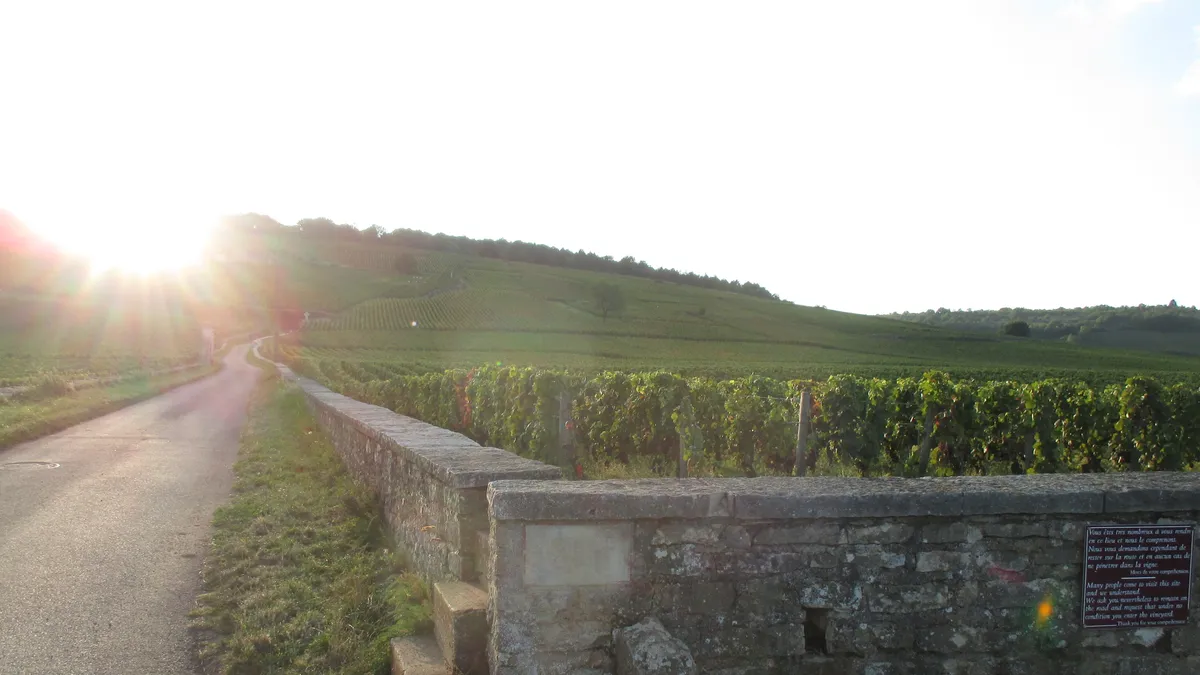
If you want to see the vineyard behind those bottles, this is the book to own.
Acker’s release also gives no hammer price and does not say whether $812,500 includes buyer’s premium. Both remain open until Acker publishes the lot.
How size changes the ranking
A jeroboam of Bordeaux holds 4.5 litres. An imperial holds 6. Old large formats are scarce, and at auction they often sell for more per litre than standard bottles of the same wine.
That is why the record history looks so jumpy. When Christie’s sold the only known imperial of Cheval Blanc 1947 in Geneva on 16 November 2010 for $304,375, against an estimate of $150,000 to $200,000, it was widely reported as the most expensive bottle ever sold at auction. It was not. Three years earlier, on 28 February 2007, a jeroboam of Mouton Rothschild 1945 from Baroness Philippine de Rothschild’s own cellar had made $310,700 in New York, double its high estimate. Wine Spectator still referred to that jeroboam as the single-bottle record when it reported the Drouhin sale in 2018.
Less than three weeks before the Cheval Blanc sale, Sotheby’s Hong Kong had sold three standard bottles of Lafite 1869, consigned direct from the château, at $233,972 each. Their estimate was HK$40,000 to HK$65,000 a bottle. The figure is sometimes printed as $232,692 per bottle; Decanter’s report of the sale gives $233,972.
The Christie’s specialist who sold the Cheval Blanc was Michael Ganne. By 2018 he was running his own Geneva house, Baghera Wines, which sold Henri Jayer’s personal cellar for $34.7 million including its 20 percent premium. A single magnum of Jayer’s Cros Parantoux 1978 made $144,893 there.
Lots, not bottles
Some of the biggest wine numbers are for quantities. They belong in a separate table, not slotted in among single bottles.
| Lot | Price | Sale |
|---|---|---|
| 114 bottles of Romanée-Conti, six each of 1992 to 2010 | HK$12,556,250 (about $1.6m) | Sotheby’s Hong Kong, Oct 2014 |
| 15 magnums, Henri Jayer Cros Parantoux 1978 to 2001 | CHF 1.16 million | Baghera Wines, Geneva, Jun 2018 |
| 50 cases of Mouton Rothschild 1982 | $1,051,600 | Sotheby’s New York, 2006 |
| Ten-vintage vertical of Harlan Estate | $700,000, charity | Napa Valley Wine Auction, Jun 2000 |
| Seven 6-litre bottles of Romanée-Conti 2005 | $1.5 million, retail, not auction | Sotheby’s retail, Hong Kong, 2018 |
The 2014 superlot worked out at about $14,121 a bottle, and it sold close to its low estimate of HK$12 million rather than its HK$20 million high. The record lot in wine history was, by the auction house’s own measure, a slightly soft result.
A charity bid is a donation with a bottle attached
At the Napa Valley Wine Auction in June 2000, Chase and Susan Bailey paid $500,000 for a 6-litre bottle of Screaming Eagle 1992. At the same auction a 10-vintage vertical of Harlan Estate made $700,000. The auction benefited the Napa Valley Vintners Association.
Those were real payments. They are just not market prices, because part of every charity bid is a gift, and nobody can say how much. The Screaming Eagle belongs on this page with a flag on it, which is how the table treats it.
The 1787 Lafite, a record set by a forgery
In December 1985 Christie’s London sold a bottle engraved “1787 Lafitte Th.J.” for £105,000. Christopher Forbes bought it for his father’s collection. The initials were meant to be Thomas Jefferson’s.
The bottle came from Hardy Rodenstock, a German collector who said a cache of 18th-century Bordeaux had been found behind a bricked-up wall in Paris. The collector William Koch later bought four bottles from the same source for about $400,000 and spent years trying to prove them fake. Examination of those bottles found the engraving had been cut with an electric drill rather than the copper wheel an 18th-century engraver would have used. The Thomas Jefferson Foundation at Monticello found the bottles matched neither Jefferson’s records of wine bought in Paris nor anything excavated at Monticello.
The drill evidence concerns the Koch bottles. The Forbes bottle shares their source and their story, so the accurate description is “widely regarded as a fake” rather than “proven fake”. Lists that rank it as the most expensive wine of its era without that caveat are reporting a forgery as a record.
Numbers that do not survive checking
The Massandra 1775 sherry did not make $43,500. That dollar figure is everywhere. Decanter’s list of the year’s top lots, compiled including premium, gives £31,900 at Sotheby’s London in October 2001. No auction result for $43,500 could be traced.
The $398,400 Romanée-Conti 2002 imperial was never a completed sale. Acker announced in September 2021 that it had sold the 6-litre bottle in Hong Kong for about HK$3.1 million. After the fraud specialist Don Cornwell questioned the bottle, Acker told Decanter the sale “had already been rescinded.”
Sotheby’s top lot of 2025 has no name. Its 2025 market report says it sold the year’s most valuable bottle of wine and was the only house above $450,000 for a single lot, but the public report does not identify the bottle or the price. Until it does, it cannot go in a table.
Retail and private sales are not auction records. The $1.5 million paid for seven Romanée-Conti imperials went through Sotheby’s retail arm. Several other headline “most expensive wines” are list prices or private deals with no published receipt, and they are left out here for that reason.
Why I trust the 1945 more than anything else on this list
My read is that wine is the hardest category in this whole section to rank honestly, and the reason is fraud, not money.
Look at who sits near the top of the history. A forged Jefferson bottle at Christie’s. A rescinded Acker imperial. Acker itself sold bottles for Rudy Kurniawan before his 2012 arrest, which VinePair raised again in its coverage of the 2026 record. Every big wine price carries a question that a guitar or a stamp price mostly does not: was it real?
Which is why the 1945 Romanée-Conti record persuades me in a way the Cheval Blanc and the Mouton never quite did. The provenance chain is short and named. Domaine, to Drouhin’s cellar, to Sotheby’s, to an identified buyer. The price for that wine then went up by nearly half in seven and a half years, and the 2026 bottle carries the same Drouhin name.
What still bothers me is the missing paperwork. Acker has not said whether $812,500 is hammer or all-in, and has not said whose bottle it was. Sotheby’s in 2018 told us both things. A record that says less than the record it replaced is still the record, but I would want the lot page before calling the question closed.
And I would stop quoting $558,000 as the answer. It was the right number for seven years. It is not now.
For the spirits side of the same market, see the most expensive whisky ever sold, and for every category we track, the most expensive things ever sold.
🏆 Top Takeaways to Success
- 1
The single-bottle auction record is $812,500, set by a 1945 Romanée-Conti at Acker in March 2026. Guinness World Records still shows the 2018 figure of $558,000.
- 2
The top three single bottles ever sold at auction are all 1945 Romanée-Conti, and all three trace back to the personal cellar of Robert Drouhin.
- 3
Large bottles, multi-bottle lots and charity lots answer different questions. Lists that mix them rank a 6-litre charity purchase beside a standard bottle as though they were the same thing.
- 4
The 1787 Jefferson Lafite still appears on record lists. It came from Hardy Rodenstock, and bottles from the same source were shown to have been engraved with a power tool.
Frequently Asked Questions
What is the most expensive bottle of wine ever sold?+
A 750ml bottle of Domaine de la Romanée-Conti 1945, at $812,500, sold by Acker at its La Paulée auction in New York in March 2026. It beat the $558,000 paid for another bottle of the same wine at Sotheby's New York on 13 October 2018. Acker's announcement does not say whether its figure includes buyer's premium.
Why is 1945 Romanée-Conti so expensive?+
It is the last vintage from the Romanée-Conti vineyard's old pre-phylloxera vines, and only about 600 bottles were made. The domaine pulled the vines up after 1945 and did not release Romanée-Conti again until the 1952 vintage. The bottles at auction since 2018 have also carried unusually clean provenance, from the cellar of Robert Drouhin.
What is the most expensive wine lot ever sold at auction?+
114 bottles of Romanée-Conti, six from each vintage from 1992 to 2010, sold for HK$12,556,250 (about $1.6 million) at Sotheby's Hong Kong in October 2014. It beat the $1,051,600 paid for 50 cases of Mouton Rothschild 1982 at Sotheby's New York in 2006. Separately, Sotheby's sold seven 6-litre bottles of Romanée-Conti 2005 for $1.5 million in 2018, but that was a retail sale, not an auction.
Is the Thomas Jefferson bottle of Lafite real?+
It is widely regarded as a fake. The bottle sold at Christie's London in December 1985 for £105,000 came from the German dealer Hardy Rodenstock. Bottles from the same source bought by the collector William Koch were found to have been engraved with an electric drill, and the Thomas Jefferson Foundation found no match with Jefferson's recorded wine purchases.
Does the $500,000 Screaming Eagle count as the most expensive wine?+
Not as a like-for-like record. It was a 6-litre bottle, eight standard bottles' worth, bought at a charity auction in June 2000 where the price includes a donation. Compare it with large-format bottles at commercial sales and it would rank first; compare it with 750ml bottles and it does not belong in the table at all.
Sources
- Acker press release: 1945 Romanée-Conti sells for $812,500 (Wine Industry Advisor, 30 March 2026)
- Domaine de la Romanée-Conti 1945 auctioned for record-shattering price (Wine Spectator)
- Most expensive wine sold at auction (Guinness World Records)
- Lafite prices spiral at record Sotheby's Hong Kong auction (Decanter)
- Mouton's private cellar makes $2m (Decanter)
- Wine bottle fetches record price at auction, Cheval Blanc 1947 (Swissinfo)
- Wine auction sales exceed expectations in 2001, top lots including premium (Decanter)
- Sale of six-litre DRC wine rescinded amid counterfeit concerns (Decanter)
- Napa Valley Wine Auction 2000: the bidding (Wine Spectator)
- Thomas Jefferson's Wine? (Winterthur Museum, Treasures on Trial)
- Bonhams record for a single bottle: DRC La Tâche 1971, 5.5 litres (Bonhams press release, June 2024)
- 2025 Wine and Spirits Market Report (Sotheby's)