Erik Spoelstra Biography: From Video Room to NBA Champion Coach
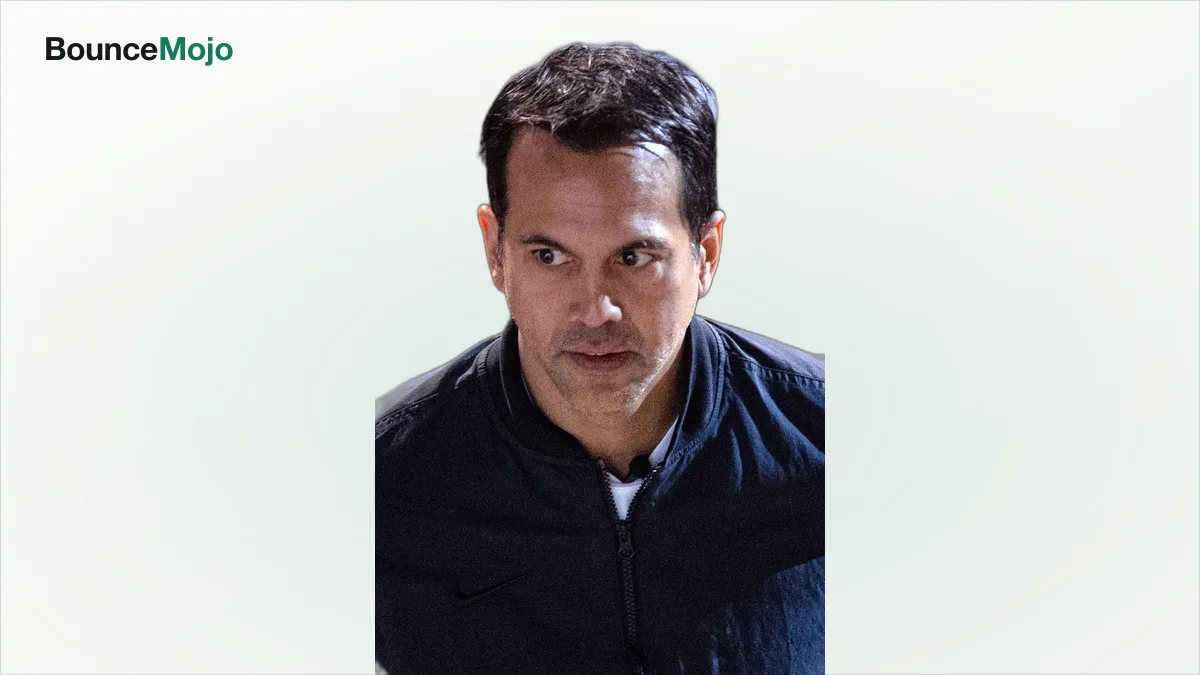
Everybody sees the two championship trophies and the record contract. Almost nobody remembers the kid splicing game tape in a back room, invisible to everyone in the building.
Here’s what most people miss: the thing that looked like the least glamorous job in basketball, cutting film for the Miami Heat, is the exact foundation that made Erik Spoelstra one of the great coaches of his era.
The Myth vs. The Reality
The myth is a résumé. Erik Spoelstra, the brilliant, unflappable NBA coach, two titles, six Finals, a record-shattering contract, the model of the modern sideline. A man who seems to have always belonged at the top.
That version is real. It’s also wildly incomplete.
Here’s the truth: Spoelstra didn’t parachute into greatness. He started at the absolute bottom of the Heat organization as a video coordinator in 1995, a job that pays little and gets no credit, and he spent 13 years clawing upward before he ever ran a team. The composed champion the world sees now was built in an editing room, one frame of tape at a time.
Think about it. We love the story of the natural-born leader because it feels clean. But Spoelstra’s rise was anything but instant. He was an undrafted, undersized point guard who had to play in Germany just to keep his career alive, then took the humblest job in the NBA because it got him in the door. The unglamorous grind is the whole point.
Now, that grind didn’t come from nowhere. It came from a specific family, a specific coast, and a heritage that made him an outsider in his own sport. Which raises the question: what shapes a person willing to start that far down?
The World That Made Erik Spoelstra
To understand Spoelstra, you have to understand the multicultural, Pacific Northwest upbringing he came from.
He was born on November 1, 1970, in Evanston, Illinois, spent early years in Buffalo, and grew up mainly in Portland, Oregon, after his family moved west in the late 1970s. His father, Jon, was an NBA executive of Dutch and Irish descent, so the business of basketball was in the household air. His mother, Elisa, was from San Pablo in the Philippines, making Erik a Filipino-American kid in a sport that had almost no one who looked like him at its highest levels.
The era mattered too. Spoelstra came of age as the NBA was globalizing but its coaching ranks remained overwhelmingly narrow. A biracial, Asian-American kid dreaming of the league was chasing a path with essentially no role models on the sideline. That absence would make his eventual rise historic.
Here’s the deal: basketball was both a family trade and a personal passion for Spoelstra. With an NBA-executive father, he grew up understanding the game as a business as much as a sport, an education that would matter enormously once he entered a front office himself.
But knowing the business didn’t hand him a shortcut. He’d have to earn his place from the very bottom. And that climb is where the real story lives.
The Crucible: Early Life and the Climb
The environment that shaped him
Two things defined the young Spoelstra: undersized talent and relentless work.
He was a good college point guard at the University of Portland, West Coast Conference Freshman of the Year in 1989, but at his size he went undrafted in 1992. Rather than quit, he went to Germany and played in the second division for TuS Herten, coaching younger players on the side. It was a humble, faraway proving ground for a young man who refused to let go of the game.
Then came the pivotal, unglamorous choice. In 1995 he took a job as the Miami Heat’s video coordinator, sitting in a dark room breaking down film. For most people, that’s a support role, not a launchpad. For Spoelstra, it was a foot in a door he would never let close.
You might be wondering: how does a video guy become a head coach? The answer is that Spoelstra treated film study as a craft to be mastered, not a chore to be endured. He learned the Heat’s system from the inside out, made himself indispensable, and earned promotion after promotion, into advance scouting, then onto the bench as an assistant.
By the mid-2000s, he was a key assistant on a championship staff, winning a ring when the Heat beat Dallas in the 2006 Finals. The film-room kid had become a coach the franchise couldn’t imagine losing.
The catalyst
The catalyst had a name: Pat Riley.
Riley, the legendary Heat coach and president, had watched Spoelstra rise through the organization for over a decade. In 2008, Riley stepped aside and handed the head-coaching job to his 37-year-old protégé, one of the boldest succession bets in the league. He was entrusting his franchise to a former video coordinator who had never been a head coach anywhere.
Here’s the kicker: Riley didn’t just give Spoelstra a job. He gave him cover and belief, the backing of the most respected man in the building, at moments when others would have wanted the young coach fired. That faith, and Spoelstra’s own steadiness, would soon be tested by the biggest spotlight in basketball.
Spoelstra became the first Asian American head coach in the four major North American pro sports leagues. The outsider had reached the sideline. But the hardest part was still to come.
The Key Players
No rise this steep is a solo act, and Spoelstra was surrounded by people who shaped his path.
Start with Pat Riley, the mentor, president, and architect who promoted Spoelstra from within and defended the decision through the rocky early years. Their relationship, boss and protégé, is the spine of Spoelstra’s entire career.
Then there’s Dwyane Wade, the franchise icon who played for Spoelstra through the toughest transition and both title runs. The trust between coach and superstar, tested early, became one of the strongest partnerships in Heat history.
And there’s LeBron James, whose 2010 arrival raised the stakes to championship-or-bust and put enormous pressure on the young coach. Spoelstra’s ability to lead a locker room featuring the best player on earth, through early failure to back-to-back titles, defined him.
There was also his father, Jon Spoelstra, the NBA executive whose career gave Erik an insider’s understanding of the league long before he ever coached in it.
Now: surround yourself with the right mentor and the right stars, and even a video-room grinder can reach the top. Spoelstra was about to prove it. But first he’d have to survive being doubted by an entire sport.
The Turning Point
The pinnacle
The pinnacle came in the summers of 2012 and 2013.
When James and Chris Bosh joined Wade in 2010, the Heat became instant favorites, and the pressure fell squarely on Spoelstra. After a Finals loss in 2011 that had many calling for his job, he adjusted, and the team broke through, winning the 2012 championship over Oklahoma City and repeating in 2013 in a classic seven-game Finals against San Antonio.
Two titles. Four straight Finals. The former video coordinator had out-coached the league with the most scrutinized roster in basketball on his shoulders. It was validation on the grandest possible scale.
Across his career the totals kept growing: six NBA Finals appearances as head coach, including gritty underdog runs in 2020 and 2023 long after the superstars had gone, plus a place among the most respected coaching minds in the game.
Here’s the truth: he became a two-time champion, and he did it after being told, publicly and loudly, that he wasn’t ready.
The price
Because the road to those titles ran through real humiliation.
In the early going with the Big Three, the Heat struggled, and Spoelstra faced constant speculation that he’d be replaced by Riley himself. He was booed. He was second-guessed nightly. A young coach handed a super-team was, paradoxically, in the most precarious job in sports, certain to be blamed for anything short of a championship.
The scrutiny never really stopped. Every season since has come with the expectation to contend, and the pressure of a franchise that measures success only in titles. Spoelstra has carried that weight for well over a decade, absorbing criticism with a composure that hides how heavy it must be.
He’d spent 13 years earning the job, only to be told he might not deserve it. That was the price of the opportunity, and he paid it by winning.
The Unvarnished Truth
Spoelstra’s story isn’t a frictionless fairy tale, and pretending otherwise misses what makes it instructive.
He was, early on, in over his head with a roster of egos he hadn’t yet learned to manage, and the 2011 Finals loss was a genuine failure that could have ended his tenure. His teams have had lean, non-contending years. Not every roster he’s been handed has been good, and not every season has ended in glory.
There’s also the quieter cost of a life given entirely to one organization. Coaching at that level demands relentless hours and singular focus, and Spoelstra has navigated personal challenges, including a divorce, alongside the unending grind of an NBA season.
Here’s what’s easy to miss: his greatest strength, an almost total dedication to craft and franchise, is also demanding in ways that don’t make headlines. The obsessive preparation that makes him elite is a life of film, travel and pressure that few outside the profession would trade for.
None of that dims the trophies. But it does explain why his steadiness is an achievement in itself.
Controversies and Criticisms
Spoelstra’s career has been remarkably clean of scandal, but it hasn’t been free of criticism.
The loudest came early, when many observers openly doubted whether a former video coordinator was equipped to coach a super-team, and called for Riley to replace him. That criticism looks foolish in hindsight, but it was relentless at the time.
There have also been the ordinary debates that follow any long-tenured coach, questions about rotations, late-game decisions, and whether even a very good coach can be judged fairly on rosters that vary wildly in talent. In a results-only league, no coach escapes second-guessing.
On the other side, Spoelstra has earned near-universal respect for his professionalism and for what his rise represents. As a pioneering Asian-American coach who reached the top on merit and loyalty, he broke a barrier that had stood for the entire history of the four major leagues, and did it without controversy or self-promotion.
So what does a career like this actually teach the rest of us? More than the trophies suggest.
What We Can Learn From Erik Spoelstra
Navigating hard times
Spoelstra’s real lesson isn’t about winning. It’s about enduring the doubt before the winning arrives.
When the whole sport questioned him, he didn’t lash out or campaign for himself. He adjusted his system, absorbed the criticism, and let sustained results answer his critics. He survived the lowest-percentage job in basketball, a young coach with a super-team, by staying composed when quitting or blaming others would have been easier.
In other words: the titles were the reward. Holding steady through the doubt was the real work.
The success blueprint
The blueprint here is about starting lower than your ambition and out-lasting everyone.
Spoelstra took the humblest job in the NBA, video coordinator, and treated it as a craft to master rather than a rung to rush past. That patience and depth of knowledge are exactly what made him ready when the head job came. He didn’t leapfrog the grind. He mastered it.
Want the fuller picture of how that translated into wealth? The full net worth breakdown shows how two titles and a record contract became an eight-figure fortune. And to see how he ranks among the sport’s biggest coaching paydays, the richest coaches list puts it in context.
The deeper takeaway is about loyalty and mastery. Spoelstra proved that you don’t have to job-hop to win big, and that a reputation for depth and dependability can be worth more than flash. Master one thing inside one place, and the world eventually pays you what you’re worth.
Which brings us to the final reckoning on the man.
Final Verdict
Erik Spoelstra is going to be remembered for the wrong number.
Most people will file him under “two titles” or “$120 million contract,” the decorated coach with the record deal. A smaller, smarter group will remember something harder and more valuable: a Filipino-American kid who went undrafted, played in a German second division to survive, took the lowest job in the NBA, and spent 13 patient years turning a video-room grind into one of the most respected coaching careers of his generation.
Here’s the bottom line: the trophies made him famous. The climb made him matter. By rising from a back room to the top of his profession, and breaking a barrier no coach before him had, he redefined what a path to the NBA sideline could look like.
He is a two-time champion and among the highest-paid coaches in sports. He is also proof that starting at the bottom, and staying loyal to the craft, can carry you further than any shortcut. And in the long run, that second story, the patient climb, is the version worth remembering.
Shop Erik Spoelstra on Amazon
Books, audiobooks, merch and more, handpicked for fans.
As an Amazon Associate we earn from qualifying purchases.
Frequently Asked Questions
Where did Erik Spoelstra grow up?+
Spoelstra was born in Evanston, Illinois, on November 1, 1970, spent early years in Buffalo, New York, and grew up mostly in Portland, Oregon, where his family moved in the late 1970s.
What is Erik Spoelstra's ethnicity?+
Spoelstra is of Filipino and Dutch-Irish heritage. His mother, Elisa, is from San Pablo in the Philippines, making him the first Asian American head coach in the four major North American sports leagues.
Did Erik Spoelstra play basketball?+
Yes. Spoelstra played point guard at the University of Portland from 1988 to 1992 and was West Coast Conference Freshman of the Year, then played professionally in Germany before moving into coaching.
How did Erik Spoelstra become the Heat's coach?+
Spoelstra joined the Miami Heat as a video coordinator in 1995 and rose through scouting and assistant roles under Pat Riley for 13 years before being promoted to head coach in 2008.
How many NBA titles has Erik Spoelstra won?+
Spoelstra has won two NBA championships as head coach, in 2012 and 2013, and reached six NBA Finals with the Heat, becoming the first Asian American head coach to win a title.
Want the money side of the story?
Read Erik Spoelstra's Full Net Worth Breakdown →Shop Erik Spoelstra on Amazon
Books, audiobooks, merch and more, handpicked for fans.
As an Amazon Associate we earn from qualifying purchases.