Arsene Wenger Biography: The Professor Who Remade English Football
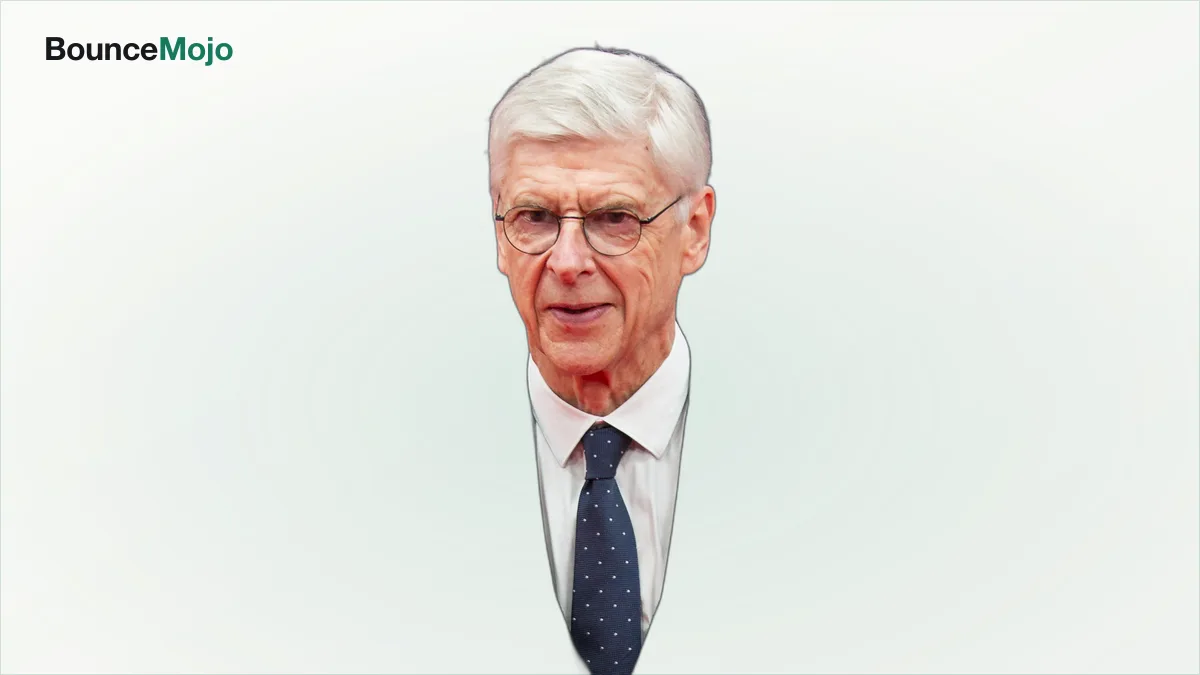
Everybody remembers the Invincibles. Almost nobody remembers the quiet economics student from an Alsace village who was told, more than once, that he’d never make it as a player.
Here’s what most people miss: the very ordinariness of Arsene Wenger’s playing career is what pushed him to think about football more deeply than almost anyone before him.
The Myth vs. The Reality
The myth is elegant. Arsene Wenger, the professor, a footballing intellectual who glided into England and rewrote the rules with the calm certainty of a genius who always knew he was right.
That version is real. It’s also wildly incomplete.
Here’s the truth: Wenger was a limited player who barely reached France’s top division, a defender who succeeded through reading the game rather than natural gifts. The “born visionary” story skips the years of doubt, the obscure coaching jobs, and the fact that when Arsenal hired him in 1996, most English fans and journalists had never heard of him.
Think about it. We love a story of effortless brilliance because it makes revolution look inevitable. But Wenger’s revolution was built on decades of quiet study, from an economics degree to years learning his craft in France, Monaco, and Japan. He wasn’t handed vision. He earned it, slowly, in places nobody was watching.
Now, that patient mind didn’t form in a vacuum. It came from a specific region, a specific family, and a specific culture that valued discipline and thought. Which raises the question: what world produces a man this studious and this quietly ambitious?
The World That Made Arsene Wenger
To understand Wenger, you have to understand the corner of France he came from, and the education that shaped him.
He was born on October 22, 1949, in Strasbourg, and raised in Duttlenheim, a small village in Alsace, the border region between France and Germany. His parents ran a bistro, and young Arsene absorbed the game by listening to local men dissect football over drinks. It was, he has said, his first classroom, a place where tactics and character were debated as seriously as anything in school.
The era and the region mattered too. Alsace gave Wenger a foot in two cultures and two languages, French and German, and he later added English, Italian, Spanish, and Japanese. That worldliness set him apart in an English game that was still insular and suspicious of foreign ideas.
Here’s the deal: Wenger’s playing talent was modest. He played mostly amateur and semi-professional football in Alsace, reaching the top flight only briefly with Strasbourg, while also earning a degree in economics from the University of Strasbourg. He was a thinker in a player’s kit.
But that studious streak was about to become his superpower. And it would take him to unlikely places first.
The Crucible: Early Life and the Climb
The environment that shaped him
Two things defined the young Wenger: intellect and patience.
Knowing he’d never be a great player, he threw himself into understanding the game as a craft, into coaching badges, tactics, and the science of fitness. He was the kind of man who read widely, thought independently, and trusted evidence over tradition. In a sport ruled by gut instinct, that made him unusual.
He began coaching in France, learning the trade at Nancy in the mid-1980s before landing the job that would announce him: Monaco. There, he won the French league in 1988 and a domestic cup, and coached stars like George Weah, showing an eye for talent that would become his trademark.
You might be wondering: how does a manager go from the French Riviera to reshaping English football? The answer is a detour almost nobody expected. In 1995, Wenger took a job in Japan, managing Nagoya Grampus Eight, winning a cup and immersing himself in a completely different football culture. It was there, far from the European spotlight, that Arsenal came calling.
The obscure Frenchman was about to walk into English football history.
The catalyst
The catalyst was Arsenal, and a man named David Dein.
In 1996, Arsenal’s vice-chairman David Dein pushed to hire the little-known Wenger, a gamble that prompted the infamous headline “Arsene Who?” English football expected him to fail. Instead, he detonated a revolution.
Here’s the kicker: Wenger didn’t just change the results. He changed the entire culture. He overhauled players’ diets, banned the drinking that had defined English dressing rooms, introduced stretching, sports science, and data-driven scouting, and imported gifted, unknown players from France and beyond. In his first full season, 1997-98, Arsenal won the league and cup Double. The doubters went silent.
That success made him the most influential foreign manager English football had ever seen. And the best was still to come.
The Key Players
No career this long is a solo act, and Wenger was surrounded by people who shaped his path.
Start with David Dein, the Arsenal vice-chairman who staked his reputation on hiring an unknown Frenchman and became Wenger’s closest ally in the boardroom. Without Dein’s conviction, the whole revolution might never have happened.
Then there’s Thierry Henry, the striker Wenger converted from a wide player into one of the greatest forwards in Premier League history. Henry became the face of Wenger’s flowing, beautiful football and the talisman of the Invincibles.
And there’s Alex Ferguson, the Manchester United manager who became Wenger’s great rival. Their duels for the title, often fierce and personal, defined an entire era of English football and pushed both men to greatness.
There was also Gianni Infantino, the FIFA president who years later would bring Wenger into world football’s governing body, giving the professor a new global stage after the dugout.
Now: back the right believers and sharpen yourself against the right rival, and you can build something historic. Wenger was about to reach a peak no English club has touched since.
The Turning Point
The pinnacle
The pinnacle came in the 2003-04 season.
Wenger’s Arsenal went the entire 38-game Premier League campaign unbeaten, a feat so rare it earned the team a nickname that would echo forever: the Invincibles. No English top-flight side had gone a full season unbeaten in modern football, and none has done it since. It was the purest expression of everything Wenger believed, attacking, technical, fearless football.
Across 22 years, he won three league titles and a record seven FA Cups, and he oversaw the club’s ambitious move to the Emirates Stadium, tying his name permanently to the identity of Arsenal itself.
For the full picture of how those achievements built his wealth, the net worth breakdown shows how two decades at one club became a $60 million fortune.
The price
Because that stadium project came at a steep cost.
The move to the Emirates saddled Arsenal with heavy debt, and Wenger spent years managing on a tight budget while rivals spent freely. He kept the club competitive and in the Champions League, an achievement in itself, but the trophies dried up, and the beautiful football stopped translating into titles.
In his final seasons, sections of the fanbase turned on him. “Wenger Out” banners appeared, and the man who had given the club its greatest era became a lightning rod for frustration. The professor, once untouchable, found that even loyalty has a shelf life. He stepped down in 2018, after 22 years, on his own terms but under real pressure.
The Unvarnished Truth
Wenger is not a flawless figure, and his story is better for admitting it.
His famous stubbornness was both a strength and a flaw. He trusted his methods so completely that, in later years, critics argued he failed to adapt as football’s tactics and money evolved around him. The same conviction that powered his revolution left him slow to change when the game changed.
There’s also the honest debate about his final decade. He kept Arsenal stable and solvent through the stadium debt, but a run without league titles led many to argue he stayed too long, that loyalty tipped into a refusal to let go.
Here’s what’s easy to miss: his greatest strength and his greatest weakness were the same trait. The unshakable belief in his own ideas made him a pioneer and, eventually, made him resistant to the reinvention his teams needed. The conviction was the gift and the trap.
None of that erases the revolution. But it explains why his legacy is debated as passionately as it is celebrated.
Controversies and Criticisms
Wenger’s career carried its share of friction, and it’s worth being honest about it.
His long rivalry with Alex Ferguson boiled over into touchline confrontations and public spats, including the infamous tunnel clashes between their teams. Wenger, usually so composed, could be prickly and defensive when questioned, and he was often accused of not seeing his own players’ fouls.
There was also the criticism that defined his final years: that his refusal to spend, and his loyalty to a fading philosophy, held Arsenal back in an era of soaring transfer fees. Fans who once revered him grew divided, and the club’s decline became a running debate.
And when he later joined FIFA, some questioned whether a purist like Wenger belonged in football’s often-controversial governing body. He argued he could do more good shaping the global game than criticizing it from outside.
So what does a life like this actually teach the rest of us? A great deal, and not only about football.
What We Can Learn From Arsene Wenger
Navigating hard times
Wenger’s real lesson isn’t about winning. It’s about principle under pressure.
When Arsenal’s budget was crushed by stadium debt, he could have walked away or blamed the board. Instead, he kept the club competitive year after year through sheer intelligence and discipline, refusing to compromise his belief in developing young talent and playing attractive football.
In other words: he showed that how you conduct yourself in the lean years matters as much as the trophies you win in the good ones.
The success blueprint
The blueprint here is about thinking differently from everyone around you.
Wenger arrived in a football culture that trusted instinct and tradition, and he won by trusting evidence, nutrition, data, sports science, ideas that seemed radical then and are standard now. He changed an entire sport not by shouting louder, but by thinking further ahead.
Want the fuller picture of how that translated into wealth? The full net worth breakdown shows how 22 years at Arsenal became a $60 million fortune. And to see how he ranks among the game’s biggest coaching earners, the richest coaches list puts it in context.
The deeper takeaway is about vision and its limits. Wenger proved that a single clear idea can transform a whole culture, but also that the same conviction, held too long, can leave you behind. The best innovators are the ones who keep innovating.
Which brings us to the final reckoning on the man.
Final Verdict
Arsene Wenger is going to be remembered as more than a trophy count.
Most people will file him under the Invincibles, three titles, seven FA Cups. A smaller, smarter group will remember something bigger: an unknown Frenchman who walked into a suspicious English game and quietly rebuilt how it eats, trains, thinks, and plays, leaving fingerprints on every club in the country.
Here’s the bottom line: the trophies made him famous, but the revolution made him important. Every modern manager who trusts diet, data, and youth development is working in a world Wenger helped create.
He is the greatest manager in Arsenal’s history. He is also proof that changing how people think can outlast any single title. And in the long run, that story, the professor who reinvented a sport, is the version worth remembering.
Shop Arsene Wenger on Amazon
Books, audiobooks, merch and more, handpicked for fans.
As an Amazon Associate we earn from qualifying purchases.
Frequently Asked Questions
Where did Arsene Wenger grow up?+
Wenger was born in Strasbourg on October 22, 1949, and grew up in Duttlenheim, a small village in Alsace, where his parents ran a bistro. He has said watching men talk football in the pub was his first education in the game.
Did Arsene Wenger play professional football?+
Wenger was a modest defender who played mostly at amateur and semi-professional level in Alsace, reaching France's top division only briefly with Strasbourg. He also earned a degree in economics from the University of Strasbourg.
Why is Arsene Wenger called 'the professor'?+
Wenger earned the nickname for his studious, intellectual approach. He spoke several languages, held an economics degree, and revolutionized English football with scientific ideas about diet, fitness, and data.
What did Arsene Wenger win at Arsenal?+
Across 22 years, Wenger won three Premier League titles and a record seven FA Cups, including the unbeaten 'Invincibles' season of 2003-04, making him the most successful manager in Arsenal's history.
What does Arsene Wenger do now?+
Since 2019, Wenger has served as FIFA's Chief of Global Football Development, working to grow and modernize the sport around the world.
Want the money side of the story?
Read Arsene Wenger's Full Net Worth Breakdown →Shop Arsene Wenger on Amazon
Books, audiobooks, merch and more, handpicked for fans.
As an Amazon Associate we earn from qualifying purchases.