Andre Agassi Biography: The Rebel Who Hated Tennis, Won Anyway
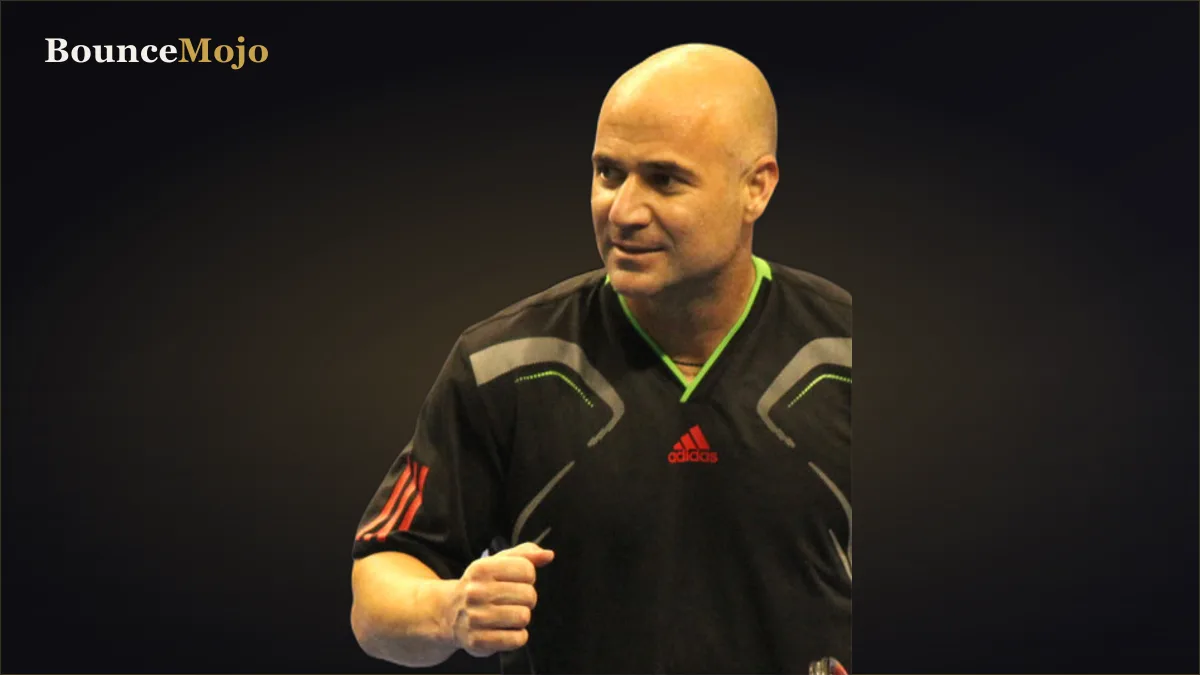
Most people remember Andre Agassi as the flashy rebel with the mullet who told us image is everything. The truth he hid for decades is almost the opposite.
Here’s what most people miss: the man who looked like he was born to perform on a tennis court secretly hated the sport that made him famous, and he carried that secret through eight Grand Slam titles.
The Myth vs. The Reality
The myth is loud. Andre Agassi: the neon rebel, the long-haired showman who brought rock-star energy to a stuffy sport, won everything, married the greatest woman ever to play, and rode off as an American icon. Image is everything. Roll credits.
The reality is stranger and sadder.
Here’s the deal: Agassi did not love tennis. In his own words, he hated it, with what he called “a dark and secret passion.” The confident rebel persona was partly a mask over a man who felt trapped in a life his father had chosen for him before he could even speak.
And the “image is everything” slogan? It was an ad line he came to resent, because his whole struggle was the gap between the image the world saw and the emptiness he felt underneath it.
You might be wondering: how does a boy end up playing a sport he hates well enough to become one of the greatest of all time? To understand that, you have to understand the world, and the father, that made him.
The World That Made Andre Agassi
Agassi was born in 1970 in Las Vegas, the city of neon, spectacle, and gambling, and it seeped into everything about him.
His father, Mike Agassi, was an Iranian-born immigrant and former Olympic boxer who arrived in America determined that one of his children would become a tennis champion. This wasn’t a hope. It was a plan, executed with military intensity.
Now: Vegas in the 1970s and ’80s was a place built on image and reinvention, and Agassi would become its perfect athletic export, flashy, marketable, made for television. But the glitz outside masked a grinding childhood inside a home organized entirely around one obsession.
Think about it: while other kids played, Andre was being drilled by a machine his father built. That collision, a spectacle-loving city and a relentless immigrant dream, is the backdrop for everything Agassi became.
The Crucible: Early Life and the Climb
The Environment That Shaped Him
Mike Agassi engineered his son’s talent with terrifying focus. He reportedly built a homemade ball machine, which young Andre nicknamed “the dragon,” that fired balls at him for hours in the family’s backyard. The goal was volume: hit a million balls a year, and greatness would follow.
Let that land. This wasn’t encouragement. It was a childhood weaponized around a single outcome.
At 13, Andre was sent to the Nick Bollettieri Tennis Academy in Florida, a boot-camp environment he later described in bleak terms, a place that felt like a prison for a homesick kid. He rebelled against the discipline with wild hair, loud clothes, and defiance, the beginnings of the rebel image that would later make him rich.
Here’s the truth: the rebellion the world found so charming was, at its root, a kid screaming against a life he never chose. The persona was armor. Underneath was a boy who wanted out.
The Catalyst
The talent was undeniable, and it broke through fast. Agassi turned pro at 16 and, by the late 1980s, was both a rising force and a marketing phenomenon, the Canon “Image Is Everything” ads making him a household name before he’d won a major.
Then came the win that legitimized the hype. In 1992, Agassi won Wimbledon, the sport’s most traditional stage, the last place anyone expected the denim-and-neon rebel to triumph.
It gets better, and much worse, before it gets better again. Because a few years after that breakthrough, Agassi would fall so far and so fast that his career, and nearly his life, would spiral toward collapse. And the way he clawed back would define him more than any title.
The Key Players
No one climbs out of a hole alone, and Agassi’s story is full of people who pushed him down and pulled him up.
Mike Agassi. The father who created the champion and, in doing so, stole the choice from his son. Their relationship is the engine and the wound of Agassi’s entire life, love and resentment braided together, documented unflinchingly in his memoir.
Gil Reyes. The trainer who became a father figure of a different kind. Reyes rebuilt Agassi’s body and, more importantly, his spirit, becoming a lifelong confidant and one of the most important relationships in his life. Where Mike demanded, Gil supported.
Brad Gilbert. The coach who took over during Agassi’s decline and reengineered his tactical game, teaching him to win with brains as much as talent, and helping engineer the greatest comeback of his career.
Steffi Graf. The 22-time Grand Slam champion who became his wife, his partner, and the calm center of his adult life. Their marriage united two of the greatest players ever, and, as his net worth story shows, two of the wealthiest.
By the way, every one of these relationships points at the same theme: a man raised without choices, slowly learning to build a life he actually wanted. That journey ran straight through his darkest year.
The Turning Point
The Pinnacle
Agassi’s peak came in two acts, and the second is the miracle.
He won eight Grand Slam singles titles and became one of only a handful of men in history to complete the career Grand Slam, winning all four majors. Add his 1996 Olympic gold medal and he achieved the rare “Career Golden Slam.” He first reached world No. 1 in 1995.
But the defining moment was the comeback. By late 1997, mired in personal chaos, Agassi had plummeted to around No. 141 in the world, playing low-level Challenger events. Then, with Gil Reyes and Brad Gilbert, he rebuilt himself from the ground up and stormed back to No. 1 in 1999, winning the French Open to complete his career Slam. As his own net worth breakdown lays out, the fame from that arc built a fortune.
The Price
Here’s the kicker: the pinnacle sat right next to the abyss.
That 1997 collapse wasn’t just a slump. Agassi later revealed it coincided with the lowest, most self-destructive period of his life. The rebel image the world adored was papering over real despair. The price of a childhood without choices was a young adulthood spent trying to find out who he even was.
And in the middle of that darkness, he made a decision he would hide from the world for more than a decade. A confession that, when it finally came, would rock the sport.
The Unvarnished Truth
Agassi’s flaws were real, and to his enormous credit, he confessed the biggest one himself.
In his 2009 memoir Open, Agassi admitted that during his 1997 low point he had used crystal methamphetamine, failed an ATP drug test, and then lied to the tour in a letter claiming he’d unknowingly ingested it. The ATP accepted the explanation, and the failed test was buried, until Agassi chose to reveal it himself years later.
Now: none of this excuses the lie, and Agassi doesn’t try to. But the context matters. This was a man at his most lost, drowning in a life he’d been conscripted into, reaching for anything to numb it. The drug use was a symptom of a much deeper crisis of identity.
The most honest thing about Agassi is that he told on himself. He could have taken the secret to his grave. Instead he laid it bare, along with his hatred of tennis, his failed first marriage, and his fraught bond with his father. His greatest strength turned out to be a willingness to be seen, flaws and all.
Controversies and Criticisms
Agassi’s honesty in Open created its own storm.
The meth confession. When the memoir revealed the 1997 drug use and the lie to the ATP, several players, past and present, were furious. Some argued he should have been sanctioned and that confessing years later, while selling a book, was self-serving. It reopened debate about how the tour handled the case.
The “image is everything” backlash. For years, critics dismissed Agassi as style over substance, a marketing creation who cared more about hair and endorsements than the game. His early inconsistency fed the narrative that he was wasting historic talent.
The Sampras rivalry framing. In the eternal comparison with Pete Sampras, Agassi was often cast as the flashy underachiever to Sampras’ disciplined machine, a framing that undersold just how complete Agassi’s career, and his comeback, ultimately was.
The father debate. Open painted an unsparing portrait of Mike Agassi’s methods, sparking uncomfortable conversations about tennis-parent culture and how far is too far in the pursuit of a child prodigy.
What We Can Learn From Andre Agassi
Navigating Hard Times
The first lesson is about rock bottom: how far you fall doesn’t decide how the story ends. Agassi collapsed to No. 141, used drugs, and lied about it, and still climbed back to No. 1 and into the Hall of Fame. A catastrophic chapter is not the whole book.
But here’s the truth his comeback makes plain: you can’t rebuild until you’re honest about what broke you. Agassi’s real recovery started when he stopped performing and started reckoning with why he was so lost, the childhood, the resentment, the missing sense of self.
The Success Blueprint
If you want the replicable part, it’s this: Agassi won his second act by getting smarter, not just fitter. With Brad Gilbert, he learned to win with strategy and will after his raw talent alone had failed him.
That’s transferable. The lesson isn’t “have a crisis.” It’s “when the old approach stops working, rebuild the whole system.” That reinvention put him among the sport’s immortals and, financially, near the top of our richest tennis players ranking, right alongside his old rival Pete Sampras.
Becoming Better
The deepest lesson is about turning pain into purpose. Agassi took a childhood robbed of choice and built the Agassi Preparatory Academy, giving underserved kids the opportunities and options he never had.
In other words, he converted his wound into his mission. The man forced into a life he hated spent his freedom making sure other children got to choose theirs, which is the most redemptive twist in his whole story.
Final Verdict
Andre Agassi is one of the most compelling figures tennis has ever produced, and “compelling” matters more here than “great,” though he was undeniably great. Eight majors, a career Golden Slam, and one of the finest comebacks in sports history. He also changed how the game looked, sounded, and sold itself.
And here’s the twist that reframes everything: the rebel who told the world image is everything spent his life fighting the very image that made him rich, then earned real peace only by telling the ugly truth about himself. The full picture of the fortune, and the marriage to Steffi Graf that anchors it, lives in his net worth breakdown, and it’s the most human ending imaginable: the boy who hated tennis grew into a man who owned his story completely.
If you want the real story, read Open: An Autobiography (2009), written with J.R. Moehringer. It’s routinely called one of the greatest sports memoirs ever, brutally honest about the hatred, the drugs, the lies, and the redemption. Read it if you love tennis, and read it more carefully if you’ve ever felt trapped in a life someone else designed for you.
Shop Andre Agassi on Amazon
Books, audiobooks, merch and more, handpicked for fans.
As an Amazon Associate we earn from qualifying purchases.
Frequently Asked Questions
Did Andre Agassi really hate tennis?+
Yes. In his memoir Open, Agassi famously wrote that he hated tennis with a dark and secret passion, a sport forced on him by a demanding father from earliest childhood.
Did Andre Agassi use crystal meth?+
Yes. In Open, Agassi admitted using crystal methamphetamine in 1997 during a low point, failing a drug test, and lying to the ATP to avoid a ban. The confession stunned the sport.
How many Grand Slams did Andre Agassi win?+
Agassi won eight Grand Slam singles titles and completed the career Grand Slam, winning all four majors, plus an Olympic gold medal in 1996, a rare 'Golden Slam' feat.
Who is Andre Agassi married to?+
Agassi is married to Steffi Graf, the 22-time Grand Slam champion. They wed in 2001 and have two children, forming one of the greatest power couples in tennis history.
What is the Agassi Preparatory Academy?+
It is the charter school Agassi founded in Las Vegas for underserved children, a cornerstone of his philanthropy and a major part of his post-tennis identity.
Want the money side of the story?
Read Andre Agassi's Full Net Worth Breakdown →Shop Andre Agassi on Amazon
Books, audiobooks, merch and more, handpicked for fans.
As an Amazon Associate we earn from qualifying purchases.