Phil Jackson Biography: The Raw Truth Behind the Zen Master
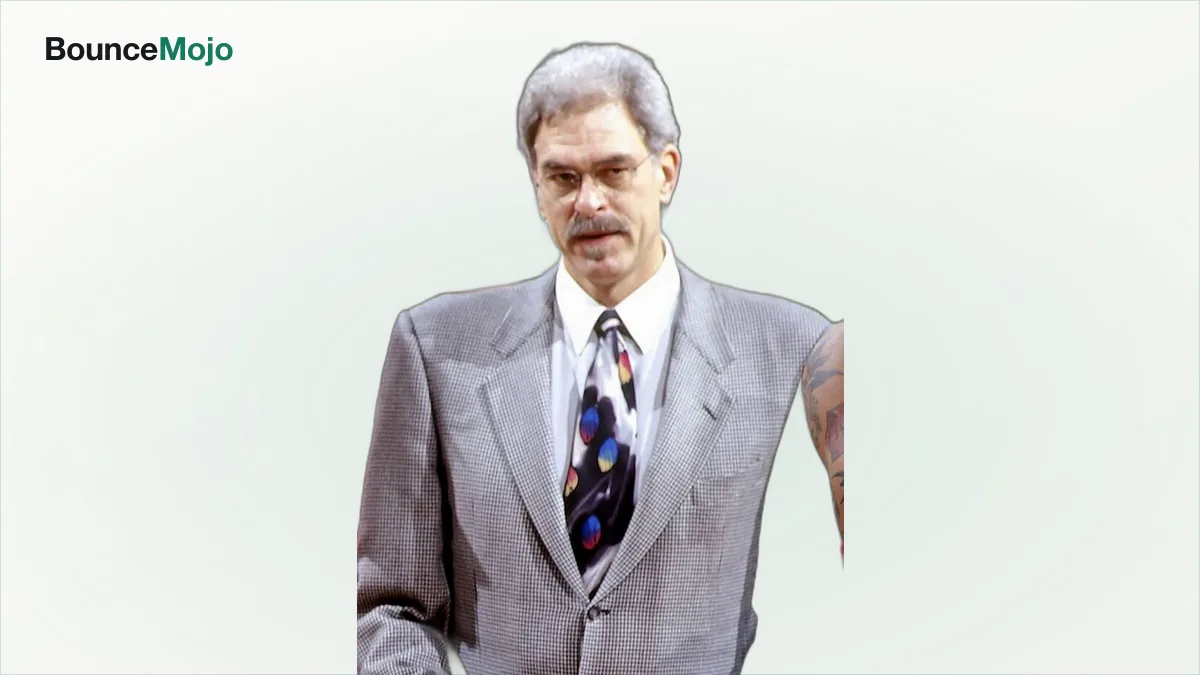
Everybody remembers the 11 rings and the triangle offense. Almost nobody remembers the preacher’s son who grew up without a television, forbidden to dance or watch movies.
Here’s what most people miss: the man who taught superstars to meditate came from one of the most rigid, controlled childhoods imaginable, and spent his whole life searching for the freedom it denied him.
The Myth vs. The Reality
The myth is serene. Phil Jackson, the Zen Master, floating above the chaos of the NBA, burning sage, handing out books, calmly guiding Michael Jordan and Kobe Bryant to 11 titles like a basketball monk. Enlightenment in a tracksuit.
That version is real. It’s also wildly incomplete.
Here’s the truth: the “calm guru” story erases the most important part. Jackson was a preacher’s son raised in strict Pentecostal isolation in Montana, a gangly, awkward player who rode a bicycle to Madison Square Garden and buried himself in Zen books precisely because he was searching for something his childhood never gave him. The serenity was hard-won, not natural. It was the answer to a lifetime of restlessness.
Think about it. We love a story of effortless calm because it lets us off the hook. If Jackson was just born wise, then his success is untouchable and unrepeatable. But that’s not what happened. He was a searcher who pieced together a philosophy from Zen, psychology and Native American thought because he needed it himself, and then discovered it worked on other people too.
Now, that search didn’t appear by accident. It was set in motion by a specific place, a specific faith, and a specific era. Which raises the question: what world produces a mind this spiritual and this competitive at the same time?
The World That Made Phil Jackson
To understand Jackson, you have to understand the Montana he came up in, and the strict faith that shaped him.
He was born on 17 September 1945 in Deer Lodge, Montana, and raised in a household led by two Pentecostal ministers. This was a childhood of rules: no television, no dancing, no movies, a life organized entirely around the church. Sports became one of the few acceptable outlets, and for a tall, athletic boy, basketball became a doorway to a wider world.
But the era mattered too. Jackson came of age in the 1960s, when the counterculture was cracking open American life, and a curious young man from a sheltered background suddenly had access to ideas his upbringing had walled off. He devoured them. By the time he reached New York as a player, he was steeping himself in Eastern philosophy and psychology, worlds away from the pulpit.
Here’s the deal: the tension between his rigid religious roots and his hunger for freedom became the engine of his whole life. He never stopped searching for meaning, and that search, more than any playbook, is what made him a great coach.
But first he had to make it as a player, in a league that didn’t quite know what to make of him. And that is where the story turns.
The Crucible: Early Life and the Climb
The environment that shaped him
Two things defined the young Phil Jackson: faith and rebellion.
The faith came from his parents, ministers who filled his childhood with scripture and structure. The rebellion came from within, a restless intelligence that couldn’t accept a world of such narrow rules. That push and pull left him searching, and the search led him far from home, first to the University of North Dakota and then to New York.
As a player, Jackson was unusual. Standing 6 foot 8 with extraordinarily long arms, he was a rugged, awkward forward rather than a star. But he was cerebral, and he watched the game like a coach even as he played it. In New York, he became a fixture of the counterculture, riding a bicycle to games and reading Zen texts on road trips.
You might be wondering: how does a role player become the greatest coach in NBA history? The answer is that his outsider’s mind, the very thing that made him an unconventional player, made him a revolutionary coach. He saw the game as a system of people and psychology, not just plays.
By the time his playing days ended, the searcher had quietly gathered everything he would need. He just didn’t have a team yet.
The catalyst
The catalyst had two parts: a mentor and a system.
The mentor was Red Holzman, his coach on the champion Knicks teams of 1970 and 1973, who taught Jackson to see basketball as a game of selfless, team-first play. The system was the triangle offense, an intricate, egalitarian scheme devised by assistant coach Tex Winter, who would become Jackson’s lifelong collaborator.
Here’s the kicker: Jackson didn’t just install the triangle. He wrapped it in a whole philosophy. When he took over the Chicago Bulls in 1989, he blended Winter’s offense with meditation, mindfulness and psychology, giving even the greatest players a shared identity larger than themselves. That fusion of tactics and spirit is what unlocked Michael Jordan’s Bulls.
The searcher had finally found his laboratory. But greatness would test his methods against the biggest egos the sport had ever produced.
The Key Players
No career this big is a solo act, and Jackson was surrounded by people who shaped his path.
Start with Michael Jordan, the superstar Jackson coached to six titles in Chicago. Jackson’s genius was convincing the most competitive player alive to trust his teammates and the triangle, channeling Jordan’s fire into a system rather than letting it burn alone.
Then there’s Kobe Bryant, the cornerstone of Jackson’s five Lakers championships. Their relationship was famously complex, brilliant, combustible, and at times openly strained, yet together they built a second dynasty in Los Angeles.
And there’s Tex Winter, the offensive mastermind behind the triangle. Winter was the technical soul of Jackson’s teams, the assistant whose system Jackson elevated into a philosophy. Their partnership spanned both dynasties.
There was also Jeanie Buss, the Lakers executive and later team president who became Jackson’s longtime partner. Their relationship tied Jackson personally to the franchise where he won five of his titles.
Now: surround yourself with the right stars and the right system, and you can build something historic. Jackson was about to do exactly that, twice. But the winning came with a quieter cost.
The Turning Point
The pinnacle
The pinnacle was not one moment but a pattern: the ability to win, again and again, with different teams.
In Chicago, Jackson led the Bulls to two three-peats, 1991 through 1993 and 1996 through 1998, six championships built around Jordan and Scottie Pippen. Then, doubted as a coach who simply had the best player, he moved to Los Angeles and did it all over again, winning five more titles with Shaquille O’Neal and Kobe Bryant.
Eleven championships. No coach in NBA history has more. He proved his method wasn’t luck or the product of one transcendent star, but a repeatable system for turning talent into unity.
Here’s the truth: he became the most successful coach the league had ever seen, and it still left him searching for what came next.
The price
Because the same intensity and control that won the titles wore on the people closest to it.
Managing the egos of Jordan, O’Neal and Bryant was a constant, grinding psychological battle. Jackson’s relationship with Kobe Bryant fractured badly, and in his book “The Last Season” he aired the tensions publicly, straining a bond that took years to repair. His need to control the environment could alienate the very stars who made him great.
There was a personal toll too. Jackson’s all-consuming focus on his teams contributed to the end of his first marriage, and the constant travel and pressure of chasing titles left little room for a settled life. The pursuit of rings extracted its own quiet price.
He’d spent decades mastering the minds of others. Managing the cost to his own relationships was harder.
The Unvarnished Truth
Jackson is not a flawless guru, and pretending otherwise does his story a disservice.
He could be manipulative, using mind games, silence and pointed book recommendations to control his players and rivals. Critics argued the Zen mystique was partly theater, a psychological edge dressed up as enlightenment. His public feud with Kobe Bryant showed a man who could be cutting and cold when crossed.
There’s also the loneliness of his kind of authority. Jackson held himself slightly apart, the professor at the front of the room, and that distance, effective as it was, could isolate him from the players he led.
Here’s what’s easy to miss: his greatest strength and his greatest flaw were the same trait. The detached, philosophical control that let him manage superstars also made him hard to fully know, and quick to wound when relationships broke down. The gift was the curse.
None of that erases the rings. But it does explain why the Zen Master was as divisive as he was revered.
Controversies and Criticisms
Jackson’s career carried real controversy, and it’s worth being honest about it.
His feud with Kobe Bryant was the most public. After leaving the Lakers in 2004, Jackson published a memoir critical of Bryant, only to return and coach him to two more titles, an awkward reconciliation that revealed how combustible their bond really was.
Then there’s the long-running debate about his résumé. Critics have argued that Jackson only ever coached teams stacked with all-time greats, Jordan, Pippen, O’Neal, Bryant, and never had to win with less. His defenders counter that managing that much ego and expectation, and doing it across two franchises and multiple eras, is its own rare skill.
His later years as an executive fueled the criticism. Jackson’s roughly three-year run as president of the New York Knicks, from 2014 to 2017, was widely seen as a failure, suggesting his genius lived on the bench, not in the front office. The Zen Master who could win 11 titles struggled to build a team from the top down.
So what does a life like this actually teach the rest of us? A lot, and not the lessons you’d expect.
What We Can Learn From Phil Jackson
Navigating hard times
Jackson’s real lesson isn’t about winning. It’s about managing people who are more talented, more famous, and more difficult than you.
His entire method was built on getting extraordinary individuals to subordinate their egos to something larger. He did it not by force but by philosophy, giving stars a shared identity and a system that made selflessness feel powerful. When egos clashed, as they always did, his tools were patience, psychology and a long view.
In other words: the basketball was the easy part. Uniting a room full of superstars, that was the real work.
The success blueprint
The blueprint here is about leading through meaning, not just tactics.
Jackson understood that people give their best when they feel part of something bigger than themselves. He wrapped his teams in ritual, mindfulness and a shared philosophy, turning a collection of talents into a unit with a soul. The triangle offense was the tactic. The culture was the real system.
Want the fuller picture of how that translated into wealth? The full net worth breakdown shows how 11 rings became a fortune built on record contracts, a front-office salary and bestselling books. And to see how he ranks among the sport’s biggest earners, the richest coaches list puts it in context.
The deeper takeaway is about identity. Jackson proved that the best leaders don’t just command, they give people a reason to belong. The ones who last are the ones who build a culture that outlives any single star.
Which brings us to the final reckoning on the man.
Final Verdict
Phil Jackson is going to be remembered for the wrong number.
Most people will file him under “11 rings,” the winningest coach in NBA history, the man who happened to have Jordan and Kobe. A smaller, smarter group will remember something harder and more valuable: a Montana preacher’s son who spent his whole life searching for freedom, pieced together a philosophy from Zen and psychology, and used it to unite the most talented and difficult players the game has ever seen.
Here’s the bottom line: the titles made him famous. The philosophy behind them made him matter. He proved that coaching greatness isn’t about drawing up plays, it’s about understanding people, and giving them something to believe in together.
He is the most successful coach in NBA history. He is also living proof that leadership is a spiritual act as much as a strategic one. And in the long run, that deeper story, the human one, is the version worth remembering.
Shop Phil Jackson on Amazon
Books, audiobooks, merch and more, handpicked for fans.
As an Amazon Associate we earn from qualifying purchases.
Frequently Asked Questions
Where did Phil Jackson grow up?+
Jackson was born on 17 September 1945 in Deer Lodge, Montana, and raised in a strict household by Pentecostal minister parents. Sports became his escape from a childhood without television, dancing or movies.
Did Phil Jackson play in the NBA?+
Yes. Jackson was a rugged forward for the New York Knicks, winning NBA championships in 1970 and 1973 before he ever became a coach. He was known for his long arms and cerebral, unconventional style.
Why is Phil Jackson called the Zen Master?+
Jackson earned the nickname for weaving Zen Buddhism, mindfulness and Native American philosophy into his coaching, using meditation and psychology alongside the triangle offense to manage huge egos.
How many NBA titles did Phil Jackson win as a coach?+
Jackson won a record 11 NBA championships as a head coach, six with the Chicago Bulls and five with the Los Angeles Lakers, the most of any coach in league history.
What did Phil Jackson do after coaching?+
After retiring from coaching in 2011, Jackson served as president of the New York Knicks from 2014 to 2017 and continued writing and speaking about leadership and mindfulness.
Want the money side of the story?
Read Phil Jackson's Full Net Worth Breakdown →Shop Phil Jackson on Amazon
Books, audiobooks, merch and more, handpicked for fans.
As an Amazon Associate we earn from qualifying purchases.