Pat Riley Biography: The Making of the NBA's Ultimate Winner
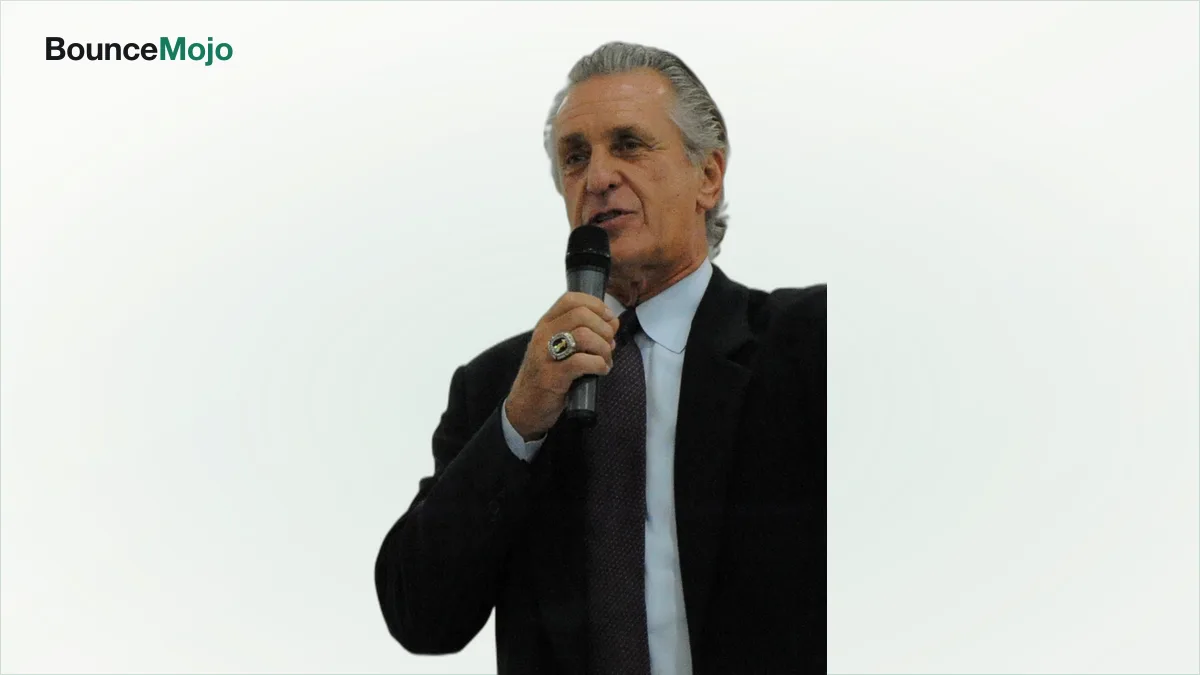
Everybody remembers the Armani suits and the slicked-back hair. Almost nobody remembers the kid from a rough neighborhood in upstate New York whose father taught him that the world owes you nothing.
Here’s what most people miss: the polished “Godfather” of the NBA was built on a hardscrabble childhood and a chip on the shoulder that never fully went away.
The Myth vs. The Reality
The myth is the image. Pat Riley, the impossibly cool coach in the tailored suit, hair perfect, jaw set, a man who seemed born to win championships and look good doing it. Nine rings. The face of Showtime. The Godfather of the Miami Heat.
That version is real. It’s also wildly incomplete.
Here’s the truth: the glamorous image erases where it came from. Riley grew up scrappy and insecure in a tough upstate New York town, the son of a proud, disappointed ex-ballplayer who drilled toughness into him. The man in the designer suit spent his whole life proving he belonged in rooms that didn’t want to let him in. The polish was armor.
Think about it. We love a story of effortless cool because it makes success look like destiny. But Riley’s success was never effortless. It was forged out of grievance, discipline and a refusal to be underestimated, first as a player nobody expected to last, then as a coach nobody thought would win.
Now, that hunger didn’t come from nowhere. It was handed down, from a father who knew exactly what it felt like to fall short. Which raises the question: what world produces a man this driven to win, and this unable to ever feel satisfied?
The World That Made Pat Riley
To understand Riley, you have to understand the working-class world he came up in, and the father who cast a long shadow over it.
He was born on March 20, 1945, in Rome, New York, and raised in Schenectady. His father, Leon “Lee” Riley, had been a minor-league baseball player and manager, a man who spent decades chasing a big-league career that mostly stayed just out of reach. That disappointment shaped the household. Lee was hard on his son, and hard about the world, teaching him that nothing would be given and everything had to be taken.
But the environment mattered too. Riley grew up in a tough part of town where you learned to defend yourself, and where sports were both an escape and a proving ground. He was a gifted two-sport athlete, a standout in basketball and football, and the games gave a restless, competitive kid a place to channel everything.
Here’s the deal: one story from his youth became legend. His father, it’s said, once sent him to a rough playground to fight his own battles, telling him to go take what was his. Whether embellished or not, that ethos, go get what you deserve, no one hands it to you, became the spine of Riley’s entire career.
But the toughness his father instilled would be tested first not in coaching, but in a playing career that nearly broke before it began.
The Crucible: Early Life and the Climb
The environment that shaped him
Two things defined the young Pat Riley: a demanding father and a fierce will to compete.
He carried Lee Riley’s hard lessons into everything. At Linton High School he became a star athlete, good enough to earn a scholarship to the University of Kentucky, one of the most storied programs in college basketball, to play for the legendary coach Adolph Rupp. It was a huge stage for a kid from Schenectady, and Riley seized it.
At Kentucky he became an All-American, the standout on the 1966 team nicknamed “Rupp’s Runts” for their lack of height. He led them all the way to the national championship game, where they fell to Texas Western in a game now remembered as a landmark in the sport’s history. Riley had proven he could compete at the very top, even when the odds and the size charts were against him.
You might be wondering: how does a college star become an NBA afterthought? The answer is that Riley’s pro career was a lesson in humility. Drafted in the first round in 1967, he bounced around the league as a role player, a hard-nosed reserve who scratched out nine seasons through effort rather than talent. He won a championship with the 1972 Lakers, but as a benchwarmer, watching the stars do the winning.
The chip on his shoulder only grew. And it was about to find its true purpose.
The catalyst
The catalyst was almost an accident: a microphone.
When his playing days ended, Riley didn’t walk straight into coaching. He took a job as a broadcaster, providing color commentary for Lakers games. It was a modest role, a former player talking about a team he used to be on. But it kept him close to the game and to an organization that would change his life.
Here’s the kicker: when the Lakers needed a coach early in the 1981-82 season, they turned, improbably, to their broadcaster. Riley was thrust onto the bench with almost no coaching experience, handed a roster stacked with Magic Johnson and Kareem Abdul-Jabbar. Plenty of people assumed the good-looking former announcer was in over his head.
He won a championship in his first full season. The broadcaster nobody took seriously as a coach had just launched a dynasty.
The kid who was told to go take what was his had done exactly that. But the winning would demand a price, and reveal a restlessness that no title could satisfy.
The Key Players
No career this big is a solo act, and Riley was surrounded by people who shaped his path.
Start with Magic Johnson, the transcendent point guard who was the engine of Showtime. Magic’s brilliance gave Riley the vehicle for his vision of fast, beautiful, winning basketball, and their partnership produced four championships and defined an era of the NBA.
Then there’s Lee Riley, his father, whose hard love and unfulfilled ambition were the emotional fuel behind everything. Riley coached with the intensity of a man still trying to answer his father, still proving that the family name belonged at the top.
And there’s Dwyane Wade, decades later, the star who became the face of Riley’s Miami Heat. As an executive, Riley built around Wade and eventually paired him with LeBron James and Chris Bosh, and Wade’s loyalty to the franchise became a symbol of the culture Riley created.
There was also LeBron James, the superstar Riley famously recruited to Miami in 2010, reportedly emptying a bag of championship rings onto a table during the pitch, a piece of theater that captured Riley’s whole approach to selling winning.
Now: surround yourself with the right talent and sell them on a vision, and you can win at every level of the game. Riley was about to prove it across four decades. But the drive that made it possible was also relentless.
The Turning Point
The pinnacle
The pinnacle wasn’t one moment. It was a career that kept finding new peaks.
The first came with the Showtime Lakers, where Riley won four titles in the 1980s, in 1982, 1985, 1987 and 1988, turning fast-break basketball into an art form and himself into the coolest figure in sports. He guaranteed a repeat in 1988 and delivered it, cementing his reputation as a coach who backed up his own bravado.
Then came reinvention. After the Lakers he took the New York Knicks and, later, the Miami Heat, rebuilding rugged, defensive-minded contenders in his own hard-nosed image. And when coaching alone couldn’t get Miami over the top, he moved to the front office, became team president, and engineered the 2006 championship as coach before assembling the superteam that won titles in 2012 and 2013 as an executive.
Add it all up and the totals are staggering: nine championship rings across four different roles, more than 1,200 coaching wins, three Coach of the Year awards and a Hall of Fame induction in 2008.
Here’s the truth: he won at every level the sport offered, and it still never seemed to be enough.
The price
Because the same relentless drive that won everything left little room for rest.
Riley was famously intense, a coach whose demanding style could wear players down over time. His tenures often ended with a sense of exhaustion on both sides, the price of a man who asked for total commitment and gave it himself. In New York and elsewhere, the intensity that won games eventually strained relationships.
There was a personal cost to that consuming ambition too. A life spent chasing the next championship, the next rebuild, the next great team, is a life of never being finished. Riley built an identity so completely around winning that satisfaction was always just out of reach, always one more title away.
He had spent his whole life taking what he believed was his. The winning proved his father’s lessons right. But a hunger that fierce doesn’t switch off, even when the trophy case is full.
The Unvarnished Truth
Riley is not a simple figure, and the smooth image hides real hard edges.
His intensity could tip into ruthlessness. He was known as a demanding, sometimes unforgiving boss, and his teams played a physical, bruising brand of basketball, especially with the Knicks and early Heat, that critics found ugly and cynical. Winning was the point, and style could be sacrificed for it.
There’s also the matter of his exits. Riley left the Knicks under contentious circumstances to join Miami, a move that drew accusations of tampering and left hard feelings in New York. His pursuit of advantage didn’t always play by the gentlemanly rules others expected.
Here’s what’s easy to miss: his greatest strength and his hardest flaw were the same trait. The all-consuming will to win that built nine championships also made him a difficult, demanding figure whose relationships often frayed under the pressure. The drive was the gift and the cost at once.
None of that dims the rings. But it does explain why Riley is respected and feared in equal measure.
Controversies and Criticisms
Riley’s career carried real controversy, and it’s worth being honest about it.
His departure from the Knicks in 1995 to become Heat president and coach sparked a tampering dispute that the league had to referee, and it left a bitter rivalry between the two franchises. Some saw it as the ruthless maneuvering of a man who always put his own ambition first.
His coaching style drew criticism too. The physical, defensive, grind-it-out basketball his Knicks and early Heat teams played was effective but, to many, a joyless departure from the beautiful Showtime game he’d once championed. Critics argued he helped usher in a rougher, lower-scoring era of NBA basketball.
Even his branding drew a wry eyebrow. Trademarking “three-peat” before his Lakers had actually won a third straight title struck some as opportunistic, a coach monetizing a championship his team hadn’t yet clinched. Riley never apologized for it. He saw an angle and took it.
So what does a life like this actually teach the rest of us? More than the highlight reels suggest.
What We Can Learn From Pat Riley
Navigating hard times
Riley’s real lesson isn’t about winning. It’s about reinvention.
When his playing career fizzled, he became a broadcaster. When that led to coaching, he became a champion. When coaching in one city ran its course, he moved to another. And when the bench was no longer the best place to win, he moved to the front office. Riley refused to be defined by a single role, and every time one door closed, he pried open a bigger one.
In other words: the willingness to reinvent, again and again, is what kept him relevant for 40 years.
The success blueprint
The blueprint here is about attaching yourself to winning in every form it takes.
Riley didn’t just want to coach. He wanted to win, and he pursued that goal from whatever seat gave him the best chance, player, assistant, coach, executive. He understood that success is a brand you can build and rebuild, and he made himself synonymous with it.
Want the fuller picture of how that translated into wealth? The full net worth breakdown shows how nine rings and a shrewd trademark became a nine-figure fortune. And to see how he ranks among the sport’s biggest coaching fortunes, the richest coaches list puts it in context.
The deeper takeaway is about hunger, and its limits. Riley’s relentless drive built one of the greatest careers in sports history. But it’s also a cautionary tale about a life where the finish line keeps moving. The lesson is to harness that hunger without letting it consume you.
Which brings us to the final reckoning on the man.
Final Verdict
Pat Riley is going to be remembered for the wrong thing.
Most people will file him under “Showtime,” the suits, the hair, the glamour, the coolest man in basketball. A smaller, smarter group will remember something tougher and more revealing: a scrappy kid from Schenectady, hardened by a demanding father, who clawed his way from benchwarmer to broadcaster to the most versatile winner the NBA has ever produced.
Here’s the bottom line: the image made him famous. The hunger underneath it made him great. Riley won championships in four different jobs because he refused to be defined by any single one, and because he never, ever stopped wanting more.
He is a nine-time champion and one of the most influential figures in basketball history. He is also proof that the polish we admire is often built on a grit we never see. And in the long run, that harder, hungrier story is the version worth remembering.
Shop Pat Riley on Amazon
Books, audiobooks, merch and more, handpicked for fans.
As an Amazon Associate we earn from qualifying purchases.
Frequently Asked Questions
Where did Pat Riley grow up?+
Riley was born in Rome, New York, and raised in Schenectady, the son of Leon 'Lee' Riley, a former minor-league baseball player and manager. He starred in both basketball and football at Linton High School.
Did Pat Riley play in the NBA?+
Yes. Riley was an All-American at the University of Kentucky and played nine NBA seasons as a guard-forward for the Rockets, Lakers and Suns, winning a championship as a reserve on the 1972 Los Angeles Lakers.
What was the Showtime Lakers era?+
As head coach of the Los Angeles Lakers in the 1980s, Riley led a fast-breaking, glamorous style dubbed 'Showtime', winning four NBA championships with Magic Johnson and Kareem Abdul-Jabbar.
Why is Pat Riley called 'the Godfather'?+
The nickname reflects his decades of influence as coach and executive, his polished image and his role building championship teams. As Miami Heat president since 1995, he became one of the most powerful figures in the NBA.
How many NBA championships has Pat Riley won?+
Riley is a nine-time NBA champion across four roles: as a player, an assistant coach, a head coach and an executive, a combination almost unique in American sports.
Want the money side of the story?
Read Pat Riley's Full Net Worth Breakdown →Shop Pat Riley on Amazon
Books, audiobooks, merch and more, handpicked for fans.
As an Amazon Associate we earn from qualifying purchases.