Most Expensive Dinosaur Fossils Ever Sold at Auction
BounceMojo is reader-supported. When you buy through links on our site, we may earn an affiliate commission. As an Amazon Associate we earn from qualifying purchases.Affiliate disclosure.
On This Page
- Fifteen sales, ranked by what the buyer paid
- How much of the Gus record is a fee schedule?
- Estimates that meant almost nothing
- Where the bones went
- The £12.4 million that ended in a forfeiture
- Rights are part of the price
- Kept out of the table
- Why I rate Apex above Gus
- Top Takeaways to Success
- Frequently Asked Questions
Gus cost its buyer $50.1 million. The bid that won it was $43 million.
That gap, $7.1 million of buyer’s premium, is where the story of the dinosaur market actually sits. Gus, a Tyrannosaurus rex from Harding County, South Dakota, sold at Sotheby’s New York on 14 July 2026 and took the fossil auction record from Apex, the Stegosaurus that made $44.6 million at the same house two years earlier.
The coverage compared those two numbers and called it a $5.5 million jump. It was not. Apex sold under a cheaper fee schedule that Sotheby’s dropped within months, and once you put the two sales on the same footing, Gus’s lead shrinks by about two million dollars.
Below are the verified results, then the arithmetic.
Fifteen sales, ranked by what the buyer paid
Prices include buyer’s premium. “Hammer” is the winning bid before fees, shown only where the auction house or a trade report published it. Sales in pounds, euros and Swiss francs keep their original currency, with the dollar figure reported at the time of sale or converted at the rate on the sale date.
| # | Specimen | Price paid | Hammer | Estimate | Sale |
|---|---|---|---|---|---|
| 1 | Gus, Tyrannosaurus rex | $50,100,000 | $43,000,000 | $20m to $30m | Sotheby’s New York, 14 Jul 2026, lot 20 |
| 2 | Apex, Stegosaurus | $44,600,000 | not published (about $40m implied) | $4m to $6m | Sotheby’s New York, 17 Jul 2024 |
| 3 | Stan, Tyrannosaurus rex | $31,847,500 | $27,500,000 | $6m to $8m | Christie’s New York, 6 Oct 2020 |
| 4 | Juvenile Ceratosaurus | $30,510,000 | $26,000,000 | $4m to $6m | Sotheby’s New York, 16 Jul 2025, lot 11 |
| 5 | Hector, Deinonychus | $12,412,500 | not published | $4m to $6m | Christie’s New York, 12 May 2022 |
| 6 | Adult and juvenile Allosaurus | £8,130,000 (about $10.4m) | not published | £5m to £8m | Christie’s London, 12 Dec 2024, lot 2 |
| 7 | Sue, Tyrannosaurus rex | $8,362,500 | $7,600,000 (reported) | n/a | Sotheby’s New York, 4 Oct 1997 |
| 8 | Big John, Triceratops | €6,651,100 (about $7.7m) | €5,500,000 | €1.2m to €1.5m | Binoche et Giquello, Drouot, Paris, 21 Oct 2021 |
| 9 | Vulcan, Apatosaurus | about €6,000,000 ($6.4m) | €4,700,000 | €3m to €5m | Collin du Bocage and Barbarossa, Paris, 16 Nov 2024 |
| 10 | Trinity, Tyrannosaurus rex (composite) | about CHF 5,500,000 ($6.2m) | CHF 4,800,000 | n/a | Koller, Zurich, 18 Apr 2023 |
| 11 | Gorgosaurus | about $6,100,000 | not published | $5m to $8m | Sotheby’s New York, 28 Jul 2022, lot 201 |
| 12 | Maximus, T. rex skull only | about $6,100,000 | not published | $15m to $20m | Sotheby’s New York, 9 Dec 2022 |
| 13 | Trey, Triceratops | $5,500,000 | not published | n/a | Joopiter (online), closed 31 Mar 2026 |
| 14 | Stegosaurus | £4,275,000 (about $5.4m) | not published | £3m to £5m | Christie’s London, 12 Dec 2024, lot 1 |
| 15 | Spike, oviraptorosaur | £3,466,000 (about $4.6m) | not published | £3m to £5m | Christie’s London, 11 Dec 2025, lot 7 |
The Christie’s figures for Hector, the Allosaurus pair, the London Stegosaurus and Spike are taken from Christie’s own lot records. Sotheby’s hides prices behind a login, so its results rest on its published estimates plus trade and wire reports.
How much of the Gus record is a fee schedule?
On 1 February 2024 Sotheby’s announced a simpler buyer’s premium: 20 percent of the hammer up to $6 million, 10 percent above it, applying to buyers from 20 May 2024. Apex sold on 17 July 2024, inside that window.
Run the schedule backwards and $44.6 million resolves to a hammer of exactly $40 million: $1.2 million on the first $6 million, $3.4 million on the next $34 million. Sotheby’s did not announce a hammer for Apex. The figure falls straight out of the published rules.
Sotheby’s abandoned the experiment. From 17 February 2025 the premium went back to tiers: 27 percent to $1 million, 22 percent from $1 million to $8 million, 15 percent above. The juvenile Ceratosaurus proves the 2025 schedule exactly: a $26 million hammer plus those three tiers comes to $30,510,000, which is the reported price. Gus’s $43 million hammer, on the same tiers, lands at about $50.06 million, which rounds to the $50.1 million Sotheby’s announced.
Now compare like with like.
- Both on the 2024 rules: Gus about $47.9m, Apex $44.6m. Gap about $3.3m.
- Both on the 2025 rules: Gus about $50.1m, Apex about $46.6m. Gap about $3.5m.
- At hammer: $43m against an implied $40m. Gap $3m.
The headline gap was $5.5 million. The real one is about $3 million to $3.5 million, roughly 7.5 percent. Gus is still the record. It is a narrower record than anybody reported, and about $2 million of the difference was Sotheby’s changing its invoice.
Stan has the opposite problem. The Antiques Trade Gazette gave its hammer as $27.5 million; Christie’s announced $31,847,500 with fees. When The Art Newspaper reported Apex in 2024, it described Apex as beating Stan’s $27.5 million sale, setting a fee-inclusive number against a hammer number in the same sentence. That is how the gap between second and third gets inflated by four million dollars without anyone noticing.
Estimates that meant almost nothing
Auction estimates in this market are a starting signal, and for three years they were wildly low.
| Specimen | Top estimate | Price paid | Multiple of top estimate |
|---|---|---|---|
| Apex | $6m | $44.6m | 7.4x |
| Ceratosaurus | $6m | $30.51m | 5.1x |
| Big John | €1.5m | €6.65m | 4.4x |
| Stan | $8m | $31.85m | 4.0x |
| Hector | $6m | $12.41m | 2.1x |
| Gus | $30m | $50.1m | 1.7x |
| Maximus | $20m | about $6.1m | 0.3x |
The pattern runs against what the record suggests. Gus, the most expensive dinosaur ever sold, beat its own top estimate by a smaller multiple than any other lot in that table, apart from the one that failed. Sotheby’s had learned from Apex and priced the next big theropod at $20 million to $30 million. The room went to $43 million and stopped.
Maximus is the counterweight. A T. rex skull, 30 of its 39 bones original, it was estimated at $15 million to $20 million in December 2022 and made about $6.1 million. A month earlier Christie’s had pulled Shen, a T. rex due to sell in Hong Kong, after Peter Larson of the Black Hills Institute said its replica bones were largely casts of Stan. Christie’s had stated that about 80 of Shen’s bones were original. The consignor lent it to a museum instead.
Original bone, it turns out, is what buyers pay the multiples for.
Where the bones went
A dinosaur skeleton is an unusual luxury asset because so many of the record buyers have put them back on public display.
Sue went to the Field Museum in Chicago in 1997, with McDonald’s and Walt Disney World Resort among the backers. The fossil’s route there began with a $5,000 payment from the Black Hills Institute to Maurice Williams, on whose land it was found, for the right to excavate. The land was held in trust by the federal government, the FBI seized the skeleton, and the auction followed years of litigation.
If that story is new to you, Larson wrote his own version of it.
Stan went to Abu Dhabi’s Department of Culture and Tourism, for the Natural History Museum Abu Dhabi. The buyer was only revealed in March 2022, seventeen months after the sale.
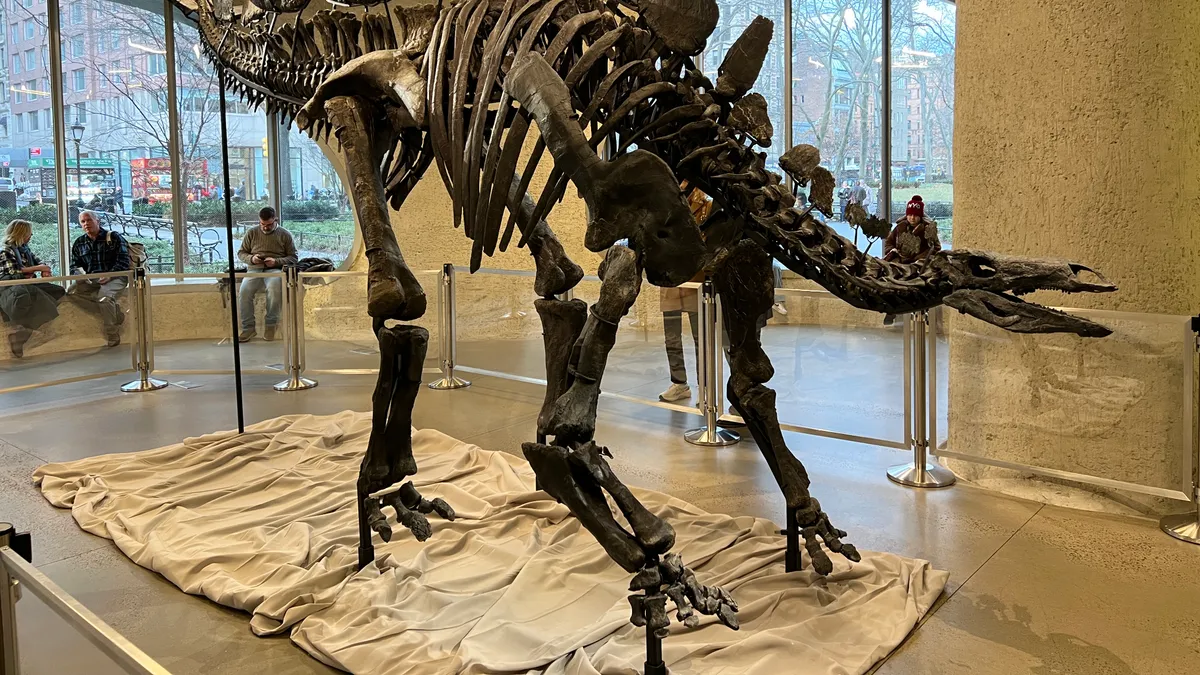
Apex went to Ken Griffin, the founder of Citadel, who lent it to the American Museum of Natural History, where it went on display in December 2024. It was found in May 2022 by commercial palaeontologist Jason Cooper on his own land in Moffat County, Colorado.
Vulcan’s anonymous buyer committed to lending it to an institution.
The flow also runs the other way. The juvenile Ceratosaurus had been on exhibit at the Museum of Ancient Life at Thanksgiving Point, Utah, until it was deaccessioned in 2024. Trey spent nearly three decades at the Wyoming Dinosaur Center before Joopiter, the platform founded by Pharrell Williams, sold it online. Museums are now sellers as well as buyers.
Gus’s proceeds were split between Sotheby’s, Theropoda Expeditions, which dug it out between 2021 and 2023, and the owners of the land. The skeleton is named after Gary “Gus” Licking, the late cattle rancher whose land it came from.
The £12.4 million that ended in a forfeiture
Lots 1 and 2 at Christie’s London on 12 December 2024 were a Stegosaurus and an adult and juvenile Allosaurus pair, sold for £4,275,000 and £8,130,000. Together, £12,405,000.
They were bought by Binghai Su, a Chinese national living in the UK. In April 2025 the High Court granted the National Crime Agency an Unexplained Wealth Order and a freezing order over his UK assets, which the NCA linked to Singapore’s largest money laundering investigation. On 5 November 2025 the NCA settled with Su and his company, Su Empire Limited. Three dinosaur skeletons acquired “for a total around £12.4 million in December 2024”, nine London flats and eleven Chinese artworks were recovered as assets deemed to represent the proceeds of crime. Reported terms: the NCA sells the property and keeps 75 percent, and Su receives 25 percent.
The settlement was a civil recovery, not a criminal conviction. It does mean that two of the fifteen most expensive dinosaurs ever sold at auction are, as far as the public record shows, due to be sold again by a law enforcement agency.
Rights are part of the price
Stan was sold without full reproduction rights. The Black Hills Institute kept its scans and its moulds, and Phil Manning of the University of Manchester has remarked that most museum T. rex casts you have seen are probably Stan. That is precisely why Shen collapsed: the casts filling its gaps were Stan’s, and the institute objected.
Gus was offered, in Sotheby’s words, “with full rights”, with documentation certifying condition, authenticity and legality of ownership.
Those are not footnotes. A buyer who can make and sell casts owns a product line, and a buyer who cannot owns a sculpture. It is reasonable to suspect some of the difference between Stan’s $31.8 million and Gus’s $50.1 million is that clause, though no one can measure it.
Kept out of the table
Cera, a juvenile Triceratops sold by Phillips in New York in November 2025, is reported at $5.3 million by one outlet and $5.4 million by another, with the sale date given as both 18 and 19 November. Until Phillips’ own result settles it, it stays out of the table. On either figure it would sit at about 15th.
Big Sara, an Allosaurus sold at Drouot in October 2020, is widely reported at three million euros, and the more precise figure in circulation could not be traced to the auction house. Omitted.
Sales by private treaty do not appear. There are reportedly several, and none has a verifiable price.
Estimates presented as prices. Several lists rank Maximus at $15 million or more, which was its estimate, not its result.
Why I rate Apex above Gus
Gus holds the record and I am not disputing it. A $43 million hammer is a $43 million hammer.
But Apex is the more remarkable sale, and I’d argue it is the one that actually changed this market. Seven bidders, fifteen minutes, an estimate of $4 million to $6 million, and a finish more than seven times the top of it. Nobody in that room had a reference price. Sotheby’s itself did not think a Stegosaurus was worth more than a good Gorgosaurus.
Gus had a reference price. It had Apex. It had Stan. Sotheby’s estimated it at five times what it had dared to put on Apex, and the bidding cleared that estimate by a margin that, in this market, looks almost ordinary. Seven bidders again, ten minutes this time. The result was strong. It was not a shock.
My read is that the July 2024 sale reset what a mounted skeleton is worth, and every big result since, the Ceratosaurus at $30.5 million, Gus at $50.1 million, has been the market catching up with Apex rather than surpassing it. The honest gap between the top two is about $3 million on a like-for-like basis. For a specimen that was the bigger animal, from the more famous species, with full rights attached, that is a smaller premium than the headlines suggest.
The other thing the numbers say quietly: the top four sales here, about $157 million in total, all happened in New York between 2020 and 2026, at two houses. Outside New York, nothing in the table passes about $10.4 million.
If you follow record prices across categories, the hammer-versus-premium problem turns up on almost every one of them, and the guitar results show it as clearly as anything here. The rest of the section lives under the most expensive things ever sold.
🏆 Top Takeaways to Success
- 1
Gus the T. rex holds the auction record at $50.1m including fees, Sotheby's New York, 14 July 2026. It hammered at $43m.
- 2
Sotheby's charged a lighter premium in July 2024, when Apex sold. On a like-for-like fee basis Gus beat Apex by roughly $3.3m to $3.5m, not the $5.5m the headlines compared.
- 3
Apex and the juvenile Ceratosaurus both came in at five to seven times their top estimates. Gus, the record, beat its own top estimate by less than either.
- 4
Two dinosaurs bought at Christie's London in December 2024 for a combined £12,405,000 were among the assets the UK National Crime Agency recovered under an Unexplained Wealth Order settlement.
Frequently Asked Questions
What is the most expensive dinosaur fossil ever sold?+
Gus, a Tyrannosaurus rex skeleton, is the most expensive dinosaur fossil ever sold at auction, at $50.1 million including buyer's premium, Sotheby's New York, 14 July 2026. It hammered at $43 million against an estimate of $20 million to $30 million and went to an anonymous phone bidder after about ten minutes of bidding.
How much did Apex the Stegosaurus sell for?+
Apex sold for $44.6 million including fees at Sotheby's New York on 17 July 2024, against an estimate of $4 million to $6 million. The buyer was Ken Griffin, the founder of Citadel, who lent it to the American Museum of Natural History. Sotheby's fee schedule at the time implies a hammer price of about $40 million.
How much did Sue the T. rex sell for?+
Sue sold for $8,362,500 including fees at Sotheby's on 4 October 1997, to the Field Museum in Chicago. The purchase was backed by McDonald's and Walt Disney World Resort. The winning bid is reported at $7.6 million, and the sale held the fossil auction record for 23 years, until Stan in 2020.
Who bought Stan the T. rex?+
Stan was bought by Abu Dhabi's Department of Culture and Tourism, which was revealed as the buyer in March 2022. It paid $31,847,500 at Christie's New York on 6 October 2020, for the Natural History Museum Abu Dhabi. The Black Hills Institute, which excavated it, kept the ability to make casts.
Why do dinosaur prices differ between sources?+
Dinosaur prices differ mainly because some reports quote the hammer price and others the price including the buyer's premium. Stan, for example, has been described as a $27.5 million sale and a $31.8 million sale, and both describe the same lot. European sales add a currency conversion on top.
Sources
- Gus, a mounted Tyrannosaurus rex skeleton, lot 20 (Sotheby's, July 2026)
- Gus the T. rex sells for a record $50.1m at Sotheby's (The Art Newspaper)
- Near-complete Stegosaurus fossil sells for record $44 million (NBC News)
- Sotheby's overhauls fees, 2024 buyer's premium schedule (Art History News)
- Deinonychus antirrhopus, price realised (Christie's New York, May 2022)
- Adult and juvenile Allosaurus, price realised (Christie's London, December 2024)
- Stegosaurus, price realised (Christie's London, December 2024)
- Dinosaur bones forfeited to settle Unexplained Wealth Order case (ArtDependence)
- Stan, the world's most expensive fossil, finds a home (National Geographic)