Jon Gruden Biography: The Raw Truth Behind Football's Fieriest Coach
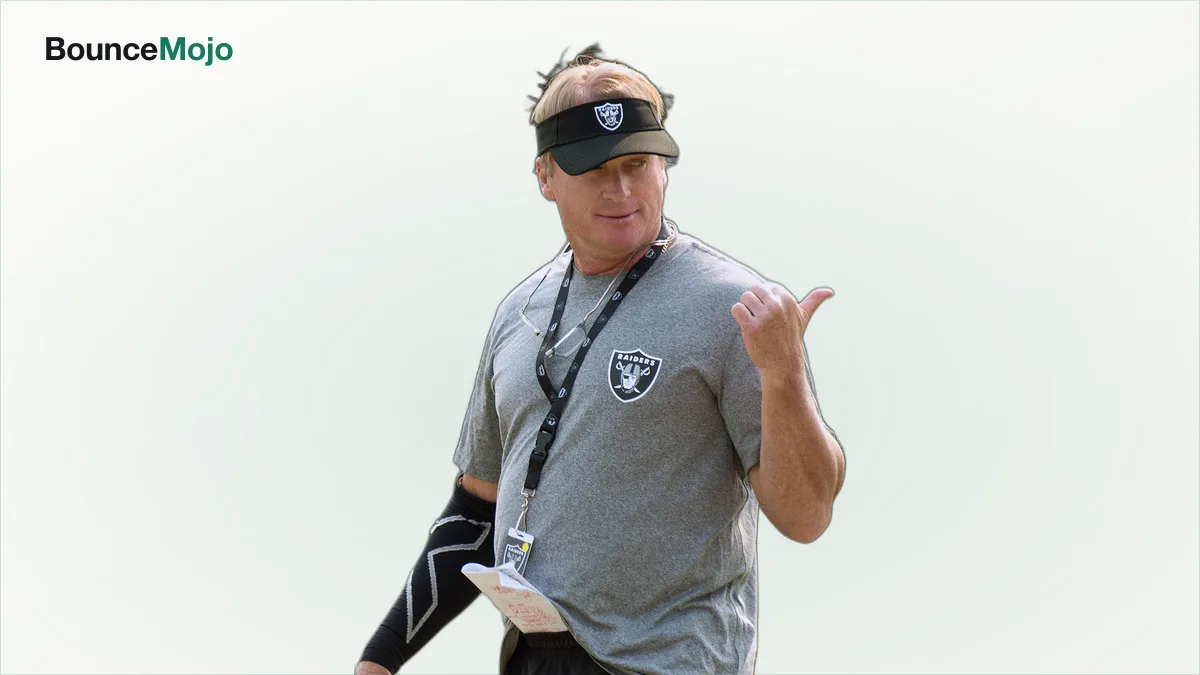
Everybody remembers the scowl, the “Chucky” face, the coach who looked like he might combust on the sideline. Almost nobody remembers that he never played a down in the NFL.
Here’s what most people miss: the thing that made Jon Gruden a legend, his all-consuming, film-room obsession, is the exact same thing that eventually cost him everything.
The Myth vs. The Reality
The myth is a caricature. Jon Gruden, the human blowtorch, jaw clenched, veins bulging, a coach so intense that television made a running joke of his face. A grinder who supposedly slept at the office and lived on game film.
That version is real. It’s also wildly incomplete.
Here’s the truth: the “football robot” story erases the person. Gruden was a coach’s kid who bounced between cities, a backup quarterback who never sniffed the pros, and a young assistant who spent years in near-anonymous jobs before anyone knew his name. The intensity people mock wasn’t a gimmick. It was the fuel a man with no playing pedigree used to outwork everyone in the building.
Think about it. We love the caricature because it’s simple. If Gruden was just born screaming, then his rise looks inevitable. But it wasn’t. He clawed up from the bottom of the profession, and the same relentless drive that got him there is what made his eventual crash so total.
Now, that drive didn’t come from nowhere. It was handed to him by a specific family and a specific sport. Which raises the question: what kind of household produces a kid this obsessed with a game he’d never star in?
The World That Made Jon Gruden
To understand Gruden, you have to understand that he was raised inside football, not beside it.
He was born on August 17, 1963, in Sandusky, Ohio, the son of Jim Gruden, a career football coach and scout. The family moved as coaching families do, and for a stretch landed in Tampa, Florida, where his father worked in the Buccaneers organization. Dinner-table conversation was coverages and depth charts. The sport wasn’t a hobby. It was the family business.
The era mattered too. Gruden came up as the NFL was becoming a film-and-scheme arms race, when a sharp young mind who could break down an offense had a path to the top even without a pro-playing résumé. Coaching was professionalizing into a year-round, all-consuming craft, and that suited a workaholic perfectly.
Here’s the deal: Gruden had a younger brother, Jay, who would also become an NFL head coach. Football was the shared language of the whole household, the thing the Gruden boys measured themselves against.
But wanting it and being good enough to play it are two different things. And that gap is where Gruden’s real story starts.
The Crucible: Early Life and the Climb
The environment that shaped him
Two things defined the young Jon Gruden: a love of the game and a body that couldn’t keep up with it.
He played quarterback at the University of Dayton, a small-college program, and it became clear he was never going to play professionally. For a kid raised to worship football, that’s a quiet heartbreak: you love the thing more than anything, and the thing tells you you’re not good enough.
So he did what coaches’ sons do. He went into coaching, at the very bottom. Low-paid assistant jobs. Long nights. Grunt work breaking down film for coordinators who barely knew his name. There was nothing glamorous about it, and no guarantee it would lead anywhere.
You might be wondering: how does an anonymous assistant become one of the most famous coaches alive? The answer is obsession. Gruden didn’t have the playing pedigree, so he built a reputation on knowing the offense cold, out-preparing everyone, and coaching quarterbacks with a fervor that got him noticed. He wasn’t fighting his lack of a résumé. He was outworking it.
By his early thirties, he’d climbed through assistant jobs with the 49ers, the Packers under Mike Holmgren, and the Eagles as offensive coordinator. The kid who couldn’t make the NFL was about to run an NFL team.
The catalyst
The catalyst was a phone call from the Oakland Raiders in 1998.
At just 34, Gruden was named head coach of the Raiders, one of the youngest in the league. He inherited a struggling franchise and dragged it back toward relevance, building a sharp offense around veteran quarterback Rich Gannon and installing the ferocious work culture that would define him.
Here’s the kicker: he did the job so well that it created a problem. Gruden and Raiders owner Al Davis had a famously prickly relationship, and in 2002, in a stunning move, Davis traded his rising-star coach to the Tampa Bay Buccaneers for a haul of draft picks and cash.
Gruden went back to the city where his father had once worked. And within a single season, he’d make Davis regret the trade in the most public way imaginable.
The Key Players
No career this big is a solo act, and Gruden was shaped by a handful of people who bent his path.
Start with Jim Gruden, his father. The elder Gruden’s coaching-and-scouting life gave Jon the blueprint and the obsession. Football wasn’t something Jon discovered. It was inherited.
Then there’s Al Davis, the Raiders’ legendary, combustible owner. Davis gave Gruden his first head job and then traded him away, a decision that would haunt Oakland when Gruden’s new team beat his old one for a title. Their relationship was equal parts opportunity and friction.
There’s Rich Gannon, the quarterback who became the on-field embodiment of Gruden’s system in Oakland, a journeyman who turned into an MVP under Gruden’s relentless coaching.
And there’s Jay Gruden, his younger brother and fellow NFL head coach, a reminder that the family produced not one but two men who reached the pinnacle of the profession.
Now: inherit the obsession, survive the owner, coach the right quarterback, and you can reach the mountaintop. Gruden was about to. But the peak came with a bill he wouldn’t be handed until years later.
The Turning Point
The pinnacle
The pinnacle came in San Diego, in January 2003.
In his very first season with Tampa Bay, Gruden took a talented, defense-first Buccaneers roster and pushed it over the top. And the opponent in Super Bowl XXXVII was almost too perfect: the Oakland Raiders, the team that had just traded him away. Gruden knew their playbook cold, and it showed.
Tampa Bay routed Oakland 48-21. At 39, Gruden became the youngest head coach ever to win a Super Bowl at the time, beating the franchise that hadn’t wanted him. It was as complete a vindication as sports offers.
Here’s the truth: it was the high point of his coaching life, and nothing that followed on the sideline ever quite matched it. The Buccaneers slid back toward the middle, and after the 2008 season, Tampa Bay fired the man who had given them their only title of the era.
The price
Because the same intensity that won the title also had a shorter shelf life than anyone expected.
Fired by Tampa Bay, Gruden reinvented himself brilliantly in the Monday Night Football booth, where his energy made him a star all over again. Then, in 2018, the Raiders, the team that once traded him, lured him back with a 10-year, $100 million contract, the richest in NFL coaching history. It looked like a storybook return.
It ended in a single week. In October 2021, emails Gruden had sent years earlier, between 2011 and 2018, surfaced publicly. They contained racist, homophobic and misogynistic language. Within days, he resigned, walking away from the remainder of that record contract.
He’d spent a lifetime building a name. Words he’d typed in private unraveled it almost overnight. That was the price, and it was steep.
The Unvarnished Truth
Gruden is not a tidy redemption story, and pretending otherwise does the facts a disservice.
The emails were his. Whatever the context of how they became public, the language in them was real, and it cost him his job and a chunk of his reputation. His defenders point to the timing and the source of the leak. His critics point to the words themselves. Both can be true at once.
There’s also the harder question of the machine he’d become. The same obsessive, all-consuming approach that made Gruden a great coach also made him a man who lived almost entirely inside football, and that narrow world is part of what he’s spent the years since his resignation fighting to redefine.
Here’s what’s easy to miss: his greatest strength and his greatest liability were the same trait. The intensity that out-prepared everyone also produced a coach who typed things he’d never be able to take back. The fire built him, and the fire burned him.
None of that erases the Super Bowl. But it does explain why his story now runs through a courtroom instead of a sideline.
Controversies and Criticisms
Gruden’s career carried real controversy, and it’s worth being honest about it.
The central one is unavoidable: the 2021 email scandal that ended his coaching career. The messages, sent while he was an ESPN analyst, included slurs and demeaning language aimed at various people in and around the league. When they became public, his position with the Raiders was untenable within days.
The fallout became a legal fight. Gruden sued the NFL, alleging the league selectively leaked the emails, which had turned up in an unrelated workplace investigation, to force him out and destroy his career. The case has moved slowly through the Nevada courts, and in 2025 the Nevada Supreme Court sided with Gruden by rejecting the league’s attempt to push the dispute into private arbitration, keeping alive his bid for an open trial.
There’s also the older debate about his coaching itself. Some argue that after the 2003 title, Gruden’s teams underachieved relative to his reputation, and that his fame outran his later results. His supporters counter that few coaches ever reach a Super Bowl at all, let alone win one in their first year with a team.
So what does a career like this teach the rest of us? A lot, and not the easy lessons.
What We Can Learn From Jon Gruden
Navigating hard times
Gruden’s real lesson isn’t about winning. It’s about what to do when the thing you built is taken away.
For most of his life, Gruden was football, and football was Gruden. When that ended in disgrace, he had to figure out who he was without a team, without a booth, without a title to chase. His answer, so far, has been to fight, in court and in public, to reclaim the narrative and whatever earnings he says the scandal cost him.
In other words: the winning was the easy part. Holding your identity together when your career detonates is the hard, unglamorous work.
The success blueprint
The blueprint here is about outworking a disadvantage.
Gruden had no NFL-playing pedigree, the usual ticket to a coaching career. Instead of accepting that ceiling, he made preparation his edge, learning the game so deeply that teams hired him anyway, and eventually paid him more than almost any coach in history.
Want the fuller picture of how that translated into wealth? The full net worth breakdown shows how a Super Bowl ring and a record contract became an eight-figure fortune. And to see how he ranks among the game’s biggest earners, the richest coaches list puts it in context.
The deeper takeaway is about the double edge of obsession. The intensity that lets you outwork everyone can also isolate you and, in Gruden’s case, leave a paper trail you can’t outrun. The people who last learn to build more than a career.
Which brings us to the final reckoning on the man.
Final Verdict
Jon Gruden is going to be remembered for two very different things, and both are true.
Most people will file him under the caricature, “Chucky,” the screaming coach, the Super Bowl winner, the voice of Monday nights. A smaller, more honest group will remember the whole arc: a coach’s son with no playing career who outworked his way to the top, won a title against the team that discarded him, reinvented himself twice over, and then lost it all to words he’d written in private.
Here’s the bottom line: the ring made him famous. The fall made him complicated. And the fight he’s waging now, to prove the league targeted him, is the part of his story still being written.
He is one of the most recognizable coaches of his generation. He is also proof that the same fire that builds a career can be the thing that ends it. For the full accounting of what that career was worth, see the net worth breakdown.
Shop Jon Gruden on Amazon
Books, audiobooks, merch and more, handpicked for fans.
As an Amazon Associate we earn from qualifying purchases.
Frequently Asked Questions
Where did Jon Gruden grow up?+
Gruden was born in Sandusky, Ohio, on August 17, 1963, and grew up in a football family that moved around before settling for a time in Tampa, Florida, where his father worked for the Buccaneers.
Did Jon Gruden play football professionally?+
No. Gruden played quarterback at the University of Dayton but was never an NFL player. He built his entire career on the coaching side, starting as a low-level assistant in his twenties.
What is Jon Gruden best known for?+
Gruden is best known for leading the Tampa Bay Buccaneers to a Super Bowl win in the 2002 season, and for his fiery sideline persona that earned him the nickname 'Chucky.' He also spent nine years as ESPN's Monday Night Football analyst.
Why did Jon Gruden resign from the Raiders?+
Gruden resigned in October 2021 after emails he had sent between 2011 and 2018, containing racist, homophobic and misogynistic language, were made public. He walked away from the remainder of a 10-year, $100 million contract.
Is Jon Gruden related to Jay Gruden?+
Yes. Jay Gruden is Jon's younger brother and a former NFL head coach who led the Washington franchise. Their father, Jim Gruden, was a longtime football coach and scout.
Want the money side of the story?
Read Jon Gruden's Full Net Worth Breakdown →Shop Jon Gruden on Amazon
Books, audiobooks, merch and more, handpicked for fans.
As an Amazon Associate we earn from qualifying purchases.