Carlo Ancelotti Biography: The Quiet Genius of Football Coaching
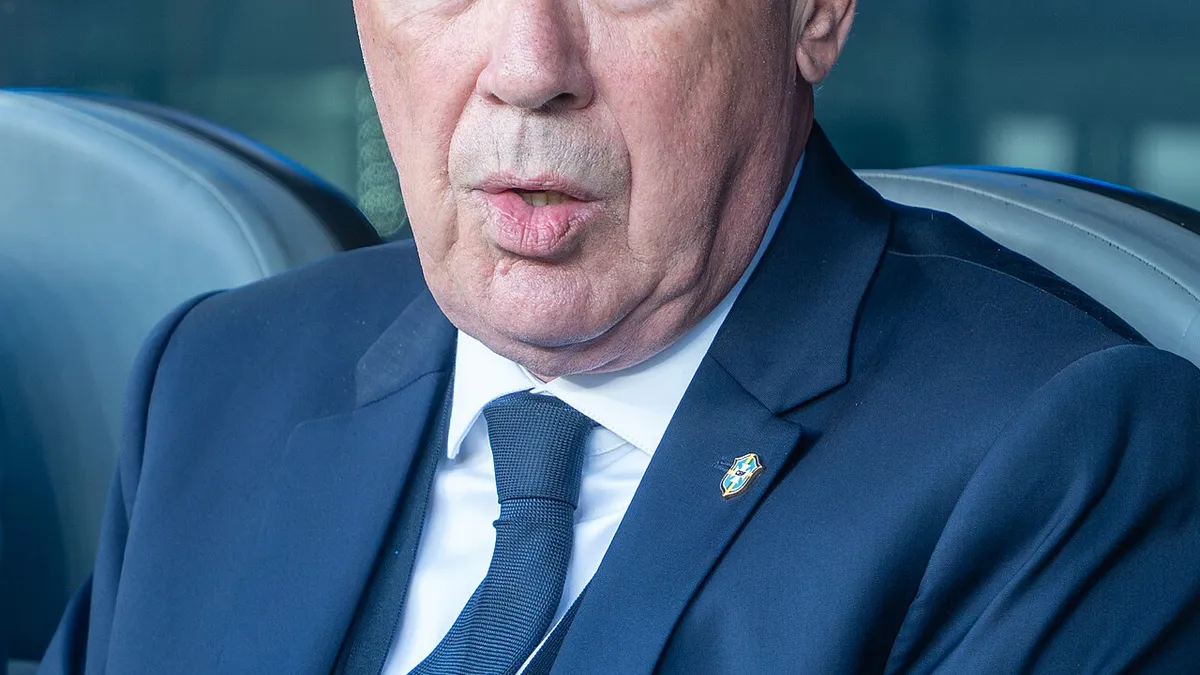
Everybody remembers the raised eyebrow, the cigar, the five Champions League trophies. Almost nobody remembers the farm boy who was told his knees would never let him play.
Here’s what most people miss: the calm that makes Carlo Ancelotti the most trusted manager on earth was forged by a life of setbacks, not a life of ease.
The Myth vs. The Reality
The myth is a smooth one. Carlo Ancelotti, the unflappable master, gliding from one superclub to the next, collecting Champions League trophies like a man picking apples. Five European Cups as a coach. Titles in five countries. A career that looks, from the outside, almost effortless.
That version is real. It’s also wildly incomplete.
Here’s the truth: the “born winner” story erases the struggle underneath. Ancelotti was a farmer’s son who fought through career-threatening knee injuries as a player, was sacked and doubted more than once as a young coach, and lost jobs even after winning trophies. The calm exterior was built on a lot of very hard, very human setbacks.
Think about it. We love a story of effortless mastery because it lets us believe some people are simply built for greatness. But Ancelotti wasn’t handed his temperament. He learned it, slowly, from a childhood of patient labor and a playing career that taught him how quickly it can all be taken away.
Now, that temperament didn’t appear from nowhere. It was shaped by a specific place and a specific kind of upbringing. Which raises the question: what world produces a man this calm in the most chaotic job in sport?
The World That Made Carlo Ancelotti
To understand Ancelotti, you have to understand the quiet, hard-working corner of Italy he came from.
He was born on June 10, 1959, in Reggiolo, a small town in the Emilia-Romagna region famous for its food. His family made Parmigiano-Reggiano cheese, and young Carlo grew up around the unglamorous rhythms of farm work: early mornings, patience, and the understanding that good things take time to mature. It was a childhood far removed from the marble corridors of the Bernabéu.
But the era mattered too. Ancelotti came of age as Italian football was becoming the strongest league in the world. Serie A in the 1980s was where the best players and biggest ideas gathered, and a talented, intelligent midfielder could learn the game at its highest level. The tactical education he absorbed as a player would become the foundation of everything he built as a coach.
Here’s the deal: Ancelotti was never the flashiest talent. He was the smart one, the reader of the game, the player coaches trusted to organize everything around him. That instinct, to control the whole picture rather than chase the ball, is the through-line of his entire life.
But before he could command dressing rooms, his own body nearly ended the dream. And that struggle is where the real story starts.
The Crucible: Early Life and the Climb
The environment that shaped him
Two things defined the young Ancelotti: patience and pain.
The patience came from the farm, from a childhood built around slow, unglamorous work. The pain came from his knees. As a midfielder for Roma and then AC Milan, Ancelotti was gifted enough to win a Serie A title and two European Cups, but he battled serious knee injuries that repeatedly threatened to end his career. He learned, young, that talent is fragile and can vanish overnight.
That lesson made him humble in a way that would later define his coaching. He never assumed success was permanent, because his own body had taught him otherwise.
You might be wondering: how does an often-injured midfielder become the greatest club manager of his generation? The answer is that Ancelotti was always more of a thinker than an athlete. While his knees limited his body, his mind was absorbing everything, how great teams were built, how star egos were managed, how a dressing room actually works. He wasn’t just playing. He was studying.
By the end of his playing days, he had two European Cups and 26 Italy caps, and a coach’s brain already fully formed.
The catalyst
The catalyst had a name: Arrigo Sacchi.
At AC Milan and later with the Italy national team, Ancelotti played and worked under Sacchi, the revolutionary coach who reinvented how the game was organized. Sacchi’s obsessive, systematic approach was the opposite of Ancelotti’s calm instinct, and that tension taught him something vital: he took Sacchi’s tactical rigor and married it to his own gift for man-management.
Here’s the kicker: Ancelotti figured out early that the best coach isn’t the loudest tactician. He is the one who can hold a room full of superstars together. He learned to control the environment, the mood, the egos, and let the football flow from there. That philosophy, formed in his playing days, would carry through every job of his career.
He started in the dugout at Reggiana and Parma, then Juventus, learning his trade before the giants came calling. The quiet farm boy was about to become the most rehired man in football.
The Key Players
No career this big is a solo act, and Ancelotti was shaped by powerful people who bent his path.
Start with Arrigo Sacchi, the mentor whose revolutionary methods gave Ancelotti his tactical foundation. What Ancelotti added was warmth, the human touch Sacchi’s system lacked.
Then there’s Silvio Berlusconi, the AC Milan owner who handed Ancelotti his defining job. It was at Milan, under Berlusconi’s ambition and budget, that Ancelotti won his first two Champions League titles and became a global name.
And there’s Florentino Pérez, the Real Madrid president who trusted Ancelotti with the most demanding job in club football, not once but twice. Their partnership produced three Champions League trophies and defined the second half of his career.
There were also the superstars, from Paolo Maldini to Cristiano Ronaldo to a generation of Galácticos, whose egos Ancelotti learned to manage better than anyone. Handling them was its own art form.
Now: surround yourself with the right owners and the right players, and manage them with calm, and you can build something historic. Ancelotti did exactly that. But the road had its bitter turns too.
The Turning Point
The pinnacle
The pinnacle kept arriving, again and again, on Champions League nights.
The first came in 2003, when his AC Milan side won the European Cup, followed by another in 2007. Then, at Real Madrid, he delivered “La Décima” in 2014, the club’s long-awaited tenth European title. And in his second spell, he won it twice more, in 2022 and 2024, taking his personal record to five, more than any manager in history.
Along the way he collected league titles in Italy, England, France, Germany and Spain, becoming the only manager ever to win in all five of Europe’s top divisions. No coach’s résumé is broader.
Here’s the truth: he became the most decorated club manager alive, and he did it while barely raising his voice.
The price
Because even the calmest career in football comes with hard falls.
Ancelotti has been sacked despite winning trophies, moved on by owners chasing something new. His first Real Madrid spell ended in dismissal after just two seasons, despite delivering La Décima. He endured difficult stretches at Bayern Munich and a mid-table grind at Everton. In a job defined by short tempers and short memories, even the best in the world gets discarded.
He also carried personal weight through it all, the constant relocations, the years away from family, the loneliness of always being the outsider brought in to fix someone else’s club. The calm cost something to maintain.
He’d spent decades being the safest pair of hands in the game. That safety was hard-won, and it was never guaranteed to last.
The Unvarnished Truth
Ancelotti is not a flawless miracle-worker, and pretending otherwise flattens his story.
He has had failures. His time at Bayern Munich ended badly, with a dressing room that reportedly turned on him. His Everton spell brought no silverware. Even his greatest employers have shown him the door. The calm doesn’t win every week, and Ancelotti would be the first to admit it.
There’s also the honest question of resources. Ancelotti has almost always managed the richest, most talented squads on earth, and critics fairly ask how much of his success is elite man-management versus simply having the best players. He would likely shrug and point out that plenty of coaches were handed those same squads and blew it. Managing greatness is its own rare skill.
Here’s what’s easy to miss: his greatest strength, that unshakeable calm, can look like passivity to outsiders who want fire and fury. What they miss is that the calm is the strategy. In rooms full of enormous egos, the quiet man is the one still in control.
None of that dims the trophies. But it does explain why owners keep coming back to him even after letting him go.
Controversies and Criticisms
Ancelotti’s career has been remarkably clean, but it hasn’t been free of criticism.
The “lucky with his squads” debate has followed him for years. Skeptics argue that a manager who always coaches Milan, Madrid or Bayern is playing life on easy mode. His defenders counter that no one else has won in five countries, or lifted five Champions League titles, luck doesn’t stretch that far.
There have been tactical critics too, who accuse him of being reactive rather than revolutionary, of managing personalities more than systems. It’s a fair observation and, arguably, the whole point: Ancelotti built his edge on human intelligence in an era obsessed with tactical diagrams.
So what does a career like this actually teach the rest of us? More than you’d expect.
What We Can Learn From Carlo Ancelotti
Navigating hard times
Ancelotti’s real lesson is about how you respond to being knocked down.
He was sacked after winning a European trophy. He was doubted at clubs where he later succeeded. Instead of raging against it, he stayed calm, learned, and waited for the next chance, which, because of his reputation, always came. He treated setbacks as weather, not verdicts.
In other words: the trophies were the easy part. Staying composed through the firings and the failures, that was the real discipline.
The success blueprint
The blueprint here is about the quiet kind of leadership.
Ancelotti proved that you don’t have to be the loudest or most intense person in the room to lead it. By controlling the environment and trusting his people, he got more out of superstars than managers who tried to dominate them. Want the fuller picture of how that translated into wealth? The full net worth breakdown shows how thirty years of elite salaries became a $50 million fortune. And to see how he ranks among the game’s biggest earners, the richest coaches list puts it in context.
The deeper takeaway is about temperament. Ancelotti proved that in high-pressure work, the person who stays calmest often wins. If you can keep your head while everyone around you loses theirs, you become the one people trust with the biggest jobs.
Which brings us to the final reckoning on the man.
Final Verdict
Carlo Ancelotti is going to be remembered for a number, five Champions Leagues, and that’s exactly right.
But the smarter way to remember him is as the farm boy who turned patience into a superpower. A limited-but-brilliant player who read the game better than the athletes around him, then spent thirty years proving that the calmest manager in the room is usually the one still standing at the end.
Here’s the bottom line: the trophies made him famous, but the temperament made him rehireable, and in a brutal, short-tempered industry, that is the rarer achievement. At 65 he took on Brazil, because the biggest jobs still call the man who never panics.
He is the most decorated club manager in football history. He is also living proof that in a chaotic world, calm is a competitive advantage. And that quieter story, the human one, is the version worth remembering.
Shop Carlo Ancelotti on Amazon
Books, audiobooks, merch and more, handpicked for fans.
As an Amazon Associate we earn from qualifying purchases.
Frequently Asked Questions
Where did Carlo Ancelotti grow up?+
Ancelotti grew up in Reggiolo, a small town in the Emilia-Romagna region of northern Italy, where he was born on June 10, 1959, into a farming family that made Parmesan cheese.
Was Carlo Ancelotti a good player?+
Yes. Before coaching, Ancelotti was an accomplished midfielder for Roma and AC Milan, winning two European Cups with Milan in 1989 and 1990 and earning 26 caps for Italy despite serious knee injuries.
How many Champions League titles has Carlo Ancelotti won?+
Ancelotti has won a record five Champions League titles as a manager, two with AC Milan (2003, 2007) and three with Real Madrid (2014, 2022, 2024), more than any coach in history.
Which clubs has Carlo Ancelotti managed?+
Ancelotti has managed a who's who of European football, including Juventus, AC Milan, Chelsea, PSG, Bayern Munich and Real Madrid, and in 2025 he took over the Brazil national team.
Is Carlo Ancelotti the only manager to win all top five leagues?+
Yes. Ancelotti is the only manager to have won league titles in all five of Europe's major divisions, Italy, England, France, Germany and Spain, a feat no other coach has matched.
Want the money side of the story?
Read Carlo Ancelotti's Full Net Worth Breakdown →Shop Carlo Ancelotti on Amazon
Books, audiobooks, merch and more, handpicked for fans.
As an Amazon Associate we earn from qualifying purchases.